
On this page
Your needs, this model
Does it fit your priorities?
Is this exact fixed 12x50 configuration the magnification and objective you want for ordinary outdoor viewing?
The exact Leupold U.S. page identifies part 175856 as fixed 12x50 and lists 272 feet per 1,000 yards (5.2°). This establishes the format, not an independent tracking or resolution test.
Explore this need in the finder →Does the exact page’s 16.6 mm eye-relief figure clear the questionnaire’s 16.5 mm minimum step, with the listed 32.1-ounce weight and 58–74 mm hinge range also in view?
The exact page lists 32.1 ounces, 16.6 mm eye relief and 58–74 mm interpupillary distance. These are manufacturer screening figures, not a promise of comfort or glasses fit.
Explore this need in the finder →Do you require the exact page’s weather claim and standard 1/4-20 tripod port, without assuming the adapter is in the box?
Leupold describes this exact configuration as waterproof/fogproof and confirms a built-in rotatable 1/4-20 port. The listed standard accessory set does not confirm a tripod adapter; do not treat the port as bundled mounting hardware.
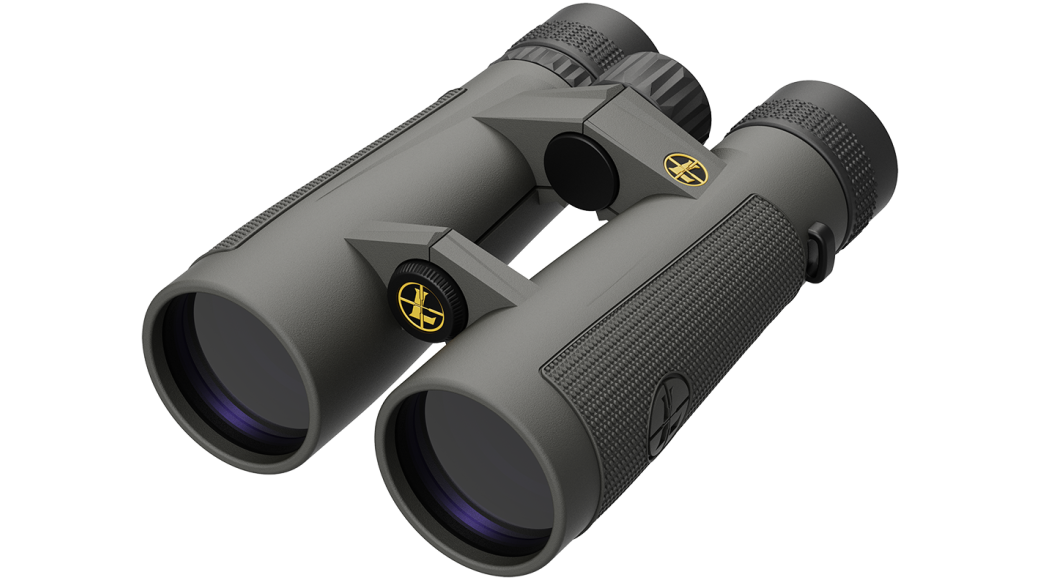
Explore this need in the finder →The Leupold BX-5 Santiam HD 12x50 (part 175856) is for a viewer who wants more reach than the 10x models while keeping a 50 mm objective. Leupold lists a 272-foot field at 1,000 yards, 32.1-ounce weight and 16.6 mm eye relief. The 12x image can make distant detail easier to inspect, but it also magnifies small hand movement and shows less surrounding scene.
More magnification for open ground
This configuration occupies the middle ground between a walkable 10x42 and the more specialized 15x56. Its 12x fixed power enlarges distant subjects more than either 10x option. For a hill, ridge or open shoreline where you can pause and brace your elbows, that may help when trying to identify a faraway shape. It is not a zoom binocular, rangefinder or spotting scope, and the page does not establish a reticle or electronic measuring function.
Leupold’s linear field figure is 272 feet at 1,000 yards; the corresponding angular field is 5.2 degrees. The Santiam 10x50 is listed at 304 feet, so the 12x model gives up 32 feet of scene while adding two powers. The 10x50 is only 0.6 ounce lighter, so this is not a major carry-weight trade. It is a choice about magnification, field and whether you can hold or mount the view steadily.
Carry, focus and eye relief
The 12x50 is listed at 32.1 ounces and 6.8 inches long, with a 50 mm objective. Its 5.2 mm exit pupil is slightly larger than the 10x50’s listed 5 mm because the objective is the same and power is higher? Actually, the page’s value should be read directly: Leupold lists 5.2 mm for the 12x50, while basic division of 50 by 12 yields about 4.2 mm. That mismatch is important: do not treat the listed exit-pupil figure as internally reconciled or use it as an essential match attribute until Leupold explains it.
Eye relief is 16.6 mm, shorter than both 10x models and the 15x56. Glasses wearers should be cautious about assuming the full field will be visible. The product page describes twist-up eyecups but does not document multiple eyecup styles or included replacement sets. Test it with your glasses, especially if a wide view is important. The manufacturer’s interpupillary range is 58–74 mm; hinge width still needs an in-person fit check.
The listed close-focus distance is 11.4 feet, so this is not the Santiam to choose for nearby objects. The center focus control and replaceable eyecups are described for outdoor handling, but no independent measurements of focusing speed, mechanical durability or focusing repeatability were performed.
Support and weather claims
The exact page describes an open-bridge roof-prism design, phase-coated prisms, fully multi-coated lenses, DiamondCoat 2 exterior surfaces and Guard-Ion hydrophobic treatment. It also lists a built-in rotatable 1/4-20 tripod port, rubber armor and waterproof/fogproof construction. The page does not identify ED glass or provide a numerical immersion depth, duration or IP rating. Its weather language is a product claim, not an invitation to submerge the optic.
The 12x50 page names a shoulder strap, case, lens covers and cloth, but does not confirm a tripod adapter in the package. Plan on checking the separate mounting hardware if you want a stable support. This matters more at 12x, where slight movement can erase the practical benefit of additional magnification. A tripod can steady the image; it does not turn the binocular into a scope with higher variable power.
Choosing between the Santiam sizes
The 10x42 is the lightest 10x choice at 24.3 ounces and gives a 341-foot field, but it has a smaller objective and 16.6 mm eye relief. The 10x50 is heavier than that walking option but nearly matches this 12x50’s weight; it offers a wider field and 19.3 mm listed eye relief. The 12x50 makes sense where subject enlargement matters more than a relaxed handheld view. For still more reach, the 15x56 adds a confirmed tripod tray, but it weighs 45 ounces and has a much narrower 231-foot field.
A close same-power comparator is the BX-4 Pro Guide HD Gen 2 12x50 part 184763. The BX-4 page lists 29.3 ounces and 257 feet; the BX-5 page lists 32.1 ounces and 272 feet. On those published figures, the Santiam is heavier but gives a somewhat wider field. The BX-5 page lists 16.6 mm eye relief versus the BX-4’s 16 mm. These differences inform a shortlist; they do not establish which one has better resolution or low-light performance.
Choose the 12x50 when you accept the narrow field and high power to inspect distant scenes, and have a practical way to stabilize it. Before committing, confirm the unusual listed exit-pupil figure with the manufacturer or a dealer and look through the model yourself. The linked general manual explains hinge adjustment, focusing and lens care, but it does not resolve that specification discrepancy.
Optifade Subalpine part 175857
A discontinued camouflage configuration is also identified as BX-5 Santiam HD 12x50 part 175857. Leupold’s older model-numbered catalog groups finish B / part 175857 with the same 12x50 field, weight, length and eye-relief row as Shadow Gray part 175856, so it is a finish variant rather than a different optical size. The exact 175857 page still labels the product 12x50, but its specification table shows the unrelated 15x56 measurement set. Do not use that 15x56 line to judge the 12x50 finish. The exit-pupil figure remains unsettled on the 12x50 pages, so it should not decide the choice.
Manufacturer sources: BX-5 Santiam HD 12x50 part 175856 exact U.S. product page and its linked general binocular owner manual.
Key specifications
Key details at a glance
| Magnification | 12× |
|---|---|
| Objective diameter | 50 mm |
| Real field of view | 5.2° |
| Eye relief | 16.6 mm |
| Close focus distance | 11.4 ft |
| Manufacturer-published weight | 32.1 oz |
More specifications and setup details
| Phase coatings confirmed | Yes |
|---|---|
| Lens and prism coatings | The exact page describes phase-coated roof prisms, fully multi-coated lenses, DiamondCoat 2 exterior lens treatment and Guard-Ion hydrophobic coating. It does not identify ED glass or every coating-stack detail. No independent transmission measurement is claimed. |
| Water and fog protection | Manufacturer waterproof/fogproof wording; no exact-page numeric immersion/IP specification located. |
| Tripod use | The exact page confirms a built-in rotatable 1/4-20 port but names only the strap, case, lens covers and cloth as included accessories. It does not confirm an adapter in the box; select/check mounting hardware separately. |
| Published weight note | Exact manufacturer product-page instrument weight; carry accessories add weight. No independent weighing was performed. |
| Manufacturer-rated waterproof | Yes |
| Built-in image stabilization confirmed | No |
| Integrated laser rangefinder | No |
| Onboard ballistic solution display | No |
| Direct 1/4-20 tripod thread confirmed | Yes |
Use the exact model’s instructions for operating limits, supplied equipment and version differences.
Sources for this review
Sources for this assessment
- Leupold exact U.S. product page, part 175856
- Leupold Binocular Owner’s Manual (Rev N; generic setup/care, not configuration-specific optical evidence)
- Exact page-linked manufacturer product image URL for part 175856
- Archived Leupold U.S. binocular directory observation leupold-us-binoculars-cycle70-p2-r2
- Dated exact model/part-name public CPSC recall search; empty response only

Choose your optical trade-off first.
Choose viewing purpose first, then magnification, objective size, scene width and any fit, weather or mounting constraint. A direct-Sun requirement is separate: only exact manufacturer-confirmed solar binoculars can pass it.