
On this page
Your needs, this model
Does it fit your priorities?
Is this exact fixed 12x50 configuration the power and objective you want for ordinary outdoor observation?
The exact page identifies fixed 12x50mm and lists 257 ft / 4.9° field at 1,000 yd. It matches the requested format; the field figure is a published specification, not a tracking test.
Explore this need in the finder →Will the 29.3-ounce body and 16 mm listed eye relief meet your numeric fit screen?
The exact specification table lists 29.3 oz, 16 mm eye relief and 56–74 mm interpupillary distance. These are screening figures, not a glasses-fit or comfort guarantee.
Explore this need in the finder →Do you require an exact-page-confirmed weather claim and standard tripod port?
Leupold describes this exact configuration as waterproof/fogproof and confirms a built-in rotatable 1/4-20 port. Adapter inclusion is not confirmed, so the port does not satisfy a need for an adapter in the box.
Explore this need in the finder →The Leupold BX-4 Pro Guide HD Gen 2 12x50mm (part 184763) is the high-power option in this quartet. The manufacturer lists a 257-foot field at 1,000 yards, a 4.9-degree real field, 16 mm eye relief and 29.3-ounce weight. It is best considered from a fixed glassing spot or when distant subject scale matters more than a forgiving handheld scan; the published figures are specifications, not independent field-test results.
Reach and the cost of a narrow field
Twelve power gives more apparent subject scale than the 10x models, but it also makes precise aiming more demanding. The field is 257 feet at 1,000 yards, the narrowest of the four BX-4 configurations compared here. A subject can move out of view more quickly while searching, so a wide-sweeping birding route often favors the 8x42 or 10x42. The manufacturer lists a 4.2 mm exit pupil, the same as the 10x42 despite the 50 mm objective; magnification is part of that calculation.
This pair weighs 29.3 ounces and measures 6.8 inches long. It is the heaviest of the four, slightly heavier than the 10x50, and substantially heavier than the 42 mm sizes. The listed close focus is 10 feet, so it is not the strongest choice in this group for nearby observation. A tripod port is confirmed, which gives a route to stabilize long viewing sessions using compatible hardware. The exact page does not establish an adapter in the box; verify the adapter, tripod and head separately.
Eye relief and fit
The exact table gives 16 mm eye relief and a 56–74 mm interpupillary range. The stated eye relief is the shortest in this four-model family, so glasses wearers should be especially deliberate about testing the view with their usual eyewear. Leupold describes interchangeable Form-Fit eyecups in winged, medium and low styles and twist-up eyecups. A low eyecup is offered for glasses use, but the actual eye position still determines whether the full field is visible.
Before comparing the view, set the hinge until a single circular image appears and adjust the central focus and right-eye diopter. The exact page identifies a locking diopter. There is a source-version wrinkle: unlike the 8x42 and the two 10x versions, the 12x50 page links an older Rev N general binocular manual, not the newer Rev Pv2 manual linked by those siblings. It is a generic setup document rather than part-specific optical evidence; do not rely on its dated lens-cleaning chemicals without confirming current manufacturer guidance.
Coating, weather and source limits
The exact page describes phase-coated roof prisms, fully multi-coated lenses, DiamondCoat 2 exterior lens surfaces and Guard-Ion hydrophobic coating. These are manufacturer feature claims, not measurements. ED glass is not identified on this page, so the model name’s “HD” should not be read as proof of ED elements. No independent resolution, glare or transmission testing is claimed.
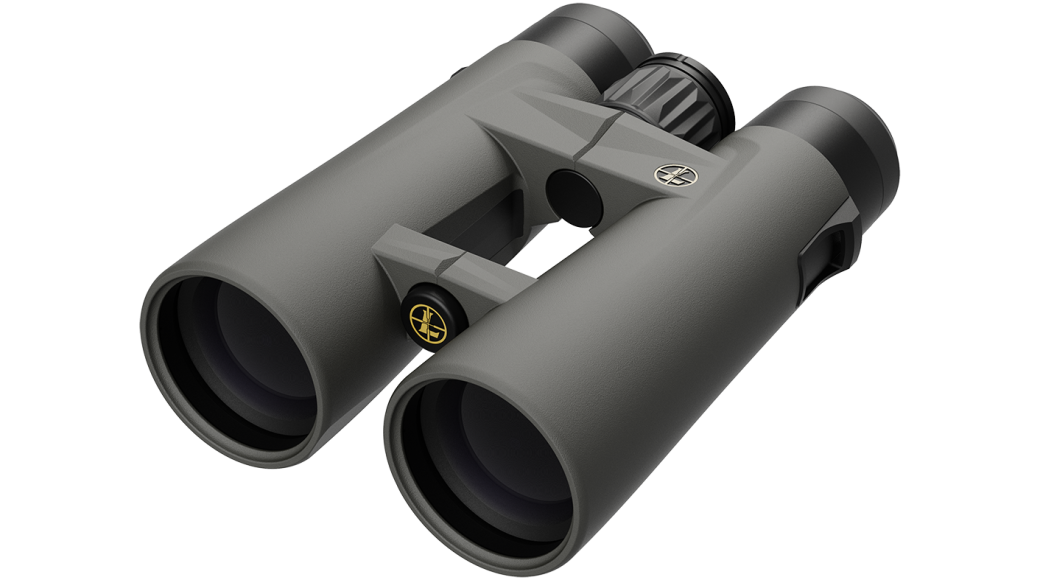
Leupold describes the 12x50 as waterproof and fogproof. The page does not give an IP rating, a numeric immersion depth or a duration, so use the wording as a general weather-protection description rather than submersion guidance. The presence of the rotatable 1/4-20 port is explicit; the included adapter is not established. The visual image is a gray product cutout shared byte-for-byte with the 10x50 image and does not visually distinguish the magnification. The association comes from the exact page’s image URL, while photo-versus-render method and republication permission are unknown.
Who should choose it
Choose 12x50 if you can support or carefully steady it and value extra reach on distant subjects. Choose 10x50 to retain a 50 mm objective but get a wider field, longer listed eye relief and slightly lower weight. Choose 10x42 for lower carry weight at the same power, or 8x42 for broadest field, largest exit pupil and frequent handheld scanning. If glasses fit, handheld steadiness, actual stock or a specific coating is a hard requirement, verify that exact point rather than assuming it from the series name.
No retailer stock, price or exact ASIN was verified for this research. Use an exact search for “Leupold BX-4 Pro Guide HD Gen 2 12x50 part 184763” and confirm the listing’s power and objective. The current U.S. product page is the authority for the listed configuration; the older linked manual has setup context only and should not be mistaken for a 12x50 test report.
Manufacturer sources: 12x50mm part 184763 exact U.S. page and the linked older general Binocular Owner’s Manual (Rev N).
Key specifications
Key details at a glance
| Magnification | 12× |
|---|---|
| Objective diameter | 50 mm |
| Real field of view | 4.9° |
| Eye relief | 16 mm |
| Exit pupil | 4.2 mm |
| Close focus distance | 10 ft |
More specifications and setup details
| Manufacturer-published weight | 29.3 oz |
|---|---|
| Phase coatings confirmed | Yes |
| Locking diopter ring confirmed | Yes |
| Lens and prism coatings | Leupold lists phase-coated roof prisms and fully multi-coated lenses, DiamondCoat 2 exterior lens treatment, and Guard-Ion hydrophobic coating. The exact page does not identify ED glass or every technical detail of the coating stack; no independent transmission measurement is claimed. |
| Water and fog protection | Manufacturer waterproof/fogproof description; no numeric immersion/IP specification located. |
| Tripod use | The exact product page confirms a built-in rotatable 1/4-20 tripod port, but does not establish an adapter model or that an adapter is included. Confirm mounting hardware separately. |
| Published weight note | Exact manufacturer-listed binocular weight; any carry accessories add weight. No independent weighing was performed. |
| Manufacturer-rated waterproof | Yes |
| Built-in image stabilization confirmed | No |
| Integrated laser rangefinder | No |
| Onboard ballistic solution display | No |
| Direct 1/4-20 tripod thread confirmed | Yes |
Use the exact model’s instructions for operating limits, supplied equipment and version differences.
Sources for this review
Sources for this assessment
- Leupold exact U.S. product page, part 184763
- Leupold Binocular Owner’s Manual (older Rev N, 2018 copyright), linked from exact product page; generic setup/care guidance, not SKU-specific optical evidence
- Exact manufacturer product-page-linked primary image URL for part 184763
- Previously archived Leupold U.S. binocular directory page 1, observed row 10
- Dated exact-name public CPSC recall search; a narrow empty result only

Choose your optical trade-off first.
Choose viewing purpose first, then magnification, objective size, scene width and any fit, weather or mounting constraint. A direct-Sun requirement is separate: only exact manufacturer-confirmed solar binoculars can pass it.