
On this page
Your needs, this model
Does it fit your priorities?
Is fixed 8x power with a compact 32 mm objective the fit you want for walking and broad scanning?
The exact 172658 page lists fixed 8x32. This is the lightest Pro Guide HD size, but its aperture and eye relief are smaller than the 42 mm choices.
Explore this need in the finder →Do the 17-ounce weight, 16 mm eye-relief screen, and seven-foot close focus fit your intended kit?
The exact table lists 17 oz, 16 mm eye relief and 7 ft close focus. Those are screens, not a glasses-fit or close-up guarantee.
Explore this need in the finder →Would you use its confirmed standard tripod port while supplying an adapter separately?
The exact page confirms a rotatable 1/4-20 port, but not the adapter in the package. Leupold describes the exact model as waterproof/fogproof without a numeric immersion rating.
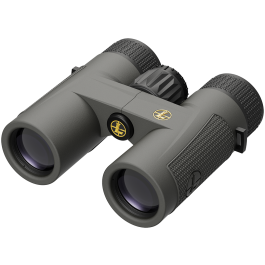
Explore this need in the finder →The discontinued Leupold BX-4 Pro Guide HD 8x32 (part 172658) is the light, compact member of the original Pro Guide HD family. Leupold lists a 17-ounce instrument, 4.8-inch length, 394-foot field at 1,000 yards, 7.5-degree real field, 16 mm eye relief, and 7-foot close focus. This is a reference review of the Shadow Gray part; Leupold also listed the Optifade Subalpine finish as part 172659. Neither older part is a Gen 2 binocular.
Why choose the small 8x32?
At 17 ounces, this was the least burdensome way into this family for someone walking more than glassing from one fixed point. The short body takes less room than the 42 mm and 50 mm members. Eight power is also a sensible handheld choice when a wide, quick-to-find scene matters more than maximum subject enlargement. The published 394 feet at 1,000 yards and 7.5-degree real field make this the widest-listed Pro Guide HD configuration in the older group. It can be useful for scanning a wooded opening, following a moving animal, or lifting binoculars repeatedly during a long walk.
The cost of that compactness is aperture. Leupold lists a 4 mm exit pupil for this model, compared with 5.3 mm on its 8x42 and 6.25 mm geometrically for a 8x50 (not sold in this family). A larger exit pupil can better use a dilated eye in dim conditions, but these figures do not prove actual transmission or brightness. For first and last light, a 42 or 50 mm model may be the more appropriate starting point if the extra bulk is acceptable. For daylight travel and short observation stops, a smaller 32 mm body may be easier to keep with you.
Eye position and focus
The 16 mm listed eye relief is a screening value, not a promise that glasses wearers will see the full field. If eyewear stays on, test the eye position with your own frames and use the eyecup adjustment to avoid dark crescents. A nominal 58–74 mm interpupillary range is also not a guarantee that a viewer's face will fit comfortably. Leupold describes twist-up, field-replaceable eyecups, a central focusing dial, and a 7-foot close-focus distance. That near focus is useful for some nearby wildlife or museum viewing, but it is not macro optics.
The product page links a general Leupold binocular guide/manual. Its hinge spacing, focusing, diopter, and care instructions are setup help, not a model-specific sharpness test. Adjust the hinge until a single circle appears, focus one side at a time as instructed, and then assess comfort. Do not treat the manufacturer’s “HD” label as proof of ED glass; the exact page does not confirm an ED element.
Outdoor claims and practical limits
Leupold calls this configuration waterproof and fogproof, describes phase-coated roof prisms, fully multi-coated lenses, DiamondCoat 2 exterior treatment and Guard-Ion water-shedding coating, and confirms a rotatable 1/4-20 tripod port. It supplies no numeric immersion depth, duration, or IP rating. The port is useful if a small tripod or adapter is part of your plan, but the exact page does not confirm an adapter in the box. The named accessory package includes a shoulder strap, case, lens covers, and lens cloth.
Choose this configuration if the walk-all-day weight matters more than a large exit pupil or long eye relief. Pick the 10x32 only if extra nominal power is worth a more demanding handheld view; its manufacturer field figures conflict, so don't rely on them to promise the same scan width. The 8x42 is the steadier general-purpose alternative with more eye relief and a wider aperture, while the 10x42 adds subject scale at a modest weight increase. This 172658 page is marked discontinued, and current condition, price, dealer stock, and exact retail identity are not established here.
Manufacturer sources: part 172658 product page and the page-linked general binocular manual.
Key specifications
Key details at a glance
| Magnification | 8× |
|---|---|
| Objective diameter | 32 mm |
| Real field of view | 7.5° |
| Eye relief | 16 mm |
| Exit pupil | 4 mm |
| Close focus distance | 7 ft |
More specifications and setup details
| Manufacturer-published weight | 17 oz |
|---|---|
| Phase coatings confirmed | Yes |
| Lens and prism coatings | The exact product page names fully multi-coated lenses, phase-coated roof prisms, DiamondCoat 2 exterior treatment, and Guard-Ion hydrophobic coating. It does not confirm ED glass or every coating-stack detail; no independent transmission test is claimed. |
| Water and fog protection | Exact page says waterproof and fogproof; no numeric immersion/IP specification was located. |
| Tripod use | The exact product page confirms a built-in rotatable 1/4-20 port. It does not identify an included adapter; select and verify mounting hardware separately. |
| Published weight note | Exact Leupold product-page weight for the binocular; accessories add weight. No independent weighing was performed. |
| Manufacturer-rated waterproof | Yes |
| Built-in image stabilization confirmed | No |
| Integrated laser rangefinder | No |
| Onboard ballistic solution display | No |
| Direct 1/4-20 tripod thread confirmed | Yes |
Use the exact model’s instructions for operating limits, supplied equipment and version differences.
Sources for this review
Sources for this assessment
- Dated exact-name public CPSC recall query
- Exact page-linked product image for part 172658
- Leupold exact U.S. product page, part 172658
- Leupold Binocular Owner’s Manual Rev N; identical bytes linked as Binocular Guide from some exact finish pages
- Exact page-linked product image for finish SKU 172659
- BX-4 Pro Guide HD 8x32mm - Optifade Subalpine


Choose your optical trade-off first.
Choose viewing purpose first, then magnification, objective size, scene width and any fit, weather or mounting constraint. A direct-Sun requirement is separate: only exact manufacturer-confirmed solar binoculars can pass it.