
On this page
Your needs, this model
Does it fit your priorities?
Is a fixed 10x50 configuration preferable to the more compact 10x42 for your mostly stationary viewing?
The exact page lists 10x50. The listed 5 mm exit pupil is geometry, not a measured brightness result.
Explore this need in the finder →Would 28 ounces, a minimum eye-relief requirement of 18.5 mm, and ten-foot close focus fit your carry and viewing limits?
These are the exact product-page figures. The larger body is longer and heavier than the 10x42, and eye relief remains a try-on screen.
Explore this need in the finder →Would you use its confirmed 1/4-20 tripod port if an adapter is selected separately?
The exact page confirms a rotatable port and a weather claim; it does not list an adapter in the package or a numerical immersion rating.
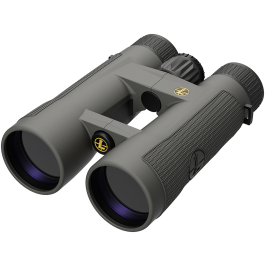
Explore this need in the finder →The discontinued Leupold BX-4 Pro Guide HD 10x50, part 172670, keeps the older family's ten-power magnification while stepping to a 50 mm front lens. Its published table gives 28 ounces, a 6.6-inch length, 283 feet per 1,000 yards, 5.7 degrees, 18.8 mm eye relief, a 5 mm exit pupil, and ten-foot close focus. This is the Shadow Gray part; Leupold also listed Kryptek Typhon Black (172671) and Optifade Open Country (172672), each as a separate finish/SKU variant rather than a distinct power or aperture.
Stationary detail with more objective
Compared with the same family's 10x42, this model uses the same nominal power and a larger objective. That is most relevant to people who spend longer glassing a distant, relatively still scene or who prefer a larger pupil geometry: Leupold lists 5 mm exit pupil here versus 4.2 mm on the 10x42. It is not a guarantee of a brighter image, because the manufacturer does not provide a transmission measurement and the observer's pupil and the conditions matter. For ordinary daylight use, carrying four additional ounces and a tube 1.1 inches longer may not improve the experience enough to justify the larger format.
The 10x42 is listed at a 326-foot field and 6.2 degrees, compared with 283 feet and 5.7 degrees for the 10x50. Those published numbers indicate less scene width in the larger objective version. If you follow moving subjects, walk with the binocular at hand, or look mostly into wooded cover, the 10x42 can be easier to carry and scan. If you rest against a rail, sit for extended observation, or want more aperture with ten-power magnification, the 10x50 is the model to compare directly. Both are too powerful to treat hand steadiness as irrelevant.
Comfort and accessories
The 18.8 mm eye-relief figure is longer than the 10x42's 16 mm and may give some glasses wearers a better starting point, but it cannot guarantee full-field viewing. Try the intended eyewear, roll the eyecups as needed, and check for black crescents. The exact product page lists 58–74 mm interpupillary adjustment and ten-foot close focus; near subjects closer than that will not come to focus. The page describes a tactile central focus dial, field-replaceable twist-up cups, an open-bridge roof design, and a built-in rotatable 1/4-20 tripod port.
The included-list description names a shoulder strap, binocular case, lens covers, and cloth; the adapter is not confirmed as an in-box accessory. If steady tripod viewing is essential, count the adapter and support system as separate parts to verify. Leupold's page calls the optic waterproof and fogproof but provides no numerical depth, duration, or IP rating. The coating feature list names fully multi-coated lenses, phase-coated roof prisms, DiamondCoat 2 and Guard-Ion. “HD” alone does not establish ED glass for part 172670.
Where it fits, and where it doesn't
This is a passive, fixed-power binocular with no stabilization, battery, laser rangefinder, or ballistic display. It is a reasonable earlier-model candidate for long, static observation if you accept its larger body and can find an accurately identified example. It is less compelling for a lightweight walking kit, a broad fast-moving scene, close focus under ten feet, or anyone who demands a new purchase with known current stock. Leupold marks part 172670 discontinued and no longer available from its site. The two camouflaged counterparts have pages and photos archived separately, but the color change does not justify pretending their optical specifications differ.
For a smaller 10x option, compare 10x42. For a wide scanning view, start with 8x42. For more reach, consider the 12x50 only if your support plan accounts for extra shake and its much narrower listed 251-foot/4.8-degree field. Retail condition, price, availability, and ASIN are not verified for any discontinued configuration.
Manufacturer sources: part 172670 product page and its linked general binocular manual.
Key specifications
Key details at a glance
| Magnification | 10× |
|---|---|
| Objective diameter | 50 mm |
| Real field of view | 5.7° |
| Eye relief | 18.8 mm |
| Exit pupil | 5 mm |
| Close focus distance | 10 ft |
More specifications and setup details
| Manufacturer-published weight | 28 oz |
|---|---|
| Phase coatings confirmed | Yes |
| Lens and prism coatings | The exact product page names fully multi-coated lenses, phase-coated roof prisms, DiamondCoat 2 exterior treatment, and Guard-Ion hydrophobic coating. It does not confirm ED glass or every coating-stack detail; no independent transmission test is claimed. |
| Water and fog protection | Exact page says waterproof and fogproof; no numeric immersion/IP specification was located. |
| Tripod use | The exact product page confirms a built-in rotatable 1/4-20 port. It does not identify an included adapter; select and verify mounting hardware separately. |
| Published weight note | Exact Leupold product-page weight for the binocular; accessories add weight. No independent weighing was performed. |
| Manufacturer-rated waterproof | Yes |
| Built-in image stabilization confirmed | No |
| Integrated laser rangefinder | No |
| Onboard ballistic solution display | No |
| Direct 1/4-20 tripod thread confirmed | Yes |
Use the exact model’s instructions for operating limits, supplied equipment and version differences.
Sources for this review
Sources for this assessment
- Exact page-linked product image for finish SKU 172671
- BX-4 Pro Guide HD 10x50mm - Kryptek Typhon Black
- Exact page-linked product image for finish SKU 172672
- BX-4 Pro Guide HD 10x50mm - Optifade Open Country
- Dated exact-name public CPSC recall query
- Exact page-linked product image for part 172670
- Leupold exact U.S. product page, part 172670
- Leupold Binocular Owner’s Manual Rev N; identical bytes linked as Binocular Guide from some exact finish pages


Choose your optical trade-off first.
Choose viewing purpose first, then magnification, objective size, scene width and any fit, weather or mounting constraint. A direct-Sun requirement is separate: only exact manufacturer-confirmed solar binoculars can pass it.