
On this page
Your needs, this model
Does it fit your priorities?
Is an 8x42 view with a broad 394-foot field the right older configuration to compare?
The exact part 181176 page lists fixed 8x42 power, 394 feet per 1,000 yards and a 7.4-degree real field. It is discontinued, so keep earlier models enabled only for comparison with an identified old or used pair.
Explore this need in the finder →Do you need at least 18 mm of stated eye relief and a manufacturer-listed weight no greater than 24.3 oz?
The exact page lists 18 mm and 24.3 oz for the instrument. Treat eye relief as a screening value: actual glasses fit and full-field comfort still need an in-person check.
Explore this need in the finder →Would the confirmed waterproof wording and direct 1/4-20 port suit your outdoor use if you select a separate tripod adapter?
Leupold describes the exact product as waterproof and fogproof and confirms a rotatable 1/4-20 tripod port. It does not publish a numeric immersion rating or list a tripod adapter among the included items.
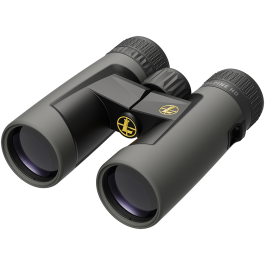
Explore this need in the finder →The Leupold BX-2 Alpine HD 8x42, part 181176, is the widest-view size in this four-configuration family. Leupold lists a 394-foot field at 1,000 yards, 24.3 ounces and 18 mm of eye relief. The official product page now marks it discontinued and no longer available for purchase. Read this as a guide to an existing instrument or a carefully identified secondhand offer, not a current recommendation.
What the 8x42 numbers mean in the field
Eight power is the least magnified choice among the Alpine HD sizes here. That does not make it a low-detail instrument; rather, it gives up some apparent reach in exchange for a broad view that can be easier to acquire when a bird moves through brush, a player crosses a field, or you are scanning a ridgeline. Leupold lists 7.4 degrees and 394 feet at 1,000 yards. The adjacent 10x42 part 181177 lists 6.5 degrees and 342 feet at the same distance, while both 42 mm versions are listed at 24.3 ounces. If you are often trying to find the subject as much as inspect it, the wider 8x view is the useful difference.
The stated 5.2 mm exit pupil is larger than the 10x42's 4.2 mm, as expected from the same 42 mm objective used at lower magnification. This is a geometry comparison, not a measured brightness result: actual appearance depends on the complete optical system and viewing conditions. Leupold describes its Advanced Optical System, HD lenses and Abbe-Koenig prism, but those maker descriptions do not establish a laboratory resolution or light-transmission score.
Fit, carrying and nearby subjects
At 5.5 inches long and 24.3 ounces before any accessories, this is a conventional full-size pair rather than a pocket travel binocular. The hinge is listed for 57–78 mm interpupillary distance, a useful first fit screen for the people who may share it. Eye relief is listed as 18 mm, the longest figure among the two 42 mm siblings in this family. Glasses wearers should still set the eyecups and hinge with their own eyewear; a number on the page cannot promise a full, comfortable field for every face.
Close focus is listed at 13.5 feet. That is adequate for many outdoor subjects at moderate distance, but it is not the closest-focusing option in this family: both 52 mm pages list 9.2 feet for 10x52 and 12.5 feet for 12x52. For a nearby feeder or a subject beside a trail, check this limitation before treating the large objective as an all-purpose upgrade. The pair is fixed 8x, not a zoom, and the maker does not identify it as stabilized or as a laser rangefinder.
Construction claims and support
The page describes waterproof and fogproof construction, rubber armor, twist-up eyecups, a magnesium housing and field-replaceable eyecups. It also confirms a rotatable standard 1/4-20 tripod port. Those are practical features for outdoor use and steady observation, but Leupold does not publish a numeric immersion depth or duration on this page. Do not interpret “waterproof” as underwater suitability. The port does not mean a tripod adapter is in the package: the exact page lists a GO Afield harness, lens covers and a lens cloth, but not an adapter. Select mounting hardware separately and verify compatibility with the instrument in hand.
The manufacturer-linked Rev N binocular owner manual covers basic hinge adjustment, focus and diopter setup, plus lens care and warranty/service direction. It is a general owner manual, not a test report for part 181176. Follow its setup sequence rather than assuming that an unfamiliar view means a defect.
Which sibling or alternative is the better fit?
Within this family, the 10x42 is the other 42 mm body: it keeps the listed 24.3-ounce weight but tightens the field to 342 feet, reduces stated eye relief to 15 mm and raises magnification to 10x. The 10x52 keeps 10x magnification while moving to a 52 mm objective and 30.5 ounces; it also has a 279-foot field. The 12x52 offers the highest power, but has a 261-foot field and weighs 32 ounces. These contrasts explain why the 8x42 is the easiest family choice for scanning, not a universal winner. A newer within-brand alternative such as the BX-4 Pro Guide HD Gen 2 8x42 is a different part and must be checked on its own; do not transfer the Alpine measurements to it.
If the finder is set to exclude earlier models, this discontinued profile should not appear as a current match. That is the right default for a new purchase. Turn on the earlier-model comparison only if you are identifying an existing pair or checking a specific used listing. For any used unit, confirm the part number, inspect the eyecups, focus travel, hinge and both images, and check the actual package and seller terms. The exact historical product page's displayed price is not proof of a current offer.
The exact U.S. page and the already archived 2026 Consumer Guide do not agree on linear field or length: the product page lists 394 ft at 1,000 yd and 5.5 in, while the catalog table lists 118 m at 1,000 m and 127 mm. Both list 7.4° real field, and their weight values agree after conversion. The source basis for the field/length difference is not explained, so this review quotes the U.S. page’s units and does not treat the metric field or length as settled fit facts.
Sources and limits
Sources: Leupold BX-2 Alpine HD 8x42, part 181176, Leupold discontinued binocular directory, and the Leupold binocular owner manual. The Leupold 2026 Consumer Guide (printed binocular page 31) provides a second family table; its differing metric field/length and, where noted, weight/eye-relief entries are preserved as unresolved source conflicts. Leupold has not identified the linked illustration as a photograph versus a render or stated a republication license. No independent optical measurements or current retail availability were established.
Key specifications
Key details at a glance
| Magnification | 8× |
|---|---|
| Objective diameter | 42 mm |
| Real field of view | 7.4° |
| Eye relief | 18 mm |
| Exit pupil | 5.2 mm |
| Close focus distance | 13.5 ft |
More specifications and setup details
| Manufacturer-published weight | 24.3 oz |
|---|---|
| Lens and prism coatings | Exact page identifies high-definition lenses and an Abbe-Koenig prism but does not establish ED glass or a complete coating stack; no independent optical testing is claimed. |
| Tripod use | Exact page confirms a rotatable standard 1/4-20 port. It does not list a tripod adapter as included; choose and check a separate adapter and support. |
| Published weight note | Exact product page weight is corroborated by the 2026 catalog after unit conversion; still instrument weight, not packed system weight. |
| Manufacturer-rated waterproof | Yes |
| Built-in image stabilization confirmed | No |
| Integrated laser rangefinder | No |
| Direct 1/4-20 tripod thread confirmed | Yes |
Use the exact model’s instructions for operating limits, supplied equipment and version differences.
Sources for this review
Sources for this assessment

Choose your optical trade-off first.
Choose viewing purpose first, then magnification, objective size, scene width and any fit, weather or mounting constraint. A direct-Sun requirement is separate: only exact manufacturer-confirmed solar binoculars can pass it.