
On this page
A conventional 8x40, not a wide-field 2x
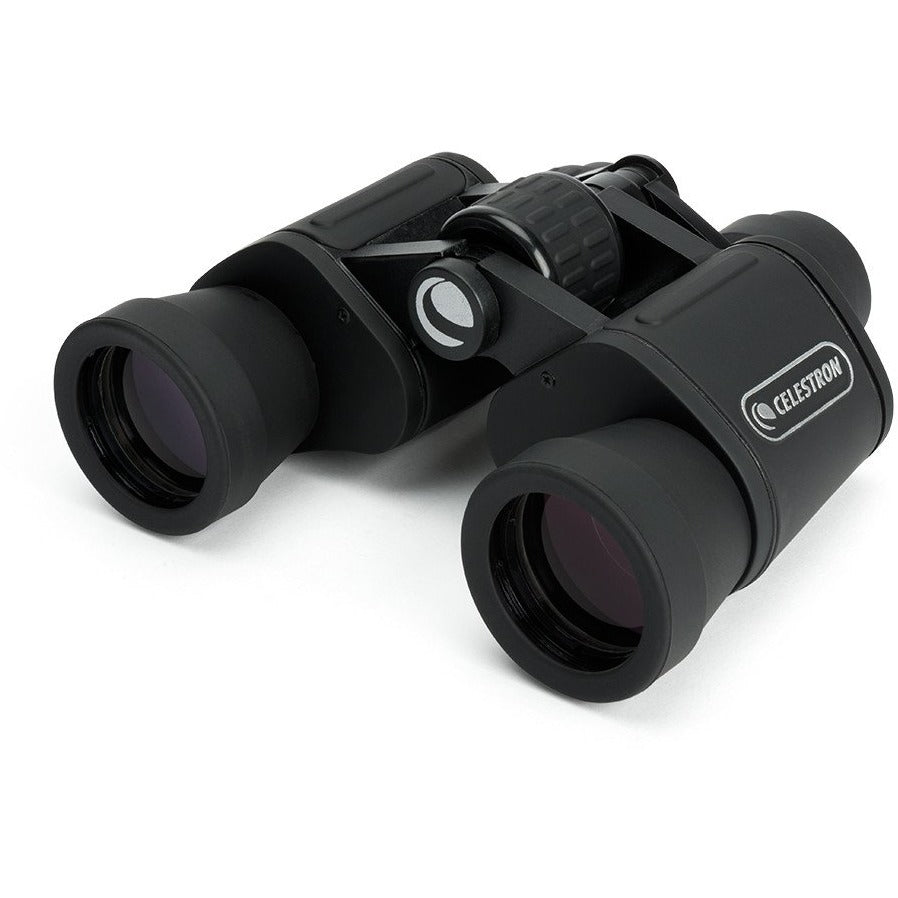
The UpClose G2 8x40 lists an 8.2° real field and weighs 24 oz; it is the conventional higher-power option beside the 6.8 oz, 24° SkyMaster Gemini 2x40. Its 19 ft close-focus figure and water-resistant wording help define the trade, without implying waterproof protection.
Explore the needs this model fits
Your needs, this model
Does it fit your priorities?
Is a broad real scene at 8x the priority?
Celestron lists 8.2° and 429 ft at 1,000 yd, wider than the 10x50 and 20x50 siblings.
Explore this need in the finder →Is 12 mm eye relief enough to make this a candidate?
Celestron publishes 12 mm; compare this number with your own eyepiece position rather than treating it as a guarantee for every glasses wearer.
Explore this need in the finder →Must the tripod adapter be included?
The Porro body is tripod adaptable, but the adapter is sold separately; the exact page leaves diopter range as TBD, so do not infer a value from another UpClose model.
Explore this need in the finder →The Celestron UpClose G2 8x40 Porro binocular (item 71252) is the broad-scene, mid-size member of its inexpensive family. The manufacturer lists an 8.2° angular field, 429 ft at 1,000 yards, a 5 mm exit pupil, 12 mm eye relief and a 24 oz body. Those figures make it more suitable for finding and following activity than the 10x50 and 20x50, while its 40 mm objectives are larger than the pocket models. It is still a substantial handheld pair, and its water-resistant label is not a waterproof rating.
A wide field makes acquisition easier
The published 429 ft linear field at 1,000 yards is the widest of the fixed full-size UpClose G2 options reviewed here. The 7x35 is wider still at 483 ft, but the 8x40 gives one more step of magnification and a 40 mm objective. The 10x50 narrows to 354 ft and the 20x50 to 168 ft. A broad real field can make it easier to locate a moving subject before following it, but it is not a claim about image edge quality or measured resolution.
A 5 mm exit pupil is published, the same nominal value as the 7x35 and 10x50. The larger 40 mm aperture does not make the 8x40 pocket-size: Celestron lists 24 oz and dimensions of 173 × 74 × 137 mm. For a long walk where every ounce matters, compare the 8 oz 8x21 or 11 oz 10x25. They are far easier to carry, but their smaller objectives, shorter eye relief and different fields are meaningful tradeoffs.
One specification is explicitly unsettled
The exact UpClose G2 8x40 page lists 12 mm eye relief, 19 ft close focus and a 56–72 mm interpupillary range. It displays the diopter adjustment range as “TBD,” so this review does not assign a numeric value. Celestron lists the 8x40 at 24 oz, with BK-7 Porro prisms, multi-coated optics and a 5 mm exit pupil. The diopter uncertainty is preserved rather than borrowing the value from the similar 7x35 or 10x50.
The page describes the 8x40 as water resistant and not nitrogen filled, without an immersion or fogproof rating. It marks the Porro body tripod adaptable. Celestron's manual explains that a threaded fitting sits under a cap and a separate binocular adapter is needed to attach a photographic tripod; the official package list does not include that adapter. The listing mentions a soft case, neck strap, lens covers, cloth and manual. If your requirements include waterproofing or an adapter in the box, the model does not meet those exact essentials.
Fit and setup for actual use
At 12 mm eye relief, this is not an automatic glasses choice. Fold down the rubber eyecups as directed, then assess whether you can see the whole scene without moving your eye position. If a stated 15 mm or 17 mm minimum is mandatory, the matcher should reject this model. Close focus is published at 19 ft, making it appropriate for ordinary distant observations but not the 10 ft close-focus role of the 8x21.
The manual's adjustment sequence is practical: first hinge the barrels until the two views form one circle; then focus the left side with the center wheel and set the right-eye diopter independently. After that, use only the center wheel for later distances. Keep the glass clean and the body in its supplied case, and do not try to service the optics internally. The manual warns against observing the Sun through binoculars or projecting its image.
Where this size fits among the alternatives
Choose the 8x40 when a generous field and 8x power matter more than pocket carry. The 7x35 is lighter at 22 oz, wider at 9.2°, has 13 mm eye relief and focuses to 13 ft; it is the better fit if that wider scene and nearer focusing matter. The 10x50 weighs 27 oz and offers more apparent reach but a smaller field. The zoom 10–30x50 adds variable power but narrows dramatically at high zoom and is heavier at 28 oz.
In the finder, 8x plus 40 mm selects the exact 71252 profile, while a broad-field minimum of 6° fits the 8.2° specification. A waterproof-essential choice excludes it, as does an adapter-in-box requirement. A weight ceiling of 24 oz includes the published instrument but leaves no allowance for carrying accessories. When you need stronger weather protection, compare the Celestron Outland X 8x42, whose exact page specifies waterproof construction and nitrogen filling; when you need much lighter carry, compare the 8x21 and accept its smaller objective. This review relies on Celestron's published information and setup instructions, not an unclaimed hands-on test.
Key specifications
Key details at a glance
| Magnification | 8× |
|---|---|
| Objective diameter | 40 mm |
| Real field of view | 8.2° |
| Field width at 1,000 m | 143 m |
| Eye relief | 12 mm |
| Exit pupil | 5 mm |
More specifications and setup details
| Close focus distance | 19 ft |
|---|---|
| Manufacturer-published weight | 24 oz |
| ED glass confirmed for this exact model | No |
| Lens and prism coatings | Celestron lists multi-coated optics and BK7 prisms; the exact table lists prism coatings as N/A. Fully multi-coated or phase-coated performance is not asserted. |
| Water and fog protection | Water resistant; not listed as waterproof; nitrogen filling: no. |
| Tripod use | Tripod adaptable, but a compatible adapter is sold separately and not included. |
| Published weight note | Exact manufacturer listed instrument weight; no field measurement or accessory weight is implied. |
| Package contents | Carrying case, objective covers, eyepiece covers, lens cloth and instruction manual are itemized; the description also mentions a neck strap. |
| Manufacturer-rated waterproof | No |
| Tripod adapter in package | No |
Use the exact model’s instructions for operating limits, supplied equipment and version differences.
Sources for this review
Sources for this assessment
- Official Celestron US UpClose G2 binocular family collection (14 rows observed)
- Official Celestron Shopify product JSON for the UpClose G2 family snapshot
- UpClose G2 8x40mm Porro Binoculars
- Celestron UpClose G2 binoculars manual; English operating and care pages inspected
- Celestron UpClose G2 official specification and package-variant sheet
- Dated CPSC ProductName search for Celestron item 71252 (empty response on 2026-10-23)
- Celestron image linked from the exact item page

Choose your optical trade-off first.
Choose viewing purpose first, then magnification, objective size, scene width and any fit, weather or mounting constraint. A direct-Sun requirement is separate: only exact manufacturer-confirmed solar binoculars can pass it.
Your needs, this model
40 mm binoculars: ultra-wide 2x or conventional 8x
Choose it when: This is the conventional alternative when a fixed 8x view matters more than the Gemini's unusually wide 2x framing. Its published 8.2° real field and 24 oz listed body define a substantially different carry-and-view choice.
40 mm binoculars: ultra-wide 2x or conventional 8x →