
On this page
A wide-field 8x21 with water-resistant wording
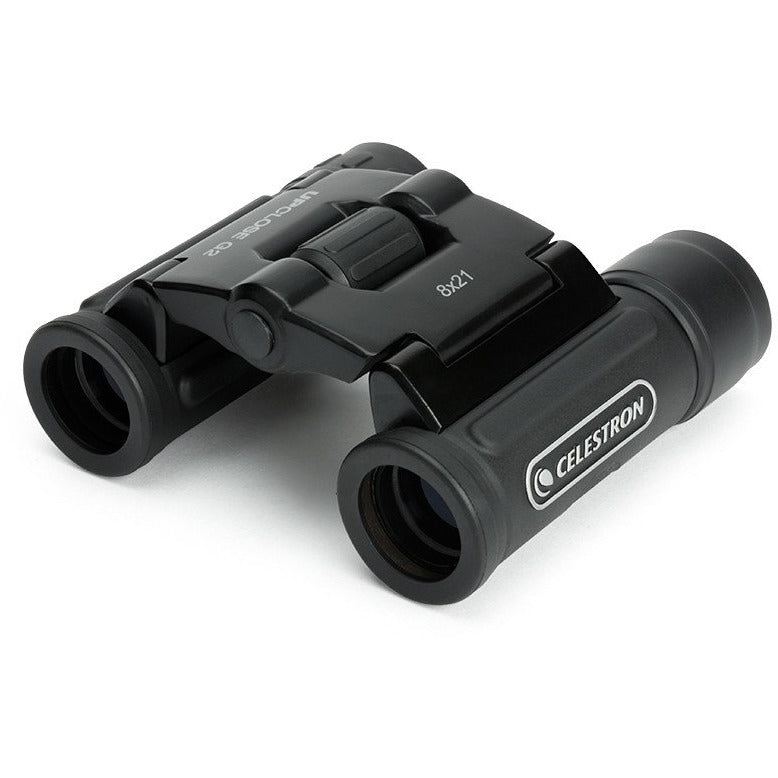
The UpClose G2 8x21 is the widest-field of the exact 21 mm options at 7.4° real field and weighs 8 oz. Its stated 11 mm eye relief is short, and Celestron calls it water resistant rather than waterproof; compare it with the lighter T02 models in the 21 mm answer.
Explore the needs this model fits
Your needs, this model
Does it fit your priorities?
Do you want the lightest 8x21 daytime configuration in this collection?
Celestron lists 8 oz, a 7.4° field and a 10 ft closest-focus distance; its 378 ft and 129 m field-width pair does not convert exactly with the stated angular field.
Explore this need in the finder →Does its 11 mm eye relief meet your glasses or comfort minimum?
It is shorter than a 12 mm minimum, so an essential 12 mm eye-relief filter correctly rejects this model even though it is small and light.
Explore this need in the finder →Must the pair focus at 10 feet or less?
Yes: the exact page lists a 10 ft closest focus, unlike the 15 ft 10x25. This is still not a promise of close-focusing macro performance.
Explore this need in the finder →The Celestron UpClose G2 8x21 roof binocular (item 71230) is the smallest and lightest current model in the dedicated UpClose G2 binocular collection: 8 oz, 21 mm objectives and a 69 × 51 × 91 mm body. Its published 7.4° field, 378 ft at 1,000 yards, and 10 ft close-focus distance are useful for casual daylight observation at short range. The small objectives and 11 mm eye relief set limits, however; it is a pocket-carry compromise, not a low-light or glasses-first instrument.
Carry first, then set realistic expectations
Eight power is a practical compact magnification for finding a subject without the narrow view of a high-power binocular. The manufacturer gives the 8x21 a broader 378 ft field than the 300 ft of the 10x25, and its close focus is 10 ft rather than 15 ft. Its 2.6 mm exit pupil is a little larger than the 10x25's 2.5 mm, though neither compact has the 5 mm exit pupil listed for the 7x35, 8x40 or 10x50. That is a comparison of published dimensions, not a measured brightness result.
At 8 oz, the 71230 is markedly lighter than every full-size Porro option in the same family. The folded roof design is easy to pack for travel, a stadium visit or an occasional walk. Celestron lists a padded soft-sided cloth case, lens cloth and instruction manual; its page also mentions the neck strap. Objective and eyepiece covers are not listed for this configuration. It is not tripod adaptable, so there is no supported mounting plan if you decide you need a stationary view.
Short eye relief and small objectives
The listed eye relief is 11 mm. The exact page states a 58–72 mm interpupillary range and ±2 diopter adjustment. If you wear glasses, fold down the rubber eyecups as the manual directs, but do not assume this will reveal the full field through every frame. A 12 mm or 15 mm minimum-eye-relief filter will exclude the 71230; if glasses are essential, look to a model with a substantially longer published eye-relief number and test the physical fit when feasible.
The 21 mm objectives make this a compact daylight instrument, and Celestron describes it as water resistant, not waterproof. Its product page lists BK-7 roof prisms, multi-coated optics and nitrogen filling no; it also explicitly says not tripod adaptable. The 8x21 has no stated waterproof depth, immersion duration, fogproof claim or stabilization. Rubber armor can help with grip but should not be read as a weather seal. Choose another model if the field requirement includes dependable waterproofing or tripod work.
Adjustment, care and safe use
The manual's order prevents common focusing confusion: first hinge the barrels until the two images merge, then focus the left eye with the center wheel, then focus the right eye with its diopter ring. The center wheel can then refocus at a new distance. Fold eyecups down for glasses and leave them up otherwise. Store the binocular in its case, remove loose dust before wiping optical surfaces, and do not open the binocular for cleaning. The manual warns that looking at the Sun through binoculars can cause permanent eye damage; this product is not a solar viewer.
Celestron publishes a close-focus distance of 10 ft, so nearby outdoor details are more plausible than with the 10x50's 23 ft or 20x50's 42 ft. It still is not a macro instrument. If the intended subject is a moving bird or sports play, the relatively broad field is a useful feature; if the subject is a small distant object at dusk, the limited aperture and shorter eye relief make the choice less persuasive.
How to use the chooser
Select 8x and 21 mm to isolate this exact model, or set a 10 ft maximum close-focus answer to retain it. A 12 mm eye-relief minimum, waterproof-essential answer, tripod-adaptable request or “adapter in the box” requirement each rules it out. A weight ceiling of 8 oz includes the listed binocular alone; it does not include the case or other carried gear. The related clamshell package is listed separately as item 71231. Celestron's family sell sheet identifies it as the same 8x21 configuration in a clamshell package, so it is treated as packaging rather than a separate optical profile.
Choose the 10x25 if extra magnification matters more than field width and weight; it is three ounces heavier, with a narrower 5.7° field and a 15 ft close focus. Choose the 8x40 if you want a 5 mm exit pupil, 8.2° field and tripod adaptability, accepting a 24 oz body and separate adapter. If weather protection matters, compare the Celestron Outland X 8x42, whose exact page lists waterproof construction. The 8x21 makes sense when pocket carry and a simple wide view are more valuable than those larger-model capabilities.
Key specifications
Key details at a glance
| Magnification | 8× |
|---|---|
| Objective diameter | 21 mm |
| Real field of view | 7.4° |
| Field width at 1,000 m | 129 m |
| Eye relief | 11 mm |
| Exit pupil | 2.6 mm |
More specifications and setup details
| Close focus distance | 10 ft |
|---|---|
| Manufacturer-published weight | 8 oz |
| ED glass confirmed for this exact model | No |
| Lens and prism coatings | Celestron lists multi-coated optics and BK7 prisms; the exact table lists prism coatings as N/A. Fully multi-coated or phase-coated performance is not asserted. |
| Water and fog protection | Water resistant; not listed as waterproof; nitrogen filling: no. |
| Tripod use | The exact roof-model page lists no tripod adaptation. |
| Published weight note | Exact manufacturer listed instrument weight; no field measurement or accessory weight is implied. |
| Package contents | Carrying case, lens cloth and instruction manual are the listed items; the product description also mentions a neck strap. |
| Manufacturer-rated waterproof | No |
| Tripod adapter in package | No |
Use the exact model’s instructions for operating limits, supplied equipment and version differences.
Sources for this review
Sources for this assessment
- Official Celestron US UpClose G2 binocular family collection (14 rows observed)
- Official Celestron Shopify product JSON for the UpClose G2 family snapshot
- UpClose G2 8x21mm Roof Binoculars
- Celestron UpClose G2 binoculars manual; English operating and care pages inspected
- Celestron UpClose G2 official specification and package-variant sheet
- Dated CPSC ProductName search for Celestron item 71230 (empty response on 2026-10-23)
- Celestron image linked from the exact item page

Choose your optical trade-off first.
Choose viewing purpose first, then magnification, objective size, scene width and any fit, weather or mounting constraint. A direct-Sun requirement is separate: only exact manufacturer-confirmed solar binoculars can pass it.
Your needs, this model
21 mm binoculars: compact 8x or tighter 10x view
Choose it when: Among these 21 mm candidates, this 8x model gives the widest listed real field. Its stated 11 mm eye relief is also longer than the T02 10x21 figure, although neither number guarantees full-field access with glasses.
21 mm binoculars: compact 8x or tighter 10x view →