
On this page
Your needs, this model
Does it fit your priorities?
Is item 71254 still a current Celestron purchase option?
No. Celestron’s product page labels this exact SKU discontinued; the review exists to identify it and compare it with current zoom alternatives.
Explore this need in the finder →Do you need an exact 7–21x40 zoom or simply a current adjustable-power option?
There is no current 7–21x40 recommendation profile here. The current UpClose zoom is a different 10–30x50; do not treat its range or body as interchangeable.
Explore this need in the finder →Does the archived 5.3° to 3.2° field range meet a fixed wide-scene need?
At 21x the published field is 3.2°, below a 6° wide-real-field requirement; check the 7x end only when using that lower power.
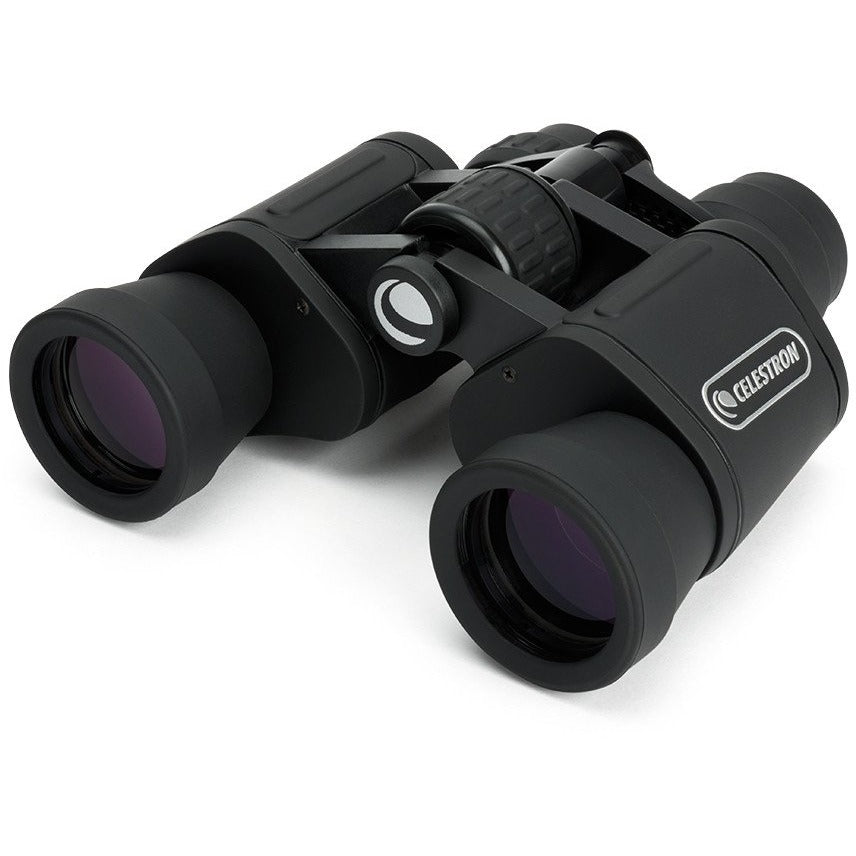
Explore this need in the finder →The Celestron UpClose G2 7–21x40 (item 71254) is a discontinued reference model, not a current buying recommendation. Celestron's US product page categorizes it as discontinued, while its archived series sell sheet and exact product page preserve the model number, variable zoom range, Porro design and published optical data. It remains useful to compare with the currently listed 10–30x50: this earlier design starts at a lower 7x, has a 40 mm objective, and reaches only 21x. Neither the family name nor an old listing makes a used unit a verified offer.
Its zoom range favors a lower starting view
The product is a variable-power 7–21x40 rather than a fixed 7x or 21x binocular. Celestron's family information sheet gives a 5.3° field and 279 ft at 1,000 yards at 7x, narrowing to 3.2° and 168 ft at 21x. The lower setting offers a wider locating view than the 10–30x50's 225 ft at 10x; the maximum setting is less powerful than that newer zoom's 30x. The choice is a deliberate range tradeoff, not a reason to prefer one model across all uses.
At 7x, the sheet lists a 3 mm exit pupil, 20 mm eye relief and closest focus at 26 ft. At 21x, those numbers change to 1.9 mm, 15 mm and 45 ft. Celestron's shared zoom instructions say to focus at the highest power first, then use the lever to change magnification. The 26 ft near-focus figure therefore applies at the low-power end; it should not be presented as a 45 ft close-focus result at every setting. The manufacturer's exact page does not provide a separate personal performance test.
A large-bodied reference, not a confirmed offer
The sell sheet lists the 71254 at 25 oz and 173 × 74 × 137 mm. It identifies BK-7 Porro prisms, multi-coated optics, water resistance and tripod adaptability. The exact product page also identifies the discontinued item number and its variable-power design. The source set does not establish any waterproof immersion rating, nitrogen-filled body, fogproof claim, adapter included with the package, or guaranteed current stock. The page's discontinued status is why this review has no purchasing recommendation, even if a retailer or resale listing appears elsewhere.
The separate 7–21x40 design can be mounted via the Porro tripod fitting described in Celestron's manual, but the adapter itself is a separate piece. The manual explains the basic IPD and center-focus/right-eye-diopter sequence, and for zoom models directs the user to focus at maximum magnification before changing power. It also advises storing the binocular in its case, cleaning the external optics cautiously, and avoiding internal work. Its solar warning applies: never view or project the Sun through binoculars.
Why the reference still helps
A shopper comparing used descriptions may encounter “UpClose G2 zoom” without a useful model number. The 7–21x40 item 71254 is not interchangeable with the current 10–30x50 item 71260: it starts at a lower 7x, uses a smaller objective, weighs three ounces less by Celestron's listing, and publishes different fields at its power endpoints. Its full-power 21x ceiling does not match the 30x ceiling of the current zoom. The current 10–30x50 has 50 mm objectives and separately publishes 20 mm relief at 10x and 15 mm at 30x; the 7–21x40's sell sheet lists the same endpoint relief pattern but different field and objective dimensions.
The questionnaire keeps this item out of current results because its lifecycle is reference-only. Selecting a zoom range, 40 mm objective or an earlier product does not turn discontinued evidence into a current offer. That separation is intentional: the model remains documented for identification and comparison, but a seller's unverified used condition, included accessory kit, or current stock is not inferred from the historical manufacturer page.
What the former model suits on paper
In a historical comparison, the 7–21x40 would be the lower-starting zoom for someone who valued a 7x view and accepted a 40 mm objective, moderate field at low power, a 25 oz body and a separately needed adapter. It would not suit a 20 mm eye-relief minimum across the entire range because Celestron lists 15 mm at maximum power. A close-focus limit of 30 ft is supported only at the 7x end; at 21x the manufacturer's figure is 45 ft. Water-resistant wording is not a waterproof requirement. These facts may help identify the model in a collection or compare it with a new alternative, but not to recommend purchasing a current or used unit.
If you need a live model, compare the 10–30x50 review for current US configuration and exact package details, or choose a fixed 8x40 or 10x50 when predictable power and field matter more than zoom. For true weather protection, search the current catalogue for an exact waterproof model. The 71254 review preserves the discontinued specification record with those boundaries visible.
Key specifications
Key details at a glance
| Magnification range | 7–21x variable zoom |
|---|---|
| Variable-power field and fit at endpoints | At 7x: 5.3° / 279 ft at 1,000 yd, 3.0 mm exit pupil, 20 mm eye relief and 26 ft closest focus. At 21x: 3.2° / 168 ft, 1.9 mm exit pupil, 15 mm eye relief and 45 ft closest focus; figures are from the official family sell sheet and exact PDP. |
| Objective diameter | 40 mm |
| Real field of view | 3.2° |
| Eye relief | 15 mm |
| Exit pupil | 1.9 mm |
More specifications and setup details
| Close focus distance | 45 ft |
|---|---|
| Manufacturer-published weight | 25 oz |
| ED glass confirmed for this exact model | No |
| Lens and prism coatings | Celestron lists multi-coated optics and BK7 prisms; the exact table lists prism coatings as N/A. Fully multi-coated or phase-coated performance is not asserted. |
| Water and fog protection | Water resistant; not listed as waterproof; nitrogen filling: no. |
| Tripod use | Tripod adaptable, but a compatible adapter is sold separately and not included. |
| Published weight note | Exact manufacturer listed instrument weight; no field measurement or accessory weight is implied. |
| Package contents | Archived manufacturer data lists soft carrying case and straps, but the item is discontinued; old package details are reference information, not a current box-content promise. |
| Manufacturer-rated waterproof | No |
| Tripod adapter in package | No |
Use the exact model’s instructions for operating limits, supplied equipment and version differences.
Sources for this review
Sources for this assessment
- Official Celestron US UpClose G2 binocular family collection (14 rows observed)
- Official Celestron Shopify product JSON for the UpClose G2 family snapshot
- UpClose G2 7-21x40mm Zoom Porro Binoculars
- Celestron UpClose G2 binoculars manual; English operating and care pages inspected
- Celestron UpClose G2 official specification and package-variant sheet
- Dated CPSC ProductName search for Celestron item 71254 (empty response on 2026-10-23)
- Celestron image linked from the exact item page

Choose your optical trade-off first.
Choose viewing purpose first, then magnification, objective size, scene width and any fit, weather or mounting constraint. A direct-Sun requirement is separate: only exact manufacturer-confirmed solar binoculars can pass it.