
On this page
Your needs, this model
Does it fit your priorities?
Is fixed 20x reach more important than a broad view?
Celestron lists a 3.2° field, 168 ft at 1,000 yd, and a 42 ft close-focus distance; choose it for more distant stationary viewing rather than for finding moving subjects.
Explore this need in the finder →Do you need at least 12 mm of eye relief?
No: this exact page lists 7 mm. That short figure may make it harder to see the full field with glasses.
Explore this need in the finder →Must the tripod adapter come in the box?
No adapter is listed in the standard items; the separate adapter is required for mounted use.
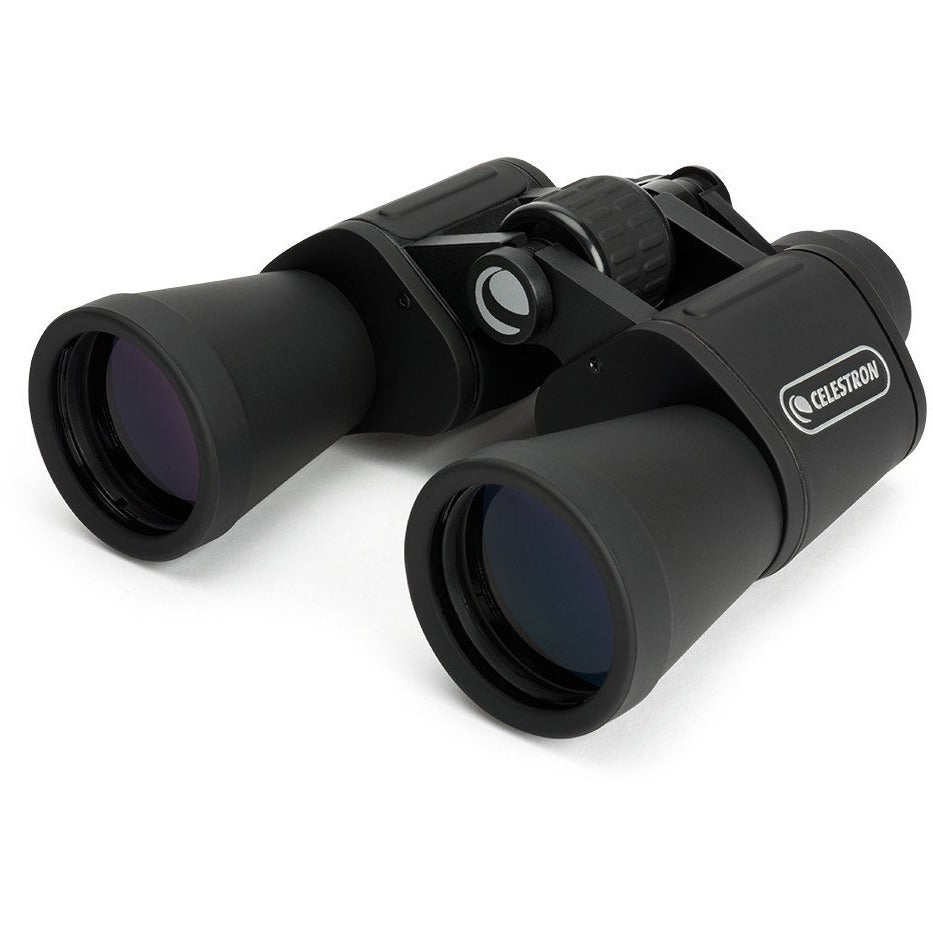
Explore this need in the finder →The Celestron UpClose G2 20x50 (item 71258) trades a wide scene and comfortable eye position for unusually high fixed magnification in a compact-priced Porro design. Its manufacturer-listed field is 3.2° (168 ft at 1,000 yards), its eye relief is only 7 mm, and it weighs 28 oz. The 50 mm objective does not cancel the handling demands of 20x. This is a candidate for distant stationary viewing when a support plan is already acceptable; it is a poor default for tracking a bird on a walk or sharing the view with eyeglass wearers.
Twenty power narrows the scene
Celestron describes the 20x magnification as a way to bring distant subjects closer, and its table lists a 3.2° field. The linear field is 168 ft at 1,000 yards, less than half the 429 ft listed for the UpClose G2 8x40. A narrower field can make it harder to acquire a moving subject and to keep it in view while it crosses the scene. For a fixed target such as a distant landmark or a celestial object, that tighter view may be the point; for finding and following wildlife, a broad 7x or 8x field is usually the more forgiving operating plan.
The 2.5 mm exit pupil is smaller than the 5 mm figures listed for the 10x50 and 8x40. A larger objective alone does not determine view quality; power, exit pupil, coatings, alignment and viewing conditions all matter. No laboratory brightness, resolution, or low-light performance is claimed here. The 20x50's published close focus is 42 ft, so it also is not suitable for near subjects. That is much farther than the 10 ft on the 8x21 or 15 ft on the 10x25.
Eye position and weight are decisive
Seven millimeters of eye relief is a material limitation. Even without glasses, some viewers need careful eye placement; with glasses, the full field is unlikely to be accessible for many users. The manual's advice to set the interpupillary distance and diopter carefully can help focus but cannot create more eye relief. If glasses fit is essential, compare the 10x50's 12 mm, 8x40's 12 mm, or better-eye-relief choices elsewhere in the catalogue, and try a unit before purchase if possible.
At 28 oz, this pair is a substantial handheld instrument. Because every tremor is magnified at 20x, a tripod is the sensible plan for prolonged observation. The exact page marks it tripod adaptable, while the manual describes a threaded fitting beneath a cap on Porro models and requires a separate binocular tripod adapter. The accessory is not in the listed standard package. Without the adapter and support, the model remains usable by hand, but the match should not assume a stable stationary viewing setup.
Weather and optical claims stay modest
The manufacturer lists BK-7 Porro prisms and multi-coated optics, and describes a rubber-covered aluminum body. Its specifications say water resistant and nitrogen filled no. They do not establish a waterproof immersion rating, a fogproof rating, ED glass or phase-correction coating. The 20x50 should therefore be excluded from a waterproof-essential brief. “Water resistant” is not a permission to submerge it, rinse it under pressure, or rely on it through prolonged wet conditions.
The shared UpClose G2 manual applies to Porro models and explains center focusing, the independent right-eye diopter, and the tripod adapter fitting. Align the barrels first; then focus with one eye at a time. Raise the rubber eyecups without glasses and fold them down with glasses. The manual advises cleaning only exterior optics with suitable tools, avoiding internal service, and storing the binocular in its case. It warns that looking at the Sun through the instrument can cause permanent eye damage.
When the questionnaire should move you elsewhere
Selecting 20x and 50 mm objectives retains the 71258. If you require a scene at least 6° wide, this model fails its 3.2° published field; a 13 mm minimum eye-relief choice also rejects it; and a waterproof requirement rejects the whole UpClose G2 family. The “adapter in the box” choice excludes it because Celestron says the binocular tripod adapter is sold separately. It remains a valid result only if those specific requirements are not essential.
Compare the fixed 10x50 for a wider 6.8° scene and a 5 mm exit pupil, accepting that both are 50 mm Porro models and neither is waterproof. The 10–30x50 can reach more power but has an even narrower 2.2° field at its highest setting, and its eye relief falls to 15 mm there. The 8x40 is a better orientation and tracking choice with a 429 ft field, while the Outland X 8x42 has a documented waterproof construction for weather-sensitive outdoor use. This 20x50 belongs on the shortlist only when high fixed power outweighs portability, field width, close focus and eye fit.
Key specifications
Key details at a glance
| Magnification | 20× |
|---|---|
| Objective diameter | 50 mm |
| Real field of view | 3.2° |
| Field width at 1,000 m | 56 m |
| Eye relief | 7 mm |
| Exit pupil | 2.5 mm |
More specifications and setup details
| Close focus distance | 42 ft |
|---|---|
| Manufacturer-published weight | 28 oz |
| ED glass confirmed for this exact model | No |
| Lens and prism coatings | Celestron lists multi-coated optics and BK7 prisms; the exact table lists prism coatings as N/A. Fully multi-coated or phase-coated performance is not asserted. |
| Water and fog protection | Water resistant; not listed as waterproof; nitrogen filling: no. |
| Tripod use | Tripod adaptable, but a compatible adapter is sold separately and not included. |
| Published weight note | Exact manufacturer listed instrument weight; no field measurement or accessory weight is implied. |
| Package contents | Carrying case, objective covers, eyepiece covers, lens cloth and instruction manual are itemized; the description also mentions a neck strap. |
| Manufacturer-rated waterproof | No |
| Tripod adapter in package | No |
Use the exact model’s instructions for operating limits, supplied equipment and version differences.
Sources for this review
Sources for this assessment
- Official Celestron US UpClose G2 binocular family collection (14 rows observed)
- Official Celestron Shopify product JSON for the UpClose G2 family snapshot
- UpClose G2 20x50mm Porro Binoculars
- Celestron UpClose G2 binoculars manual; English operating and care pages inspected
- Celestron UpClose G2 official specification and package-variant sheet
- Dated CPSC ProductName search for Celestron item 71258 (empty response on 2026-10-23)
- Celestron image linked from the exact item page

Choose your optical trade-off first.
Choose viewing purpose first, then magnification, objective size, scene width and any fit, weather or mounting constraint. A direct-Sun requirement is separate: only exact manufacturer-confirmed solar binoculars can pass it.