
On this page
Lightest exact 16x model, without a confirmed tripod route
The UpClose G2 16x32 is the 13 oz match in the exact 16x set, but its 3.5° field is narrower than Nikon's 16x50 and its page does not list tripod adaptation. It is water resistant, not waterproof, and its 26 ft close focus is for distant subjects.
Explore the needs this model fits
Your needs, this model
Does it fit your priorities?
Do you specifically want fixed 16x in a 32 mm roof body?
The exact product page lists 16x32; Celestron gives a 3.5° field, 10 mm eye relief and 13 oz weight.
Explore this need in the finder →Does the published 10 mm eye relief meet your chosen threshold?
It meets a 10 mm floor but fails a 12 mm floor; with glasses, eye relief and eyecup position need checking before choosing it.
Explore this need in the finder →Must a tripod adapter be supplied for steady high power?
No adapter is listed and the exact page says the model is not tripod adaptable; choose another configuration if tripod support is essential.
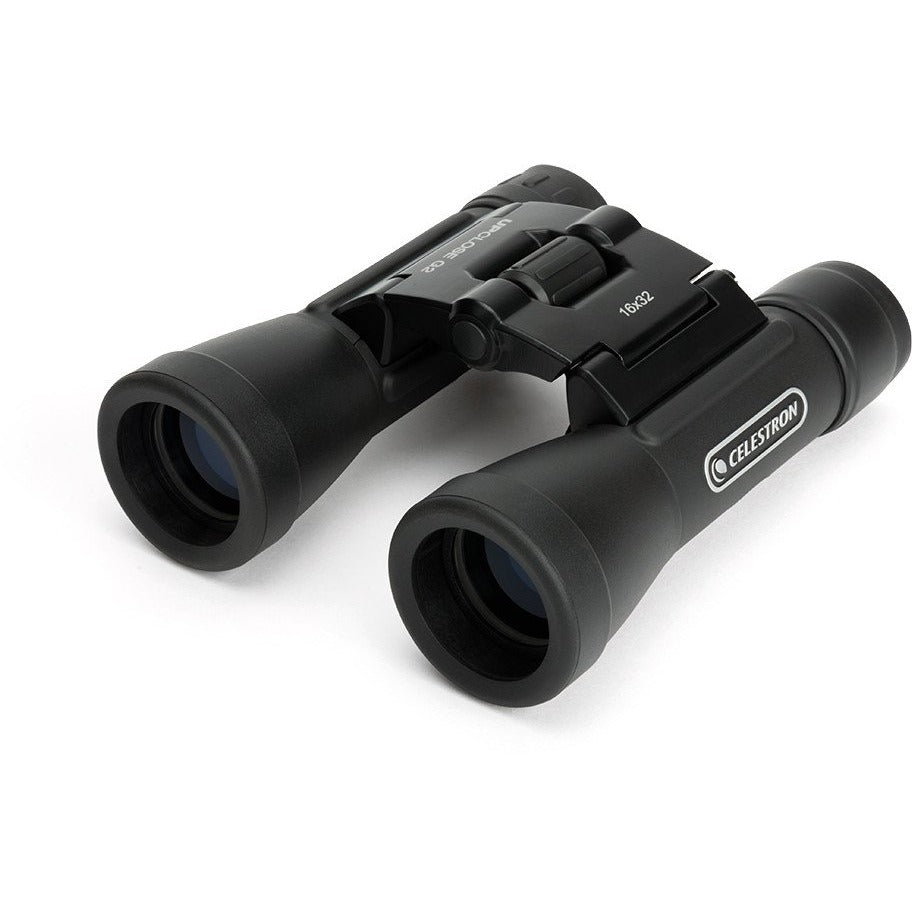
Explore this need in the finder →The Celestron UpClose G2 16x32 roof binocular (item 71234) puts 16x magnification into a 13 oz body with 32 mm objectives. It is physically shorter and narrower than the family’s large Porro models, but it is not a low-power or tripod-ready pocket view: Celestron publishes only a 3.5° field, 185 ft at 1,000 yards, 10 mm eye relief and a 26 ft close focus. Choose it only when a compact body and strong fixed magnification are more important than steadiness, a wide scene or generous eyeglass fit.
Small body does not make 16x an easy handheld view
The 16x32 is an unusually high-power configuration for a small roof-prism instrument. Its 2 mm exit pupil and narrow field are both listed by Celestron; they should temper expectations for the high-power label. The field is much narrower than the 378 ft of the 8x21 or 300 ft of the 10x25, and it does not have the 5 mm exit pupil found on 7x35, 8x40 and 10x50. A narrow view can slow target acquisition, especially if the subject moves or the user is unfamiliar with the area.
The actual instrument is 13 oz and 91 × 56 × 142 mm according to the manufacturer. That is more compact than a large Porro body but heavier than the 8 oz 8x21 and somewhat heavier than the 11 oz 10x25. More importantly, 16x magnification emphasizes small hand motion. The page does not list a stabilization system or tripod adaptability. Do not assume it will deliver a steady, supported view simply because the chassis is smaller.
Close focus and glasses fit are limited
Celestron lists 10 mm eye relief, an interpupillary range of 58–72 mm and a ±2 diopter adjustment. Ten millimeters is short for many eyeglass wearers. The manual says to fold down the rubber eyecups for glasses, but that does not extend the underlying eye relief or guarantee that the full field can be seen. If a 12, 15 or 17 mm minimum is essential, choose an alternative with a longer exact published figure and try the fit if possible.
Close focus is 26 ft, which is considerably farther than the 10 ft of the 8x21, 15 ft of the 10x25 and 19 ft of the 8x40. The 16x32 is therefore for distant objects, not details close to a trail or garden. The exact page also labels the body water resistant, gives BK-7 prism glass and multi-coated optics, and says nitrogen filled no. It does not provide a waterproof depth or duration, fogproof claim, ED glass or phase-coating feature.
What the shared manual can and cannot fix
Set interpupillary distance until the two barrel images merge; then focus the left view with the center wheel and the right eye with the diopter. Fold the eyecups down with glasses and keep them raised without glasses. These setup choices help align the view but do not change the 16x power, the narrow field or the 10 mm eye relief. Celestron's manual advises keeping lenses clean, using the supplied case, and leaving internal service to a qualified repairer. It also warns never to look at the Sun through the binocular or project an image of the Sun.
Celestron lists a padded soft-sided cloth case, lens cloth and instruction manual in the product specification. The manufacturer also describes a neck strap. It lists water resistance, not waterproofing. If the intended outing involves wet weather, a waterfront or frequent exposure to damp conditions, do not treat the rubber armor as an all-weather seal.
Choose it only if 16x is part of the plan
The questionnaire’s 16x and 32 mm choices isolate this exact configuration. It passes a 15 oz weight ceiling, but fails a 12 mm minimum eye-relief requirement, a 20 ft maximum close-focus requirement, a waterproof-essential answer, a tripod-adaptable preference and an adapter-in-box condition. The model should not be shown as an answer to any of those hard needs simply because it is lightweight relative to a 50 mm binocular.
For observing moving wildlife or sports, the 8x21 is wider and lighter, and the 8x40 is wider still with a 5 mm exit pupil but weighs 24 oz. For greater reach with a larger 50 mm objective, the 20x50 is tripod adaptable but needs a separately purchased adapter and has just 7 mm eye relief. The 10–30x50 zoom lets the observer choose a lower power before zooming, but it too is heavier and should be supported at high power. The 16x32 is therefore a narrow niche: portable dimensions paired with firm high magnification, with steadiness and eye positioning left to the user.
Key specifications
Key details at a glance
| Magnification | 16× |
|---|---|
| Objective diameter | 32 mm |
| Real field of view | 3.5° |
| Field width at 1,000 m | 62 m |
| Eye relief | 10 mm |
| Exit pupil | 2 mm |
More specifications and setup details
| Close focus distance | 26 ft |
|---|---|
| Manufacturer-published weight | 13 oz |
| ED glass confirmed for this exact model | No |
| Lens and prism coatings | Celestron lists multi-coated optics and BK7 prisms; the exact table lists prism coatings as N/A. Fully multi-coated or phase-coated performance is not asserted. |
| Water and fog protection | Water resistant; not listed as waterproof; nitrogen filling: no. |
| Tripod use | The exact roof-model page lists no tripod adaptation. |
| Published weight note | Exact manufacturer listed instrument weight; no field measurement or accessory weight is implied. |
| Package contents | Carrying case, lens cloth and instruction manual are the listed items; product description also names a neck strap. |
| Manufacturer-rated waterproof | No |
| Tripod adapter in package | No |
Use the exact model’s instructions for operating limits, supplied equipment and version differences.
Sources for this review
Sources for this assessment
- Official Celestron US UpClose G2 binocular family collection (14 rows observed)
- Official Celestron Shopify product JSON for the UpClose G2 family snapshot
- UpClose G2 16x32mm Roof Binoculars
- Celestron UpClose G2 binoculars manual; English operating and care pages inspected
- Celestron UpClose G2 official specification and package-variant sheet
- Dated CPSC ProductName search for Celestron item 71234 (empty response on 2026-10-23)
- Celestron image linked from the exact item page

Choose your optical trade-off first.
Choose viewing purpose first, then magnification, objective size, scene width and any fit, weather or mounting constraint. A direct-Sun requirement is separate: only exact manufacturer-confirmed solar binoculars can pass it.
Your needs, this model
Two very different 16x binoculars
Choose it when: This is the lighter of the two exact 16x matches at 13 oz. It is the model to consider when low instrument mass matters more than a broader published field or confirmed tripod support.
Two very different 16x binoculars →