
On this page
Your needs, this model
Does it fit your priorities?
Is this the small 10x25 daytime option you want to carry?
The exact title and table state 10x25, a 5.7° field, 11 oz weight and roof prism; the page’s isolated “20x25” phrase is inconsistent with those exact identity fields.
Explore this need in the finder →Must the close-focus distance be 10 ft or less?
No. The exact product table says 15 ft; the 8x21 sibling’s 10 ft figure is nearer.
Explore this need in the finder →Is a waterproof rating essential?
No: this model is described as water resistant, not waterproof, and has no tripod adapter thread.
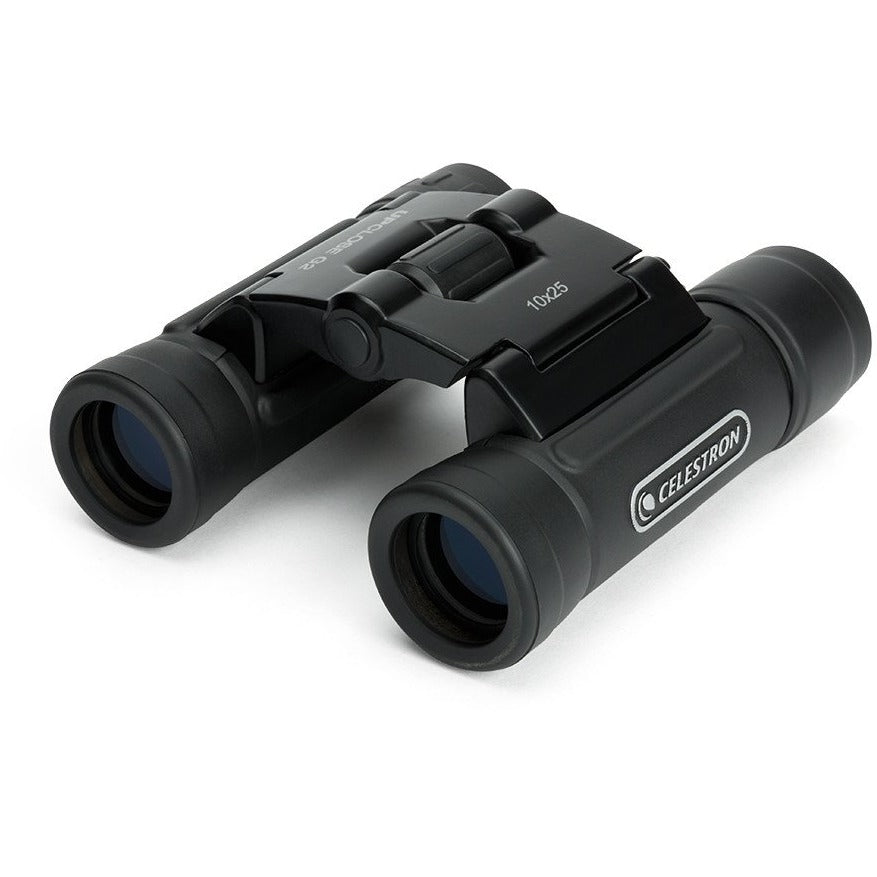
Explore this need in the finder →The Celestron UpClose G2 10x25 roof binocular (item 71232) is the pocket-size 10x option: 11 oz, 25 mm objectives and a short folded body. Celestron publishes a 5.7° field, 300 ft at 1,000 yards, 11 mm eye relief and a 15 ft close-focus distance. Its rubber-covered, water-resistant construction is convenient for daytime travel, but the small exit pupil and lack of tripod compatibility make it a compact daylight companion rather than an all-weather or low-light tool.
Compact size has real optical consequences
At 10x, the view is more enlarged than the 8x21, while the 25 mm objective gives a 2.5 mm exit pupil. The page lists 300 ft of scene width at 1,000 yards; the 8x21 is wider at 378 ft and reaches closer at 10 ft. The 10x25's extra power can be helpful when a distant detail matters, but it also makes a moving scene less forgiving than the 8x21's view. Those differences are reflected in published geometry, not in a personal field test. One product-copy paragraph on Celestron's page mistakenly calls this a “20x25”; the exact page heading, item 71232 and technical specification table identify it as 10x25, which is the configuration assessed here.
The official specification table lists the 10x25 as 76 × 51 × 114 mm and 11 oz. A soft case and neck strap are mentioned, and the item list also names a lens cloth and instruction manual. Objective and eyepiece covers are not included in that list, unlike the larger Porro configurations. A clamshell SKU, 71233, is separately listed by Celestron for the same 10x25 binocular. Celestron's family sell sheet identifies box versus clamshell packaging; that retail-packaging change does not create a different optical configuration and is covered by this review.
Close focus, glasses and weather
The 15 ft close-focus figure is a useful specification for viewing subjects nearer than a typical distant landscape, but it is not close-focus specialization. The 8x21 is the closer-focusing compact at 10 ft. Eye relief is 11 mm, which is a short published distance for glasses; rolling a rubber eyecup down is the manual's correct setup, but it does not guarantee that every wearer will see the full field. If eye relief is an essential minimum above 11 mm, choose another exact configuration rather than assuming eyecup adjustment solves it.
Celestron describes the roof-prism optics as BK-7, multi-coated and the body as water resistant. The page explicitly says nitrogen filling is no and tripod adaptability is no; no waterproof depth or fogproof claim is provided. Do not treat the wording “water resistant” as an immersion rating. For outdoor use in dependable rain or near water, compare a product whose exact page gives waterproof construction and a stated support manual, not merely a compact body with rubber armor.
Set the two eyepieces before judging sharpness
The shared UpClose G2 manual starts with interpupillary distance: hinge the barrels until both eyes see one circle. Close the right eye and focus the left view with the central wheel, then close the left eye and set the right-eye diopter. Once that difference between eyes is set, use the center wheel for distance changes. Raise the rubber eyecups without glasses and fold them down with glasses. The manual also says to store the pair in its case, remove dust before cleaning the optical surfaces, and avoid taking the body apart.
The compact format makes it tempting to keep this binocular available for spontaneous use. A simple care habit still matters: put it in the case when not in use, keep fingers off the glass, and use an optics-safe brush or cleaning kit if dust or smudges appear. Celestron's manual warns never to look at the Sun through the instrument or project sunlight through it. The product has no solar filter or solar-use designation.
How your finder answers change the shortlist
Choose 10x and 25 mm objectives to select this configuration rather than the 8x21, 10x50 or 10–30x50. A waterproof-essential answer removes it because its exact environmental classification is only water resistant. A tripod requirement also removes it because Celestron explicitly marks this roof model not adaptable. A 12 mm minimum eye-relief answer rejects the listed 11 mm. Conversely, a 15 ft maximum close-focus answer fits the published number, and a 12 oz weight limit includes it.
Pick the 8x21 if low weight, a wider field and closer focus are more important than ten-power reach. Choose a full-size Porro such as the 7x35, 8x40 or 10x50 if you prefer their larger exit pupils and are willing to carry more weight; tripod support on those Porro models still requires a separate adapter. If weather sealing is essential, move to an exact waterproof model such as Celestron's Outland X 8x42 rather than treating this compact's water-resistant label as equivalent. The 10x25 is most persuasive when small size is the priority and the shorter eye relief, narrow-field tradeoff and dry-weather limit are acceptable.
Key specifications
Key details at a glance
| Magnification | 10× |
|---|---|
| Objective diameter | 25 mm |
| Real field of view | 5.7° |
| Field width at 1,000 m | 100 m |
| Eye relief | 11 mm |
| Exit pupil | 2.5 mm |
More specifications and setup details
| Close focus distance | 15 ft |
|---|---|
| Manufacturer-published weight | 11 oz |
| ED glass confirmed for this exact model | No |
| Lens and prism coatings | Celestron lists multi-coated optics and BK7 prisms; the exact table lists prism coatings as N/A. Fully multi-coated or phase-coated performance is not asserted. |
| Water and fog protection | Water resistant; not listed as waterproof; nitrogen filling: no. |
| Tripod use | The exact roof-model page lists no tripod adaptation. |
| Published weight note | Exact manufacturer listed instrument weight; no field measurement or accessory weight is implied. |
| Package contents | Carrying case, lens cloth and instruction manual are the listed items; product description also names a neck strap. |
| Manufacturer-rated waterproof | No |
| Tripod adapter in package | No |
Use the exact model’s instructions for operating limits, supplied equipment and version differences.
Sources for this review
Sources for this assessment
- Official Celestron US UpClose G2 binocular family collection (14 rows observed)
- Official Celestron Shopify product JSON for the UpClose G2 family snapshot
- UpClose G2 10x25mm Roof Binoculars
- Celestron UpClose G2 binoculars manual; English operating and care pages inspected
- Celestron UpClose G2 official specification and package-variant sheet
- Dated CPSC ProductName search for Celestron item 71232 (empty response on 2026-10-23)
- Celestron image linked from the exact item page

Choose your optical trade-off first.
Choose viewing purpose first, then magnification, objective size, scene width and any fit, weather or mounting constraint. A direct-Sun requirement is separate: only exact manufacturer-confirmed solar binoculars can pass it.