
On this page
An exact 10–30x zoom with a long close-focus limit
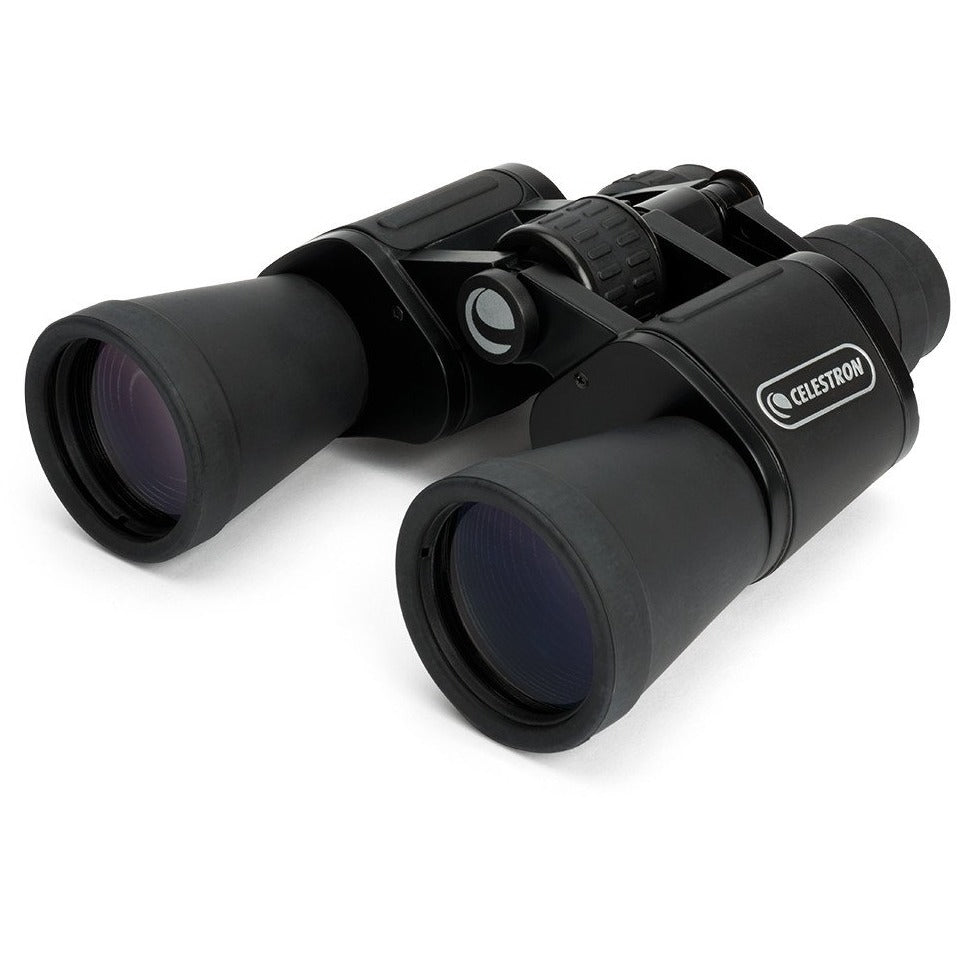
The UpClose G2 10–30x50 is the exact zoom-band configuration with a 28 oz listed mass and 45 ft close focus. The adapter for tripod mounting is separate; the exact product record uses Water Resistant wording rather than confirming waterproof immersion protection.
Explore the needs this model fits
Your needs, this model
Does it fit your priorities?
Do you need a true variable-power view from 10x through 30x?
Yes only if changing magnification is useful enough to accept the narrower field and smaller exit pupil at 30x; refocus at high power and expect the far end to need support.
Explore this need in the finder →Does the 30x end still meet a broad-scene requirement?
No. At maximum zoom Celestron lists a 2.2° real field (115 ft at 1,000 yd), compared with 4.3° (225 ft) at 10x.
Explore this need in the finder →Can the adapter be part of the supplied standard package?
No. The exact page says tripod adaptable, while the adapter is a separate purchase; do not treat compatibility as inclusion.
Explore this need in the finder →The Celestron UpClose G2 10–30x50 (item 71260) is the variable-power Porro choice in this family. Its zoom lever changes from a 10x locating view to 30x, and Celestron publishes field width, exit pupil, eye relief and closest focus separately at those endpoints. It weighs 28 oz, accepts a tripod adapter sold separately, and is only listed as water resistant. This makes it a specialized low-cost option for someone who specifically wants magnification to change—not a general-purpose upgrade over a fixed 8x or 10x pair.
Find the target at 10x, then decide whether to zoom
At 10x, the manufacturer lists a 4.3° angular field and 225 ft across at 1,000 yards. At 30x, it lists 2.2° and 115 ft. Starting at lower power gives a wider scene for locating a distant subject; the 30x setting enlarges it but shows a much smaller slice of the landscape. The zoom feature is most useful for a stationary or slow-moving subject that can be found first and watched at either setting. It does not provide the broad, stable feel of a fixed 7x or 8x binocular.
Other published values also change with zoom. Exit pupil is 5 mm at 10x and 1.7 mm at 30x; stated eye relief is 20 mm at 10x and 15 mm at 30x. Closest focus is 26 ft at 10x and 45 ft at 30x. In other words, the near-focus advantage is available at the low-power end, not the maximum setting. Anyone with glasses should judge fit at the power they expect to use most, rather than treating the longest eye-relief number as an all-zoom guarantee.
High magnification is not free detail
The objectives remain 50 mm while magnification rises to 30x, so the exit pupil narrows and small hand movements are magnified too. The page does not provide a stabilization system; no steady-view performance measurement is claimed. Celestron marks the binocular tripod adaptable and the manual describes the Porro tripod fitting. A separate binocular tripod adapter is needed and is not listed in the standard package. Mounting is therefore the practical plan for extended use near 30x, not a supplied feature that makes the high-power image automatically stable.
At 28 oz, the zoom is slightly heavier than the fixed 10x50 and 20x50 models and heavier than the 24 oz 8x40. Its product page lists BK-7 Porro prisms and multi-coated optics. It does not claim phase correction, ED glass, nitrogen filling, waterproofing or fogproofing. The environmental entry is “water resistant,” which should not be stretched into an immersion or sustained-storm promise. The body is rubber-covered aluminum in Celestron's description.
Follow the manual's focus procedure
Celestron's shared UpClose G2 manual says to focus zoom binoculars at maximum power first: set the zoom lever to its highest magnification, focus the left view with the center wheel, then adjust the right-eye diopter. After that, zooming in or out should preserve focus according to the manual. The first step is still aligning interpupillary distance so the two barrels show one circle. Fold down the rubber eyecups if you wear glasses; raise them otherwise. The manual recommends keeping the glass clean, storing the instrument in its case, and never attempting internal cleaning or disassembly.
There is also a strict solar warning. Never look at the Sun through the binocular or use the optics to project an image of the Sun. That warning matters in a family marketed for outings and casual observing: the instrument is not a solar viewer and has no solar filter.
How the finder choices affect this model
Choose variable zoom if that function is essential; a fixed 10x50 or 20x50 cannot satisfy it. The exact zoom selection is 10–30x and 50 mm objectives. A close-focus ceiling of 26 ft is met only at the 10x end; a stricter 25 ft limit is not. A 20 mm eye-relief minimum is not met across the range because Celestron lists only 15 mm at 30x. A waterproof requirement removes it, and requiring a tripod adapter in the box removes it as well.
For a predictable handheld view, compare the 8x40's 8.2° field and 12 mm relief or the fixed 10x50's 6.8° field and simpler one-power setup. For stronger magnification without a zoom lever, the 20x50 is a separate fixed-power choice; its 7 mm eye relief is even shorter and it benefits from support. The 10–30x50 is for shoppers who knowingly accept those compromises in order to shift from a 10x locating view to a 30x inspection view. Its published values are product specifications, not a claim of personal field testing or measured optical performance.
Key specifications
Key details at a glance
| Magnification | 10× |
|---|---|
| Magnification range | 10–30x variable zoom |
| Variable-power field and fit at endpoints | At 10x: 4.3° / 225 ft at 1,000 yd, 5 mm exit pupil, 20 mm eye relief and 26 ft closest focus. At 30x: 2.2° / 115 ft, 1.7 mm exit pupil, 15 mm eye relief and 45 ft closest focus. |
| Objective diameter | 50 mm |
| Real field of view | 2.2° |
| Field width at 1,000 m | 38 m |
More specifications and setup details
| Eye relief | 15 mm |
|---|---|
| Exit pupil | 1.7 mm |
| Close focus distance | 45 ft |
| Manufacturer-published weight | 28 oz |
| ED glass confirmed for this exact model | No |
| Lens and prism coatings | Celestron lists multi-coated optics and BK7 prisms; the exact table lists prism coatings as N/A. Fully multi-coated or phase-coated performance is not asserted. |
| Water and fog protection | Water resistant; not listed as waterproof; nitrogen filling: no. |
| Tripod use | Tripod adaptable, but a compatible adapter is sold separately and not included. |
| Published weight note | Exact manufacturer listed instrument weight; no field measurement or accessory weight is implied. |
| Package contents | Carrying case, objective covers, eyepiece covers, lens cloth and instruction manual are listed; the product description also mentions a neck strap. |
| Manufacturer-rated waterproof | No |
| Tripod adapter in package | No |
Use the exact model’s instructions for operating limits, supplied equipment and version differences.
Sources for this review
Sources for this assessment
- Official Celestron US UpClose G2 binocular family collection (14 rows observed)
- Official Celestron Shopify product JSON for the UpClose G2 family snapshot
- UpClose G2 10-30x50mm Zoom Porro Binoculars
- Celestron UpClose G2 binoculars manual; English operating and care pages inspected
- Celestron UpClose G2 official specification and package-variant sheet
- Dated CPSC ProductName search for Celestron item 71260 (empty response on 2026-10-23)
- Celestron image linked from the exact item page

Choose your optical trade-off first.
Choose viewing purpose first, then magnification, objective size, scene width and any fit, weather or mounting constraint. A direct-Sun requirement is separate: only exact manufacturer-confirmed solar binoculars can pass it.
Your needs, this model
A binocular with a 10–30x zoom range
Choose it when: It is the only current configuration returned for the exact 10–30x preset. The 50 mm objectives and zoom lever provide variable magnification across the requested band, while the exact product page supplies the listed mass and close-focus limit.
A binocular with a 10–30x zoom range →Choosing between binoculars with a variable-power zoom
Choose it when: Choose the UpClose if reaching 30x matters more than the lighter carry of the Nikon and you can work within its long close-focus distance. It is the lightest configuration among these three and has a confirmed tripod-adapter route.
Choosing between binoculars with a variable-power zoom →