
On this page
Your needs, this model
Does it fit your priorities?
Does this 8x/42 model meet the questionnaire's broad-scene field choice?
The exact source lists a 7.5° real field. The discontinued SKU is retained for comparison but cannot enter current purchase suggestions.
Explore this need in the finder →Does the exact model meet a 18 mm listed eye-relief floor?
The exact manufacturer data list 18 mm eye relief; that is a numeric comparison, not an individual glasses-fit guarantee. This SKU remains reference-only.
Explore this need in the finder →Does its published 13.1 ft focus figure fit a 14 ft maximum when waterproofing is essential?
The exact table lists 13.1 ft close focus and the manufacturer states waterproof construction; no rating depth or duration is stated. The discontinued model is excluded from current recommendations.
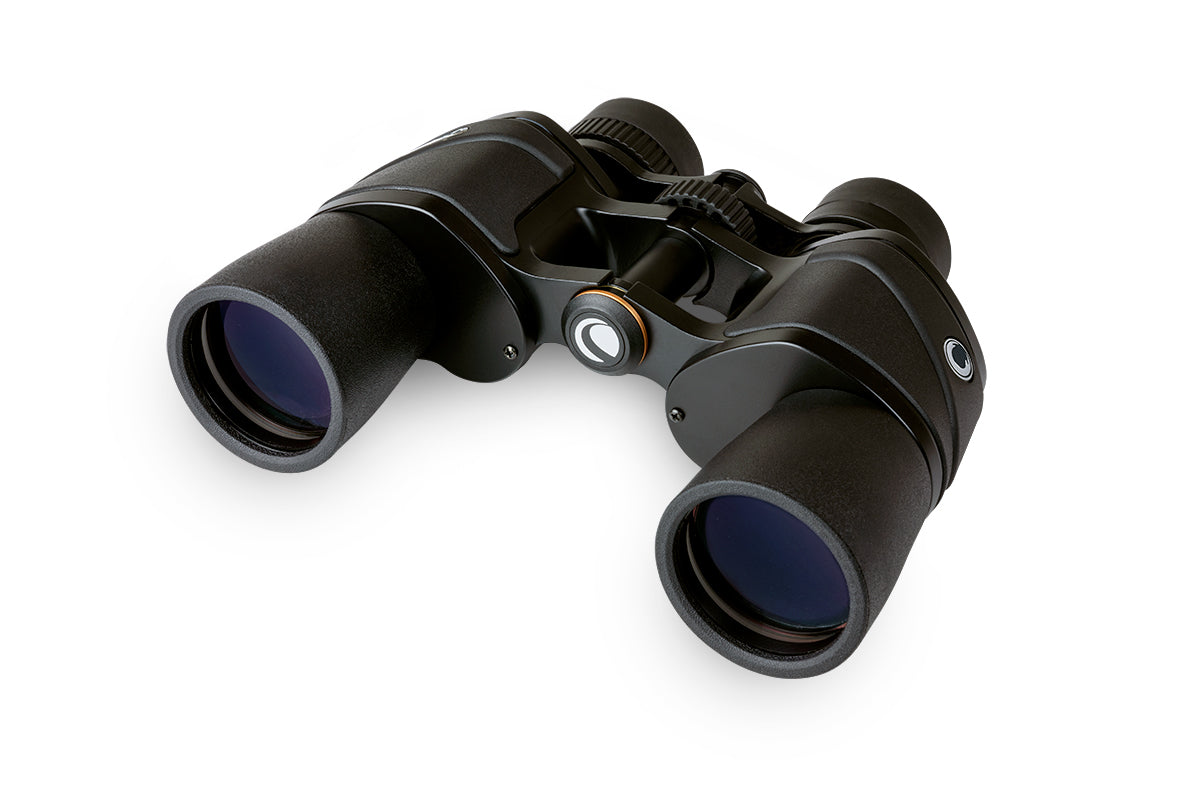
Explore this need in the finder →The Ultima 8x42 item 72252 combines an 8x Porro layout with a 7.5° real field, 18 mm listed eye relief and a manufacturer-published 21.9 oz weight. Celestron marks the exact item discontinued and unavailable in its dedicated collection. It is useful as a reference point for a traditional full-size 8x42, not as a current buying suggestion.
Why compare the 8x42 to smaller Ultimas?
The 8x42 shifts the family from 32 mm objectives to 42 mm while retaining the lower-shake character of 8x magnification. Celestron lists a 393-foot field at 1,000 yards and 131 metres at 1,000 metres, alongside a 7.5° angular field. These are manufacturer specs, not an independent field-of-view test. Relative to the Ultima 8x32, the 8x42 offers a larger stated exit pupil (5.3 mm versus 4 mm) and a wider 18 mm eye-relief figure instead of 15 mm, while adding 100 g/3.6 oz. The 6.5x32 is still broader at 9.2° and lighter at 18.3 oz, but trades away magnification and objective diameter.
The 5.3 mm exit pupil is simple geometry, not a verdict about perceived brightness. Celestron lists a relative-brightness index of 28, but the apparent view still depends on the observer, the light, alignment and the instrument’s optical condition. The 21.9 oz published weight matters if you carry binoculars for hours. A roof-prism 8x42 can pack more neatly than a Porro, though shape alone does not prove a better image or fit. The exact product page lists dimensions of 140 × 175 × 52 mm.
Fit and protection claims
The specification table lists 18 mm eye relief, an interpupillary range of 50–74 mm, ±4 diopter adjustment and 13.1-foot close focus. Eighteen millimetres may be more accommodating on paper than the 15 mm 8x32 or 10x42 models, but glasses comfort has to be tested by seeing whether you can reach the full field with the eyecups positioned correctly. The 13.1-foot close-focus distance is not suited to very close feeder or butterfly viewing; the 8.2-foot 32 mm versions focus nearer, as listed.
Celestron describes the body as waterproof and nitrogen filled. It gives no depth or duration, so do not infer underwater use. The page identifies a case, strap, eyepiece covers and tethered objective covers in the package. Tripod adaptability is stated, but the Ultima manual describes a separate adapter, absent from the listed package contents. If tripod use is essential, verify a compatible adapter independently rather than treating the tripod socket as a supplied support solution.
Practical operation and what this comparison can establish
Align the barrels to your interpupillary distance before focusing. The shared Ultima manual then sets the center focus for the left eye and the separate right diopter for the other eye; once the right-eye ring is adjusted, normal distance changes use the center wheel. The fold-down eyecups let glasses users move the eye position closer. Keep grit away from the lens before wiping, replace the caps after use, and keep the binocular dry after exposure. The manual warns against observing the Sun through ordinary binoculars.
For a current general-purpose 8x42, compare this older Porro with current models in the catalogue using weight, verified water protection, eye relief, field and close focus—not just “8x42.” The Ultima’s 7.5° field and 18 mm relief are distinct from the 8x32 siblings; its 21.9 oz weight and 13.1 ft focus are meaningful costs. It is reference-only because the observed exact SKU is unavailable, and a used version should be checked for alignment, focus, hinge motion, glass condition and included parts. No unit-specific used condition is promised here.
Sources: Celestron Ultima 8x42 item 72252; Ultima family manual.
Key specifications
Key details at a glance
| Magnification | 8× |
|---|---|
| Objective diameter | 42 mm |
| Real field of view | 7.5° |
| Field width at 1,000 m | 131 m |
| Eye relief | 18 mm |
| Exit pupil | 5.3 mm |
More specifications and setup details
| Close focus distance | 13.1 ft |
|---|---|
| Manufacturer-published weight | 21.9 oz |
| ED glass confirmed for this exact model | No |
| Lens and prism coatings | Celestron exact table lists Fully Multi-Coated optics, BaK-4 prism glass and prism coatings N/A. ED objectives and roof prism phase coating are not established for this Porro model. |
| Water and fog protection | Celestron labels the exact model waterproof and nitrogen filled. No depth/duration rating is published; this is not an underwater-use claim. |
| Tripod use | Celestron marks the model tripod adaptable. The Ultima manual calls for a separate binocular adapter; it is not listed in this exact package. |
| Published weight note | Manufacturer lists 21.9 oz (620 g); not independently weighed. |
| Manufacturer-rated waterproof | Yes |
| Tripod adapter in package | No |
Use the exact model’s instructions for operating limits, supplied equipment and version differences.
Sources for this review
Sources for this assessment

Choose your optical trade-off first.
Choose viewing purpose first, then magnification, objective size, scene width and any fit, weather or mounting constraint. A direct-Sun requirement is separate: only exact manufacturer-confirmed solar binoculars can pass it.