
On this page
Your needs, this model
Does it fit your priorities?
Do you specifically require a current 18–40x zoom with 80 mm objectives?
Item 71021 has that exact optical range in Celestron's record, but the manufacturer marks it discontinued, unavailable and out of stock. It stays in the reference library and cannot be returned as a current recommendation; the finder may show no current match rather than substitute a different zoom range.
Explore this need in the finder →Is at least 20.5 mm eye relief essential throughout the zoom?
Celestron states 20.3 mm at 18x only. Eye relief at 40x and throughout the full range is not confirmed, and this reference-only item is not recommendation-eligible; do not treat the minimum-setting figure as proof for the top setting.
Explore this need in the finder →Must the tripod adapter be confirmed in the box?
The exact page calls the 71021 tripod-adaptable, but conflicts on adapter inclusion: a feature bullet says included while the Included Items list omits one. It cannot satisfy an essential in-box adapter need; verify the exact package and mounting fit.
Explore this need in the finder →Is waterproofing essential for this binocular?
Celestron says Water Resistant and Nitrogen Filled: No, not waterproof. The shared manual does not turn that wording into an immersion or fogproof rating; it is not a safe match for a waterproof requirement.
Explore this need in the finder →Would a 15–35x70 zoom be acceptable if the discontinued 18–40x80 is not available?
That is a different configuration: item 71013 begins at 15x, uses 70 mm objectives and is listed at 53 oz. It may be an adjacent comparison when your chosen range allows it, but it does not meet an exact 18–40x80 requirement.
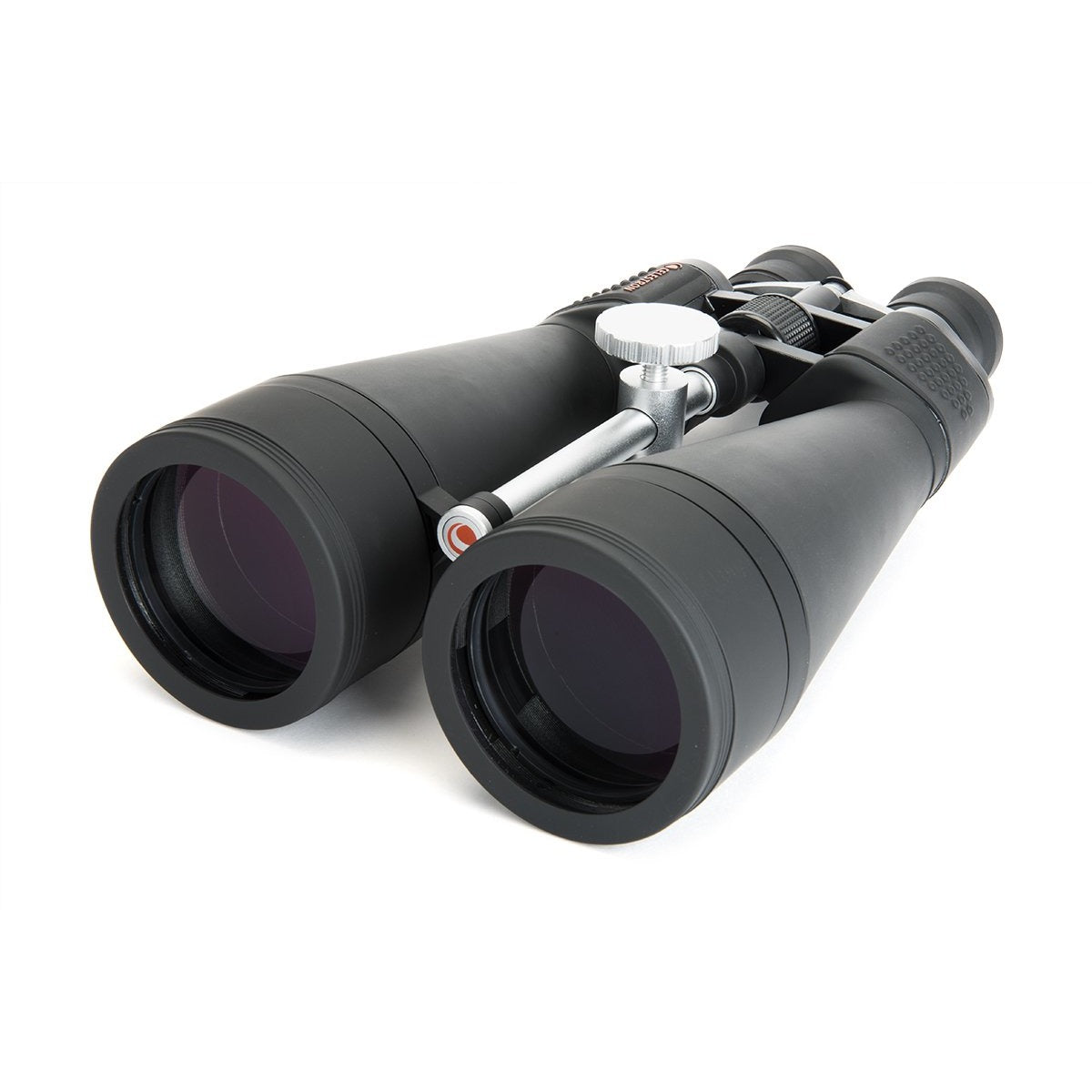
Explore this need in the finder →Celestron’s SkyMaster 18–40x80 (item 71021) is a large-aperture Porro zoom binocular spanning 18x to 40x, with a listed instrument weight of 76 oz. Celestron classifies the exact item as discontinued and its product page says out of stock. This is a reference for identifying an existing pair, not a current purchase recommendation. The practical question is whether you want a heavy instrument for a supported, mostly stationary view and accept a narrow field and unresolved package details.
A high-power range that starts high
The two numbers in 18–40x80 describe a variable 18x-to-40x magnification and 80 mm objectives. Even its lowest setting is a long-view power rather than a broad, easy-to-sweep view like an 8x or 10x pair. At 18x, Celestron lists a 1.9-degree angular field and 96 feet at 1,000 yards. Its table also prints 33.2 metres at 1,000 metres. These rounded statements are close but not a single exact unit conversion; retain their stated units and setting rather than calculating a more precise field. No field at 40x is stated in the table.
The manufacturer gives exit-pupil values of 4.4 mm at 18x and 2.0 mm at 40x. Raising power enlarges a distant subject but does not preserve the low setting’s wider scene or larger exit pupil. The linked SkyMaster manual says lower zoom settings give the widest field and brighter, sharper images, and cautions that refocusing may be needed when moving from low to high power. That is operating guidance, not a guarantee of sharpness; haze, focus, eye placement and movement still affect a distant view.
Plan around a substantial, supported instrument
At 76 oz (2,155 g), the binocular weighs 4.75 lb before its case or other gear. Celestron prints dimensions of 228 × 120 × 355 mm (9.0 × 4.7 × 14.0 in) without axis labels, so they are not a fit guarantee. This is a poor walking-day or moving-bird choice. For extended high-power viewing, plan a stable support: Celestron marks it tripod-adaptable, and the manual recommends a heavy-duty photographic tripod for best stability.
There is an important package ambiguity. The product page’s feature text says a tripod adapter is included, but its exact “Included Items” list names caps, a rainguard, nylon carrying case, neck strap, lens cloth and manual—and does not list an adapter. The package detail is therefore not reliable enough to meet an essential “adapter in the box” requirement. Do not assume a tripod, a particular adapter, or a specific thread size is supplied; confirm the exact package and fit before depending on one.
Eye position, focus distance and weather limits
Celestron publishes 20.3 mm eye relief at 18x, not across the full zoom range. That starting figure alone cannot establish comfortable full-field viewing with every eyeglass frame at 40x, so glasses users should verify eye position rather than treating it as a guaranteed fit. The closest-focus figure is 106.2 ft at 18x; that is a long-range instrument, not a choice for insects, nearby plants or indoor exhibits. The page also lists 56–72 mm interpupillary spacing and a −4 to +10 diopter adjustment range.
The specified optics are multi-coated with BaK-4 prisms. The page does not establish ED glass, phase coating, dielectric prism coating or full multi-coating of every surface. Its environmental wording is “Water Resistant,” while nitrogen filling is marked “No.” That is not a waterproof or fogproof guarantee; keep it dry and do not treat it as equipment for prolonged rain, immersion or abrupt damp-to-cold conditions. The series manual also warns never to look at the Sun through SkyMaster binoculars.
Use the zoom deliberately
The manual’s setup order is: align the hinge until both eyes see one circle, focus the left side with the center wheel, set the right-eye diopter separately, then use the center wheel for distance changes. For zoom models, Celestron says to focus at maximum power and notes that a change in magnification may call for refocusing. Locate the target at lower power if useful, then increase it only when support and conditions permit. A tripod reduces shake at 40x but cannot widen the field or improve atmospheric conditions.
Who should keep item 71021 as a comparison point?
This exact configuration makes sense as a specification reference for someone comparing a large objective and a 40x ceiling for distant terrestrial observation or astronomy, especially when the binocular can stay at a fixed observing position. It is a poor match for portability, close subjects, wide-scene scanning, a guaranteed waterproof body, or an essential included adapter. If you are comparing zoom designs, the different SkyMaster 15–35x70 item 71013 begins at 15x, has a 70 mm objective, lists 53 oz and publishes a 2.2-degree field at 15x; those differences may matter more than the other model’s higher 40x ceiling. See the 15–35x70 assessment for its exact-source caveats, and the zoom-range comparison for the trade-offs side by side.
If examining a used example, match the item number and inspect the focus and zoom controls through their full travel, image alignment, lens condition and the actual included parts. Celestron’s manual says a drop or rough handling can disturb collimation and directs repairs to the manufacturer or a qualified binocular repairer; it does not establish that any particular used example is aligned. The current status and that package ambiguity are decisive: keep 71021 as an older-model reference, not a suggestion to buy.
Key specifications
Key details at a glance
| Magnification | 18× |
|---|---|
| Magnification range | The exact table lists 18–40x; 18 is the selected/minimum value and 40 the maximum. The page gives angular field, linear field, exit pupil, eye relief and close focus specifically at 18x; it does not give their values at 40x. |
| Variable-power field and fit at endpoints | The exact product title and specifications identify a zoom model. The page-linked SkyMaster manual says to focus at maximum power and that a change from low to high power may require refocusing; lower settings give the widest field. |
| Objective diameter | 80 mm |
| Manufacturer-published weight | 76 oz |
| Lens and prism coatings | The exact page says Lens Coatings: Multi-Coated and Prism Coatings: N/A. It does not establish full multi-coating of every optical surface, ED glass, phase coating or dielectric prism coating. |
More specifications and setup details
| Manufacturer-rated waterproof | No |
|---|
Use the exact model’s instructions for operating limits, supplied equipment and version differences.
Sources for this review
Sources for this assessment
- Celestron exact US product page for SkyMaster item 71021
- Celestron US SkyMaster collection object for exact item 71021
- Celestron five-language SkyMaster Series manual linked from exact item 71021 page
- Celestron exact SKU-page-linked original product image for item 71021
- Official CPSC exact-number ProductName recall query for item 71021

Choose your optical trade-off first.
Choose viewing purpose first, then magnification, objective size, scene width and any fit, weather or mounting constraint. A direct-Sun requirement is separate: only exact manufacturer-confirmed solar binoculars can pass it.