
On this page
A supported 15–35x zoom; adapter does not include a tripod
The SkyMaster 15–35x70 is the exact long-range zoom configuration at 53 oz with a 73.8 ft close-focus limit. Its listed package includes a binocular adapter, not a tripod; the water-resistance statement does not establish an immersion rating.
Your needs, this model
Does it fit your priorities?
Do you specifically want the 15–35x zoom range on a 70 mm SkyMaster?
Exact item 71013 has a variable 15x minimum to 35x maximum, a 70 mm objective and a lever. If a fixed 15x wide view is more important, compare standard item 71009 instead.
Explore this need in the finder →Must variable magnification be available at the eyepiece?
The exact 71013 product page describes its 15–35x range and the family manual shows a zoom lever. The focus may need to be reset when magnification changes.
Explore this need in the finder →Is at least 21 mm of stated eye relief essential?
Celestron gives 20.3 mm at 15x. That figure does not confirm 21 mm, nor does it establish the same eye relief throughout the zoom range.
Explore this need in the finder →Must the binocular focus at about 74 ft or closer?
The exact 71013 page lists 73.8 ft. It should not match if a closer focusing limit is essential.
Explore this need in the finder →The Celestron SkyMaster 15–35x70 Zoom (item 71013) is a large, tripod-oriented Porro binocular with a variable-power lever. Its value is the range, not a claim that every zoom setting behaves like a dedicated fixed-power instrument. Celestron lists 15x to 35x, 70 mm objectives, a 53 oz body, 20.3 mm eye relief at 15x and a tripod adapter in the package. The field and exit pupil change across the range, so choose it only if adjusting power is part of the actual observing plan.
Zoom changes the view, and the work
At the minimum 15x end, the exact page lists a 2.2° angular field and a 4.7 mm exit pupil; at 35x it lists a 2.0 mm exit pupil. Higher magnification narrows the view and makes hand movement more evident. Celestron’s shared SkyMaster manual says lower powers give the widest and brightest view, and that focus may need adjustment after changing power. It recommends focusing zoom binoculars at maximum power first. For easier target acquisition, begin low, find the subject, then increase power carefully from a stable mount.
Celestron prints a linear field as 111 feet at 1,000 yards and 38.4 meters at 1,000 meters, associated with 15x. Those two figures do not convert exactly: 111 feet is about 33.8 meters. I retain the published pair and its discrepancy rather than silently correcting one value. The exact angular figure remains 2.2°. These are manufacturer table values, not a field measurement.
Adapter in the box; tripod still separate
The exact included-items list names caps, a tripod adapter, rainguard, nylon case, neck strap, cloth and instruction manual. The tripod is separate. At 53 oz this binocular itself is over three pounds; at 35x, support is even more important because motion is magnified. It weighs five ounces more than the fixed 15x70, and its two-model comparison should focus on the very different view: the fixed 15x70 lists a 4.4° field, while this zoom table lists 2.2° and starts at 15x. If you usually leave it at 15x and prefer a wider field, compare item 71009 rather than assuming the zoom is an upgrade.
The zoom table states 20.3 mm eye relief at 15x, not a guarantee that the same eye position holds at 35x. If you wear glasses, the published value is a useful starting point but not a promise of full-field viewing at every setting. The shared family manual describes central focus and a right-eyepiece diopter, along with eyecup adjustment. The exact page gives a diopter range from -4 to +10. Set the hinge and diopter deliberately, then refocus after zooming if needed.
Long-range optics, not weatherproofing
The closest-focus figure is 73.8 feet, a clear mismatch for close birding or garden observation. The exact table says “Water Resistant,” and “No” for nitrogen filling. It gives no waterproof or fogproof rating, so protect the instrument in rain and do not infer sealed construction. Celestron lists Multi-Coated optics and BaK-4 Porro prisms; the page does not establish ED glass or phase or dielectric coatings.
The weight ceiling, eye-relief minimum and close-focus options should change the recommendation. The model fits an exact 15–35x/70 mm request and a requirement for a documented zoom lever; it should fail a 21 mm eye-relief minimum, a 70-foot closest-focus maximum, or an essential waterproof requirement. Unknown features do not become positive just because this is an astronomy-oriented model.
Who should pick the zoom?
This is for someone who values changing power at a supported stationary position and accepts a narrower 15x field, long minimum focus, water-resistant-only wording and a larger package than an ordinary birding binocular. For a wide, fixed 15x70 view, the 71009 is lighter and lists an adapter in the package. For more aperture but much greater weight, the 25x100 uses a built-in mounting rod and individual-eyepiece focus. For nearby or fast-moving subjects, consider a lower-power model rather than trying to solve those limits with zoom.
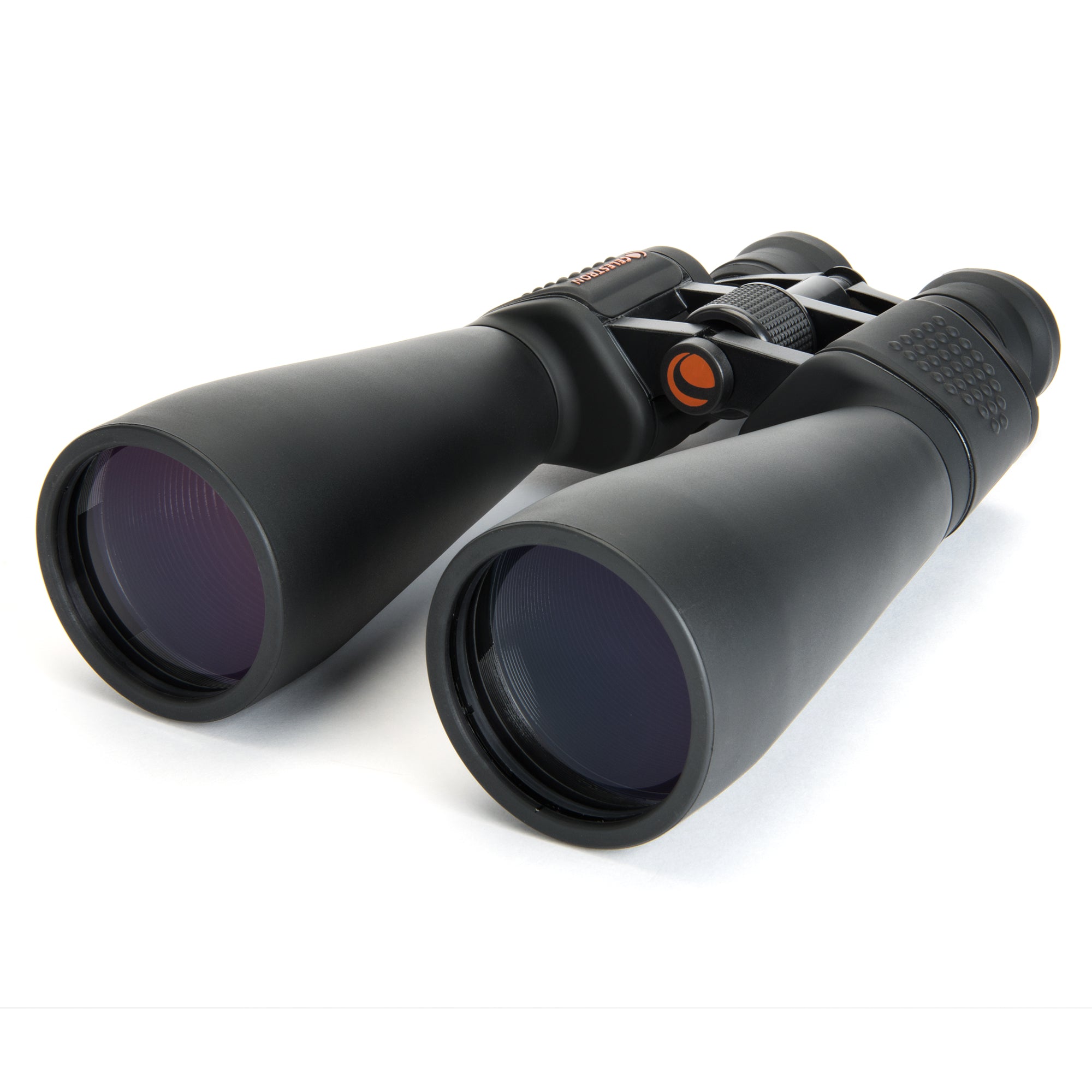
Celestron’s page-linked image shows a 70 mm Porro body associated with the exact 71013 page; no item number is legible on the image, and the maker does not identify it as a photograph or rendering. The page warns never to look at the Sun through this ordinary optic. The exact-number CPSC query returned no rows on the dated check, a limited query rather than a future guarantee.
The Used Outlet SKU does not verify a zoom sample
Celestron’s Used Outlet page identifies the variable-power configuration as SKU 557101355, links to item 71013 for full product details, and repeats its 15–35x70 specification. That particular used listing was out of stock on October 24, 2026. Celestron states generally that its used products are inspected and working and receive the same comprehensive warranty, but this wording does not report how a specific unit’s zoom control or optical alignment was checked. The range of magnifications is a model feature, not a guarantee about a used specimen. Judge the 71013’s zoom tradeoffs in this review; the separate used listing is not another profile or currently available condition match.
Exact-model sources: Celestron SkyMaster 15–35x70 item 71013, Used Outlet SKU 557101355, and the linked SkyMaster Series manual.
Key specifications
Key details at a glance
| Magnification | 15× |
|---|---|
| Objective diameter | 70 mm |
| Real field of view | 2.2° |
| Field width at 1,000 m | 38.4 m |
| Exit pupil | 4.7 mm |
| Close focus distance | 73.8 ft |
More specifications and setup details
| Manufacturer-published weight | 53 oz |
|---|---|
| Lens and prism coatings | Celestron describes the exact optics as Multi-Coated and identifies BaK-4 Porro prisms. The page does not confirm ED glass, phase or dielectric coatings, or that every optical surface is fully multi-coated. |
| Tripod use | The exact 71013 page lists a tripod adapter in the included-items list; the tripod itself is separate. Published zoom-specific field width is labeled at 15x; the printed 111 ft and 38.4 m pair does not convert exactly and is preserved as the manufacturer states it. |
| Manufacturer-rated waterproof | No |
| Tripod adapter in package | Yes |
Use the exact model’s instructions for operating limits, supplied equipment and version differences.
Sources for this review
Sources for this assessment
- Celestron exact US product page for item 71013
- Five-language SkyMaster Series manual linked from exact item 71013 page
- Dated CPSC ProductName API query for exact item 71013
- Celestron US general binocular collection page 1; exact model card linked to item 71013
- Celestron Used Outlet exact US product page for SKU 557101355
Choose your optical trade-off first.
Choose viewing purpose first, then magnification, objective size, scene width and any fit, weather or mounting constraint. A direct-Sun requirement is separate: only exact manufacturer-confirmed solar binoculars can pass it.
Your needs, this model
70 mm binoculars: fixed 15x or a zoom range
Choose it when: The 15–35x lever gives a different use pattern from the fixed 15x pair when magnification adjustment is important at a supported position.
70 mm binoculars: fixed 15x or a zoom range →A tripod-oriented 15–35x binocular zoom
Choose it when: It is the only current candidate for the exact 15–35x option. Its power range, 70 mm objectives and bundled adapter make it a distinct stationary-viewing choice rather than a smaller handheld zoom.
A tripod-oriented 15–35x binocular zoom →Choosing between binoculars with a variable-power zoom
Choose it when: Choose the SkyMaster if a 35x top setting is important and a stationary 70 mm setup is acceptable. The package lists a binocular adapter, which removes that separate-adapter step but does not provide the tripod.
Choosing between binoculars with a variable-power zoom →