
On this page
Waterproof construction in the Pro 20x80
The SkyMaster Pro 20x80 retains 20x80 power and an integrated sliding adapter while documenting waterproof and fogproof construction. It is heavier and narrower-field than the standard model, so the Pro weather specification is not a reason to ignore carry mass or support needs.
Explore the needs this model fits
Your needs, this model
Does it fit your priorities?
Do you want the fixed 20x80 size rather than the Pro 15x70?
Item 72031 is the 20x80 member of the non-ED SkyMaster Pro pair. It has a narrower published 3.2° / 168 ft field and weighs 86.4 oz; choose it only when the additional nominal magnification and larger objective suit a stationary view.
Explore this need in the finder →Can an 86.4 oz instrument stay within my carry limit?
The exact 72031 table lists 86.4 oz. An 87 oz limit admits that value; an 86 oz maximum does not. This excludes the separate tripod and carrying case.
Explore this need in the finder →Does its stated 15.5 mm eye relief satisfy a 15.5 mm minimum?
Yes, the published number is exactly 15.5 mm. A 15.6 mm minimum excludes it, and the figure alone cannot promise full-field viewing with every face or pair of glasses.
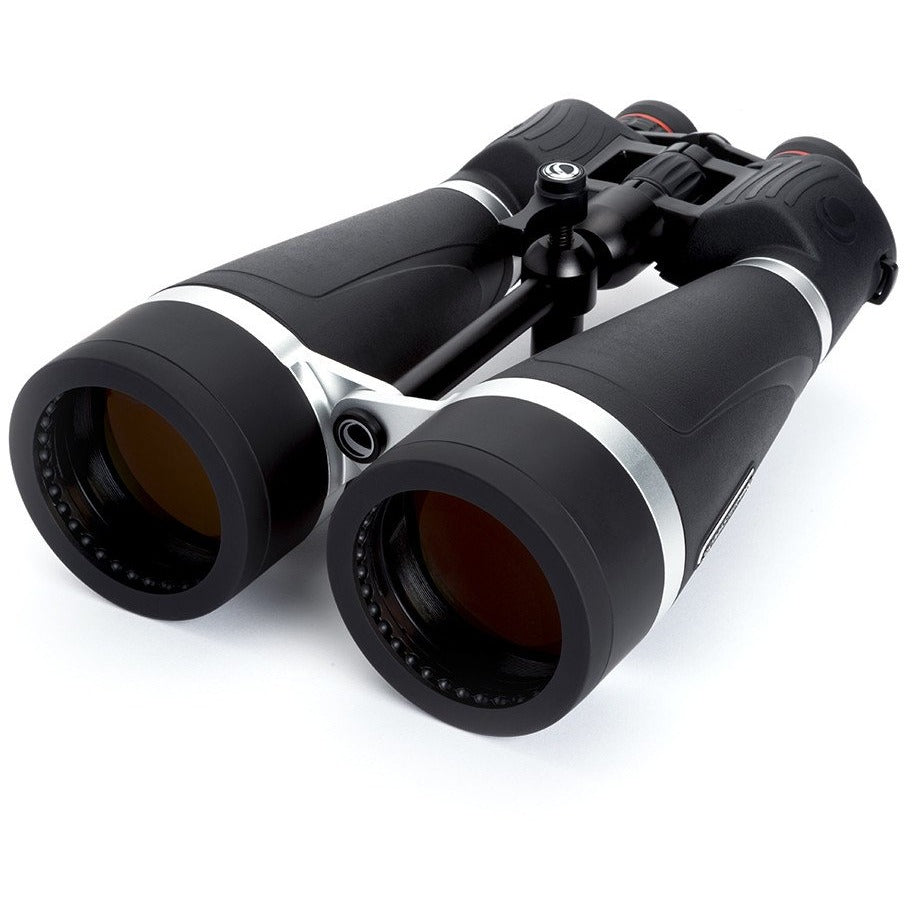
Explore this need in the finder →The Celestron SkyMaster Pro 20x80 (item 72031) is a fixed high-power binocular with a built-in sliding tripod adapter on its center support rod. It pairs 20x magnification and 80 mm objectives with a 3.2° field and a listed instrument weight of 86.4 ounces. That combination is compelling only when you can plan for a stationary, supported view. It is not the natural choice for quick scanning, nearby subjects or a long day carrying optics.
More reach comes with a tighter scene
Celestron lists a 3.2° angular field, which spans 168 feet at 1,000 yards. Its Pro 15x70 sibling is wider at 4.4° / 231 feet and 35.4 ounces lighter. The 20x80 therefore calls for more deliberate aiming: a distant landmark or a celestial object can be the point, while a small moving animal is easier to lose as you pan across a narrow view. The larger objectives are intended for low-light and astronomical observation, but nominal aperture is not a guarantee of a particular image or a substitute for steadiness.
The 20x80 specification table lists a 4 mm exit pupil, a 15.5 mm eye-relief figure, BaK-4 Porro prisms and fully multi-coated XLT optics. Its 16 relative-brightness index is a manufacturer-listed number, not a measured comparison. The exact configuration is named SkyMaster Pro, not SkyMaster Pro ED; ED glass is not confirmed for item 72031. If ED is a hard requirement, look at the distinct 72035 Pro ED 20x80 rather than assuming all models with “Pro” in the name share that feature.
The center rod is part of the mounting setup
The adapter arrangement is a useful reason to choose this model, but it does not mean a tripod is included. The manual identifies a built-in adapter attached to the center support rod, with a threaded bottom for a photographic tripod. Loosen the top lever and slide the binocular along the rod to find a balance point before observing. That adjustment can make a stable setup easier; it cannot make a lightweight, undersized tripod steady enough for 20x viewing.
The included RSR rail clips to the center rod and accepts an optional red-dot finder. The finder itself is not listed in the package, and the manual says it needs alignment with the binocular. If you do not need an aiming aid, the rail can remain unused. The included-items list also names objective caps, interchangeable flared eyecups, rainguard, neck strap, lens cloth and instruction manual. The tripod is an additional piece of equipment.
Check fit and focus distance
Celestron’s table gives a 56–72 mm interpupillary range, ±4 diopter adjustment and 15.5 mm eye relief. This is shorter stated relief than the 15x70’s 17 mm. Eyeglass wearers should fold the standard rubber eyecups down and test whether their own glasses still allow a comfortable view of the whole field. The manual also supplies winged eyecups to shade stray light, but that does not change the listed eye-relief measurement. Set the hinge first, focus for the left eye, adjust the right-eye diopter, then use the center wheel for changes in distance.
The closest focus is 66.2 feet. That is a long-distance instrument: it cannot focus on a nearby bird feeder or a close subject in the yard. If the same binocular must work at both a viewing platform and at close range, a shorter closest-focus limit should take priority over the 20x label. At 86.4 ounces before adding the tripod or other gear, a realistic carry allowance matters too.
Outdoor use and what the page does not promise
The exact 72031 product page calls the body waterproof and nitrogen-purged. It does not give an IPX depth or immersion duration, so that wording is not a diving rating. Keep the binocular protected, cap the objectives for storage, brush off grit before wiping glass and follow the manual’s care instructions. Celestron explicitly warns not to view or project sunlight through the instrument. It is an ordinary binocular, not a solar filter optic.
Used Outlet item U72031 retains the 20x80 name and repeats the optical specifications on a distinct outlet listing. Celestron describes it as gently used, inspected and in working order, while allowing that it may show signs of prior use; the exact page showed it out of stock. Its image is the normal 72031 catalog image, not a record of any used unit’s cosmetic condition. That listing is therefore recorded as a condition variation of this optical configuration, not as a second 20x80 review or as a currently available recommendation.
Choose item 72031 if high magnification and a built-in balanceable adapter fit a fixed viewing station, and you accept its mass, narrower field, limited close-focus reach and separate tripod. Choose the Pro 15x70 if a wider scene, lower weight, longer stated eye relief and a packaged adapter matter more. The standard 20x80 SkyMaster item 71018 is much lighter but lacks the same explicit waterproof/nitrogen claims; the Pro ED 20x80 item 72035 adds ED objectives and a different weight and field profile. Those are separate products with their own tradeoffs, not alternate names for 72031.
Exact-model sources: Celestron SkyMaster Pro 20x80 item 72031, its Used Outlet item U72031, and the SkyMaster Pro manual linked from both exact product pages.
Key specifications
Key details at a glance
| Magnification | 20× |
|---|---|
| Objective diameter | 80 mm |
| Real field of view | 3.2° |
| Field width at 1,000 m | 56 m |
| Eye relief | 15.5 mm |
| Exit pupil | 4 mm |
More specifications and setup details
| Close focus distance | 66.2 ft |
|---|---|
| Manufacturer-published weight | 86.4 oz |
| Lens and prism coatings | Celestron identifies fully multi-coated optics with proprietary XLT coatings and BaK-4 Porro prisms. The exact 72031 page does not confirm ED glass, phase coating, or dielectric coating; ED remains unknown rather than a presumed negative or positive. |
| Water and fog protection | The exact page says waterproof and nitrogen-purged, but gives no IPX depth or duration. Treat that as outdoor weather protection, not evidence of suitability for underwater use. |
| Tripod use | The exact 72031 page describes a built-in adapter rod. The manual explains that the adapter slides along the center support rod to find a balance point; a suitable tripod is not included. |
| Manufacturer-rated waterproof | Yes |
| Tripod adapter in package | Yes |
Use the exact model’s instructions for operating limits, supplied equipment and version differences.
Sources for this review
Sources for this assessment
- Celestron US SkyMaster Pro 20x80 product page, item 72031
- Celestron Used Outlet SkyMaster Pro 20x80 page, item U72031
- SkyMaster Pro multilingual manual linked from the exact 72030 and 72031 product pages
- Celestron US SkyMaster collection product and Used Outlet rows, 2026-10-23 archive
- CPSC exact product-name query for item number 72031; empty results are a limited dated search, not a future guarantee
- Manufacturer product image linked from the exact 72031 US page

Choose your optical trade-off first.
Choose viewing purpose first, then magnification, objective size, scene width and any fit, weather or mounting constraint. A direct-Sun requirement is separate: only exact manufacturer-confirmed solar binoculars can pass it.
Your needs, this model
80 mm binoculars: compare three 20x80 setups
Choose it when: This exact Pro configuration retains 20x80 power and an integrated sliding adapter while documenting waterproof and fogproof construction.
80 mm binoculars: compare three 20x80 setups →