
On this page
Your needs, this model
Does it fit your priorities?
Is the SkyMaster Pro 15x70 the more manageable of the two non-ED Pro sizes?
Item 72030 is fixed at 15x with 70 mm objectives, a 4.4° / 231 ft real field and 51 oz listed weight. It is lighter and wider-field than item 72031's 20x80 configuration, while still requiring a deliberate support plan.
Explore this need in the finder →Does its 51 oz listed instrument weight fit a strict carry ceiling?
The exact 72030 specification lists 51 oz. A hard maximum of 51 admits that listed value; a 50 oz ceiling does not. The number does not include a tripod or accessories.
Explore this need in the finder →Will the published 49.2 ft closest focus work if I need a 49 ft limit?
No. The exact page lists 49.2 ft, just beyond a 49 ft maximum. It can pass a 50 ft limit, but this remains a long-focus instrument rather than a close feeder binocular.
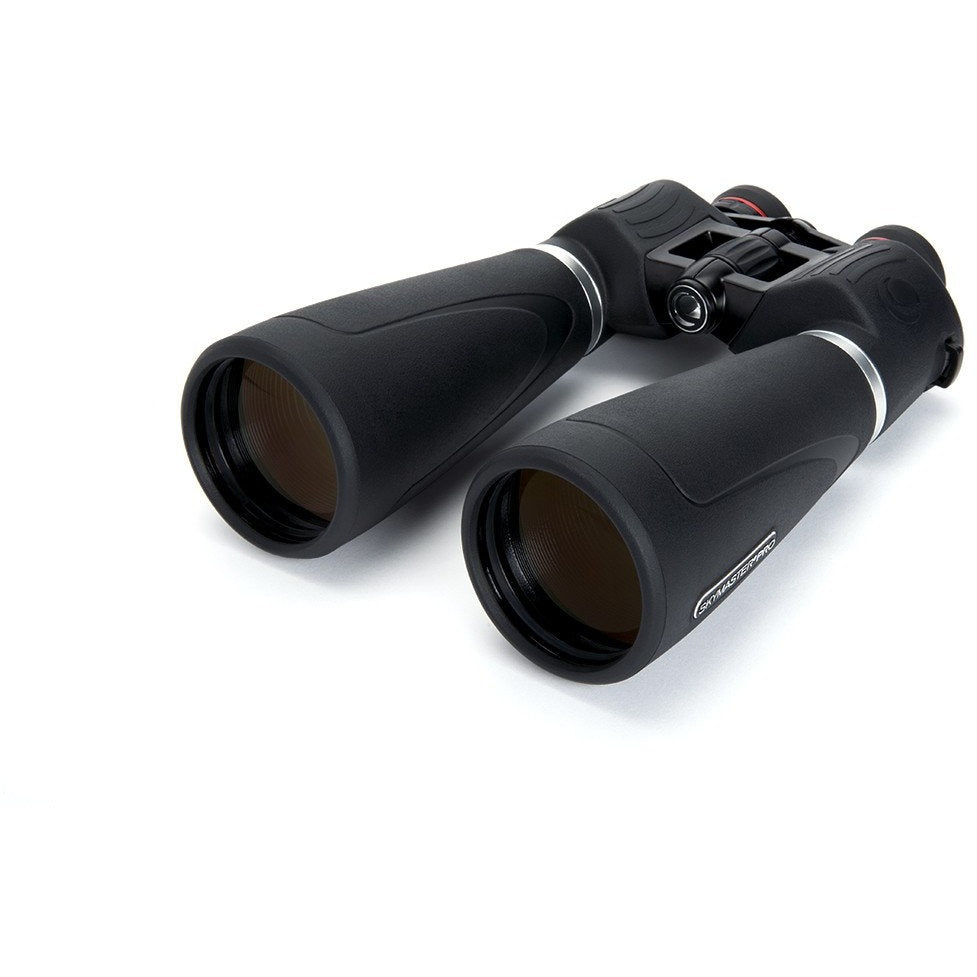
Explore this need in the finder →Celestron’s SkyMaster Pro 15x70 (item 72030) is the less massive and wider-field member of the non-ED Pro pair. It combines 15x magnification, 70 mm objectives and a listed 51-ounce instrument weight with a 4.4° field. Its normal package lists a tripod adapter and a removable finder rail. That adds practical setup value, but the high power and body size still suit a planned viewing spot better than an all-day walk.
A field and power combination for settled viewing
The published real field is 4.4°, or 231 feet at 1,000 yards. That is broader than the Pro 20x80’s 3.2° / 168-foot field and the lower of the two masses by 35.4 ounces. Those differences matter before the view reaches your eyes: with a little more scene around a distant subject, it is less difficult to place and reacquire than the tighter 20x view. Still, 15x magnification leaves little room for shaky hands or quick panning. Celestron positions the model for long-distance land observation and astronomy; for wildlife that darts between branches, a lighter 8x or 10x binocular is a more forgiving starting point.
The 70 mm objectives and fully multi-coated XLT optics are manufacturer specifications, not a promise of a certain brightness at every time of day. The listed exit pupil is 4.6 mm. Celestron lists BaK-4 Porro prisms and a 21.16 relative-brightness index, which should not be mistaken for an independent image comparison. The exact item is called SkyMaster Pro, not Pro ED: ED glass is not confirmed on this 72030 page, and the finder should not treat that missing claim as either a defect or an ED feature. If ED optics are essential, compare the separate 72034 Pro ED 15x70 instead.
The tripod connection is supplied, but the support is not
Item 72030’s included-items list names a tripod adapter as well as the RSR (Reflex Sight Ready) rail, caps, interchangeable flared eyecups, rainguard, strap, cloth and manual. The adapter is a separate piece that screws into the tripod threads behind the logo plate; Celestron’s manual shows the 15x70 attachment. You must still supply a compatible photographic tripod. The rail allows an optional red-dot finder to be mounted and aligned, but a red-dot sight is not listed as part of the binocular package.
The distinction from the 20x80 is not merely the same adapter in another place: the Pro 20x80 has a built-in sliding adapter on its center support rod. That rod lets you shift the body to find balance on a tripod. The 15x70’s adapter is listed in the box and attaches underneath; the tripod itself is separate in either case. If you already own a support, check its height and stability for high-power viewing rather than assuming that any small photo tripod will hold a comfortable view.
Fit the eyepieces to your face before choosing
Celestron states 17 mm of eye relief, a 56–72 mm interpupillary range, and a diopter adjustment of ±4. Seventeen millimeters is a useful figure to compare if you wear glasses, but it cannot predict full-field access for every face. The included regular eyecups fold down for eyeglass use; a second winged set can help shade stray side light. The manual’s setup sequence is straightforward: align the hinge until you see one image, focus the left eye with the center wheel, then adjust the right-eye ring for your vision. After that, the center wheel focuses as distance changes. A locking diopter is not specified.
At 49.2 feet, its listed closest focus is far beyond a nearby feeder or flower. That is one reason not to use “70 mm” as shorthand for a general wildlife binocular. It is intended for distant scenes, and the close-focus figure is a real limit if you need one optic to serve close and distant subjects together.
Weather limits, used listings and alternatives
The manufacturer calls the 72030 waterproof and nitrogen-purged. Its table gives no IPX depth or duration, so treat that as protection for outdoor use rather than permission for immersion. Wipe away moisture and follow the manual’s storage and lens-cleaning sequence. Never look at the Sun through ordinary binoculars or project sunlight with them; the exact product page and manual carry that warning.
Celestron’s separate Used Outlet item U72030 repeats the 15x70 optical specifications and sends shoppers to the original product page for details. The outlet listing describes a gently used item that has been inspected and may show signs of earlier use; it was out of stock when checked. Its catalog images are the standard 72030 image, not photos of a particular used unit. It is a condition variant rather than another optical design, so inspect the specific offer’s availability, package and condition if shopping used.
Choose the 72030 if a 15x70 view, a wider scene than the Pro 20x80 and an adapter in the normal package suit a mostly stationary session. Choose the 20x80 when more magnification and its built-in balance rod matter more than its extra weight and narrower view. The non-Pro SkyMaster 15x70 item 71009 is lighter but is specified only as water resistant and does not carry the same Pro weather claims. The Pro ED 15x70 item 72034 is a different, heavier configuration with ED objectives; it also requires a separately purchased tripod adapter. Compare those exact models on the requirements that matter instead of treating all 15x70 binoculars as interchangeable.
Exact-model sources: Celestron SkyMaster Pro 15x70 item 72030, its Used Outlet item U72030, and the SkyMaster Pro manual linked from both exact product pages.
Key specifications
Key details at a glance
| Magnification | 15× |
|---|---|
| Objective diameter | 70 mm |
| Real field of view | 4.4° |
| Field width at 1,000 m | 77 m |
| Eye relief | 17 mm |
| Exit pupil | 4.6 mm |
More specifications and setup details
| Close focus distance | 49.2 ft |
|---|---|
| Manufacturer-published weight | 51 oz |
| Lens and prism coatings | Celestron identifies fully multi-coated optics with proprietary XLT coatings and BaK-4 Porro prisms. The exact 72030 page does not confirm ED glass, phase coating, or dielectric coating; ED remains unknown rather than a presumed negative or positive. |
| Water and fog protection | The exact page says waterproof and nitrogen-purged, but gives no IPX depth or duration. Treat that as outdoor weather protection, not evidence of suitability for underwater use. |
| Tripod use | The exact page lists a tripod adapter and RSR rail in the 72030 package. The manual explains that the 15x70 adapter screws into the threads behind the logo plate; a tripod is not included. |
| Manufacturer-rated waterproof | Yes |
| Tripod adapter in package | Yes |
Use the exact model’s instructions for operating limits, supplied equipment and version differences.
Sources for this review
Sources for this assessment
- Celestron US SkyMaster Pro 15x70 product page, item 72030
- Celestron Used Outlet SkyMaster Pro 15x70 page, item U72030
- SkyMaster Pro multilingual manual linked from the exact 72030 and 72031 product pages
- Celestron US SkyMaster collection product and Used Outlet rows, 2026-10-23 archive
- CPSC exact product-name query for item number 72030; empty results are a limited dated search, not a future guarantee
- Manufacturer product image linked from the exact 72030 US page

Choose your optical trade-off first.
Choose viewing purpose first, then magnification, objective size, scene width and any fit, weather or mounting constraint. A direct-Sun requirement is separate: only exact manufacturer-confirmed solar binoculars can pass it.