
On this page
Very broad 2x context rather than distant magnification
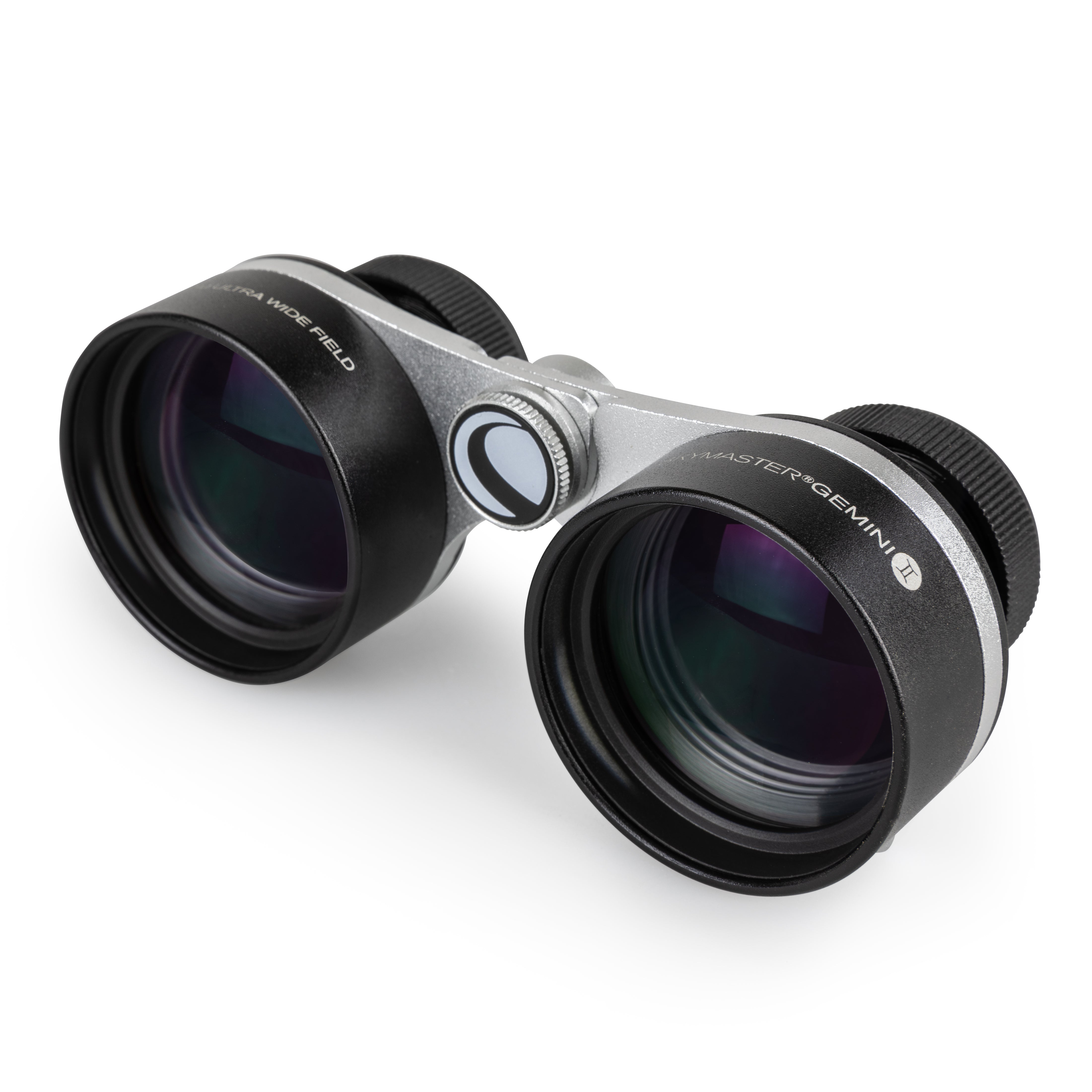
The SkyMaster Gemini 2x40 is the sole exact 2x match, with a manufacturer-listed 24° real field and 6.8 oz body. It suits broad-scene context, not distant detail; its individual-eyepiece focus and IPX4 water resistance are important limits for anyone expecting a conventional waterproof field binocular.
Explore the needs this model fits
Your needs, this model
Does it fit your priorities?
Do you want a 2x binocular with the exact page's 24-degree true field?
The item 71010 table lists 2x, a 24-degree true field and 1,260 ft at 1,000 yd (420 m at 1,000 m). It is suited to wide-scene context, not fine distant detail.
Explore this need in the finder →Must a 40 mm low-power instrument include tripod support hardware?
Celestron lists a tripod adapter among the exact product's included items. The tripod is separate.
Explore this need in the finder →Is 10 mm of stated eye relief sufficient for your use?
The page lists 10 mm. A 12 mm minimum excludes this model; the number alone does not establish comfortable full-field viewing through every pair of glasses.
Explore this need in the finder →Is a waterproof rating essential, or is a stated IPX4 water-resistant instrument acceptable?
The exact page lists Water Resistant (IPX4), not waterproof. A waterproof-essential requirement correctly excludes it.
Explore this need in the finder →The Celestron SkyMaster Gemini 2x40 (item 71010) is an unusually low-power, ultra-wide binocular for taking in a broad sky or scene, not for pulling a distant bird or player into close detail. Its listed 2x magnification and 24-degree true field make it a different tool from the standard 7x–10x pairs most people picture. The exact page gives a 6.8-ounce weight and 40 mm objectives; Celestron’s page was marked out of stock when checked on October 23, 2026, so availability should be verified rather than assumed.
What a 2x view is for
At only two power, the Gemini enlarges a subject less than ordinary 7x, 8x or 10x binoculars. The compensation is breadth: Celestron lists a 24-degree angular field and 1,260 feet at 1,000 yards (420 metres at 1,000 metres). That is an unusually expansive framing for scanning star patterns, following a broad meteor shower, or keeping a large performance or landscape in view. The manufacturer also positions it for concerts and sports. These are manufacturer specifications and use cases, not results from a lab or from my own observing.
The broad field is most valuable when locating or tracking is more important than magnified detail. If your purpose is identifying a small bird across a marsh, reading a distant sign, or isolating a player, 2x is likely too little. A conventional 8x or 10x pair provides more apparent reach, though it frames a much smaller real scene. The Gemini is not a zoom: there is no lever to trade field width for power.
Large objectives, tiny carry weight
Forty-millimetre objectives on a body Celestron lists at 6.8 ounces are an unusual combination. The published 20 mm exit pupil is the arithmetic result of 40 mm divided by 2x, not a promise that every observer receives a 20 mm-wide beam or a brighter image. The observer’s own pupil limits how much light enters the eye, and no specification can replace a real comfort check. The low magnification should also be easier to hold steadily than 10x or 15x power, but the company does not list image stabilization, and I have not measured shake or brightness.
The exact table lists a 10 mm eye relief. Do not treat the generous exit pupil as proof that this will work well over glasses: eye relief is a separate fit dimension, and the product page does not establish full-field viewing with every frame. Its 56–72 mm interpupillary adjustment and -5 to +3 diopter range are useful fit details, but an essential glasses requirement calls for trying the eyecups and field in person if possible.
Focus and included support
This is a Galilean design, not a roof- or Porro-prism model; the exact page lists prism glass as not applicable. There is no central focus wheel. The page and the item-71010 quick setup guide describe individual focusing, so set each eyepiece for your eye separately. The guide’s practical sequence starts with both eyepieces fully extended, covers one objective, focuses the visible side on a distant target, then switches the cap and repeats for the other eye. It also asks you to align the bridge for a comfortable combined view. This is not the familiar center-wheel-plus-right-diopter routine used by many conventional binoculars.
Celestron lists a 6.6-foot close focus, 56–72 mm interpupillary range, 122 × 39 × 47 mm dimensions, and water resistance rated IPX4. Water resistant is not waterproof: do not treat this as an immersion-ready instrument or leave it exposed to heavy weather. The listed box contents include a case, neck strap, objective covers, eyepiece cover, lens cloth, and tripod adapter. A tripod is not listed as included; the adapter lets you add support for a static view. The quick guide says the instrument is intended for people 14 and older.
When another binocular is the better choice
Choose a familiar 8x or 10x if a single pair must serve for wildlife identification and general distance viewing. For a brighter-looking low-power astronomy option with substantially more magnification, compare Celestron’s SkyMaster Pro ED 7x50; it is a larger, heavier Porro binocular and needs a separately acquired adapter for its tripod connection. For a pocket daytime pair, the 8x21 UpClose G2 is a more conventional higher-power alternative, but its scene is far narrower. None of these ordinary binoculars is safe for looking at the Sun; the Gemini’s own quick guide warns that doing so can cause permanent eye damage.
In the chooser, select 2x, 40 mm, and a broad real field if the goal is a wide, low-power view. A request for 10x, a waterproof rating, or at least 12 mm eye relief should reject this model. A tripod-adapter-in-the-box filter can retain it, but that does not mean a tripod comes in the package. Celestron’s exact product title says SkyMaster Gemini 2x40, while its page-linked image bears the wording “Gemini II”; the linked setup guide identifies item 71010 but does not explain that naming difference. The image is therefore shown as the manufacturer page’s associated image, not proof of a separate version.
Key specifications
Key details at a glance
| Magnification | 2× |
|---|---|
| Objective diameter | 40 mm |
| Real field of view | 24° |
| Field width at 1,000 m | 420 m |
| Eye relief | 10 mm |
| Exit pupil | 20 mm |
More specifications and setup details
| Close focus distance | 6.6 ft |
|---|---|
| Manufacturer-published weight | 6.8 oz |
| Lens and prism coatings | The exact page calls the optics fully multi-coated. It lists prism glass and prism coatings as N/A; no prism-material or roof/Porro-prism claim is assigned. |
| Water and fog protection | The exact table says Water Resistant (IPX4), not waterproof. No immersion depth or duration is stated. |
| Tripod use | The exact page and guide list a tripod adapter in the package. A tripod itself is not listed as included; no tripod-head thread measurement is claimed. |
| Published weight note | Exact manufacturer listed product weight; included accessories are not added to the number. |
| Package contents | The product page names a case and a cloth hard-shell zippered case; the quick guide says carrying case with wrist strap. This is recorded as one case, without inferring a duplicate case. |
| Manufacturer-rated waterproof | No |
| Tripod adapter in package | Yes |
Use the exact model’s instructions for operating limits, supplied equipment and version differences.
Sources for this review
Sources for this assessment
- Official Celestron US SkyMaster collection product JSON, 28 product objects
- SkyMaster Gemini 2x40 Binoculars, item 71010
- Celestron SkyMaster Gemini 2x40 item 71010 five-language quick setup guide
- Celestron product image linked from exact item 71010 page
- CPSC exact item-number ProductName query attempt for Celestron item 71010; provider returned an error object
- CPSC Recalls Retrieval API re-query for Celestron item 71010 and model-family terms
Choose your optical trade-off first.
Choose viewing purpose first, then magnification, objective size, scene width and any fit, weather or mounting constraint. A direct-Sun requirement is separate: only exact manufacturer-confirmed solar binoculars can pass it.
Your needs, this model
40 mm binoculars: ultra-wide 2x or conventional 8x
Choose it when: Pick the Gemini for a very broad, low-power sweep. Its 24° real field and 6.8 oz listed weight distinguish it from the conventional 8x40; the viewing task is wide context rather than distant detail.
40 mm binoculars: ultra-wide 2x or conventional 8x →A true 2x binocular for broad-scene context
Choose it when: This is the exact 2x40 configuration returned for the request. Its very broad published real field and low listed mass suit scanning a large scene when keeping context matters more than enlarging a small distant subject.
A true 2x binocular for broad-scene context →