
On this page
An exact 12x60 with long close-focus distance
The SkyMaster 12x60 is the exact 60 mm choice, with a 5.3° real field and a 39.2 oz listed weight. It is tripod adaptable only with a separate adapter; the maker’s water-resistant wording does not establish waterproofing.
Explore the needs this model fits
Your needs, this model
Does it fit your priorities?
Do you want the exact standard SkyMaster 12x60 configuration?
Item 71007 is fixed at 12x with 60 mm objectives and a published 5.3° real field. It is the lowest-power, lightest instrument in this six-model standard SkyMaster comparison, but it is still a large binocular.
Explore this need in the finder →Is 39.2 oz at or under your maximum instrument-weight limit?
Celestron lists the bare 71007 binocular at 39.2 oz. That is below the listed weights of the standard 15x70, 20x80, 25x70, 25x100 and 15–35x70, but the carrying kit is heavier.
Explore this need in the finder →Must a tripod adapter be included rather than bought separately?
The exact 71007 page says the binocular is tripod adaptable and its adapter is sold separately. A plan that requires an adapter in the standard package should exclude this model.
Explore this need in the finder →Would a 59 ft closest-focus limit be too distant for your subjects?
The exact 71007 page lists closest focus at 59 ft. That is unsuitable if a feeder, garden details or other nearby subjects are essential.
Explore this need in the finder →The Celestron SkyMaster 12x60 (item 71007) is a large Porro binocular aimed at steady, distant viewing rather than a quick grab-and-go walk. Its fixed 12x power, 60 mm objectives and listed 39.2 oz body make it the lightest of the standard SkyMaster configurations covered here, but it still benefits from support. The important package detail is easy to miss: the exact page says an adapter is sold separately, so the 12x60 is tripod-adaptable without including the binocular-side adapter.
What the 12x60 changes
Celestron lists a 5.3° real field, or 278 feet at 1,000 yards. That is more view width than the higher-power SkyMaster models, useful when acquiring a distant landmark or sweeping a patch of sky. Twelve power is less demanding than 25x, but it still magnifies hand motion far more than a conventional 8x or 10x pair. Treat this as a position-and-observe instrument: a solid place to rest your arms helps, while an adapter and stable tripod are the more deliberate choice for prolonged astronomy or extended-distance viewing.
The manufacturer table gives a 5 mm exit pupil and a relative-brightness index of 25. Those are listed specifications, not measurements of the view under your sky, your eyes, or your conditions. Larger objectives do not make every scene brighter by themselves, and the 12x image still has more apparent motion than a low-power binocular. The meaningful choice is the combination of a wide-for-this-family field, 12x magnification and a still-large body—not a promise of a particular visual result.
Plan for the missing adapter
The included-items list names a lens cap, rainguard, nylon case, neck strap, cloth and manual. The product page separately says an adapter is sold separately. No exact adapter part number is stated on that page, so do not buy a mount accessory based only on a picture or assume that a tripod is in the box. If the question in the finder says the adapter must be included, this configuration should not pass that essential condition. If optional buying is acceptable, verify that the separately acquired adapter is actually compatible with the 71007 before ordering.
Once mounted, the shared English SkyMaster manual describes how to set the hinge for your interpupillary distance, focus the left side with the center wheel, set the right-eyepiece diopter, and use the center wheel for later distance changes. It also covers eyecup position and tripod mounting. The page lists a diopter range of -4 to +8 and 17 mm eye relief; neither figure guarantees comfortable spectacle use for every face. Try the eye position with your own glasses if keeping your spectacles on is essential.
Distance, weather and handling limits
A listed closest focus of 59 feet rules out feeder viewing, flowers and other nearby subjects. The table calls the exterior protection “Water Resistant,” but says the binocular is not nitrogen-filled; it gives no waterproof, fogproof or immersion rating. Plan for dry conditions and cover it if weather turns. The page identifies BaK-4 Porro prisms and Multi-Coated optics. It does not confirm ED glass, phase coating or dielectric coating, so those must not be inferred from the SkyMaster family name.
At 39.2 oz, this is easier to carry than the standard 15x70 at 48 oz, the 25x70 at 52 oz, the 15–35x70 zoom at 53 oz, the 20x80 at 75 oz, or the 25x100 at 140 oz. But a 39.2 oz instrument is not a pocket pair, and a separate tripod plus adapter changes the packed system. If you set a strict maximum weight, use the listed bare-binocular figure rather than treating it as the weight of the complete kit.
How the Used Outlet listing changes the decision
Celestron also lists this configuration under used-condition SKU U71007. Its US listing points back to original item 71007 for the full product details, and repeats the 12x60 specification and package table. Celestron describes its used stock as inspected and in working order and says the same comprehensive warranty applies. That is the maker’s general policy statement, not an independent report about a particular pair or a promise about its cosmetic condition. The listing was marked out of stock when checked on October 24, 2026. Its linked image is a standard product illustration, not documentation of an individual used unit. Keep U71007 as a condition/listing variant rather than treating it as another optical model or a current buying option. If “used only” is essential, this dated listing does not establish an available fit; if your need is the 12x60 optical layout, judge the base 71007 on its own merits and verify the specific listing before purchase.
Who should choose another configuration?
Choose the 12x60 when you want the 12x/60 mm configuration, value its 5.3° field and lower instrument weight within this large-aperture family, and can source the correct adapter if a tripod is part of the plan. A fixed 15x70 gives more reach, a narrower 4.4° field and an adapter listed in its package. The 20x80 raises power and weight again. The 25x70 and 25x100 are much more demanding at high power; the latter is a prepared, heavy support setup. For moving wildlife, nearby subjects, rain exposure or a genuinely light travel kit, look beyond standard SkyMaster sizes.
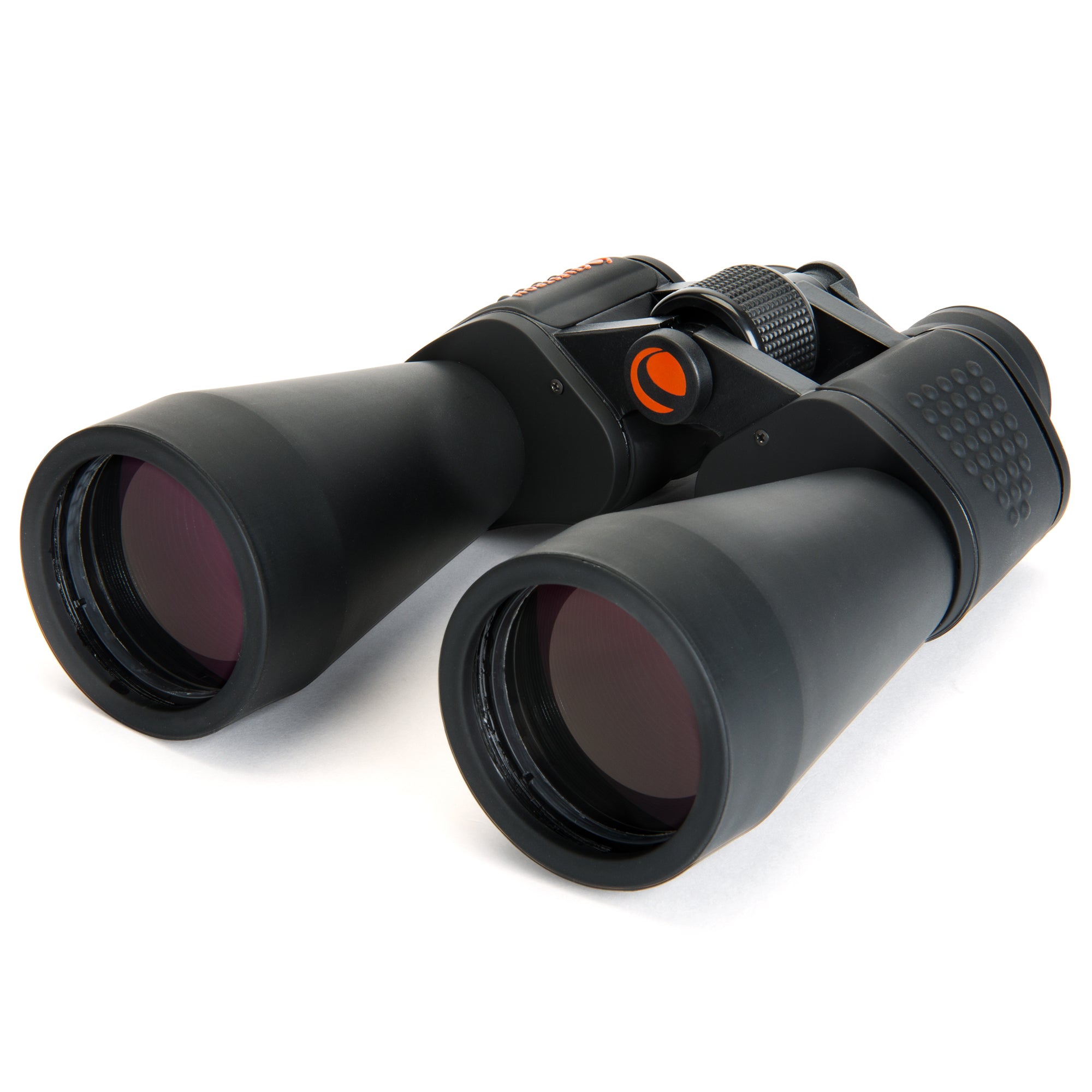
Celestron warns never to look at the Sun through this ordinary binocular or project sunlight through it. The page-linked official image shows the SkyMaster body, but it contains no legible 71007 marking and Celestron does not disclose whether the image is a photograph or rendering. The image therefore illustrates the exact page-linked model without independently proving the power. A dated exact-number CPSC query returned an empty result; that narrow check is not a guarantee against differently named or later notices.
Exact-model sources: Celestron SkyMaster 12x60 item 71007, its Used Outlet SKU U71007 listing, and the SkyMaster Series manual linked from the exact product page.
Key specifications
Key details at a glance
| Magnification | 12× |
|---|---|
| Objective diameter | 60 mm |
| Real field of view | 5.3° |
| Field width at 1,000 m | 92 m |
| Eye relief | 17 mm |
| Exit pupil | 5 mm |
More specifications and setup details
| Close focus distance | 59 ft |
|---|---|
| Manufacturer-published weight | 39.2 oz |
| Lens and prism coatings | Celestron describes the exact optics as Multi-Coated and identifies BaK-4 Porro prisms. The page does not confirm ED glass, phase or dielectric coatings, or that every optical surface is fully multi-coated. |
| Tripod use | The exact page says this 71007 is tripod-adaptable but that its adapter is sold separately; the tripod is also separate. The linked series manual describes mounting once a compatible adapter is acquired. |
| Manufacturer-rated waterproof | No |
| Tripod adapter in package | No |
Use the exact model’s instructions for operating limits, supplied equipment and version differences.
Sources for this review
Sources for this assessment
- Celestron exact US product page for item 71007
- Five-language SkyMaster Series manual linked from exact item 71007 page
- Dated CPSC ProductName API query for exact item 71007
- Celestron US general binocular collection page 1; exact model card linked to item 71007
- Celestron Used Outlet exact US listing for item U71007
Choose your optical trade-off first.
Choose viewing purpose first, then magnification, objective size, scene width and any fit, weather or mounting constraint. A direct-Sun requirement is separate: only exact manufacturer-confirmed solar binoculars can pass it.
Your needs, this model
60 mm binoculars: the exact 12x60 match
Choose it when: It is the only exact 60 mm match in the current reviewed set and gives a larger-objective, fixed 12x alternative to the 50 and 70 mm classes.
60 mm binoculars: the exact 12x60 match →