
On this page
Your needs, this model
Does it fit your priorities?
If the discontinued 9x60 is unavailable, would you accept a separate 12x60 SkyMaster instead?
The 12x60 item 71007 is a different, more highly magnified model; it is not an optical clone and lacks the PopSci phone kit, but it can be a current comparison if you relax the exact 9x60 request.
Explore this need in the finder →Is the phone adapter and shutter essential, or can a current 12x60 without the kit work?
71023 includes a phone adapter and Bluetooth shutter, but it is discontinued. If the accessories are essential, current matching may return nothing. If they are optional, 71007 offers a different 12x60 profile without that bundled phone kit.
Explore this need in the finder →Would you relax from the exact 21 mm stated eye relief to a current 42 mm pair with at least 18 mm listed relief?
The 71023 page says 21 mm, but the model is discontinued and glasses fit depends on face and frame. A current 42 mm profile with a confirmed 18 mm or greater figure may be a practical alternative, though it is not the same 9x60 configuration.
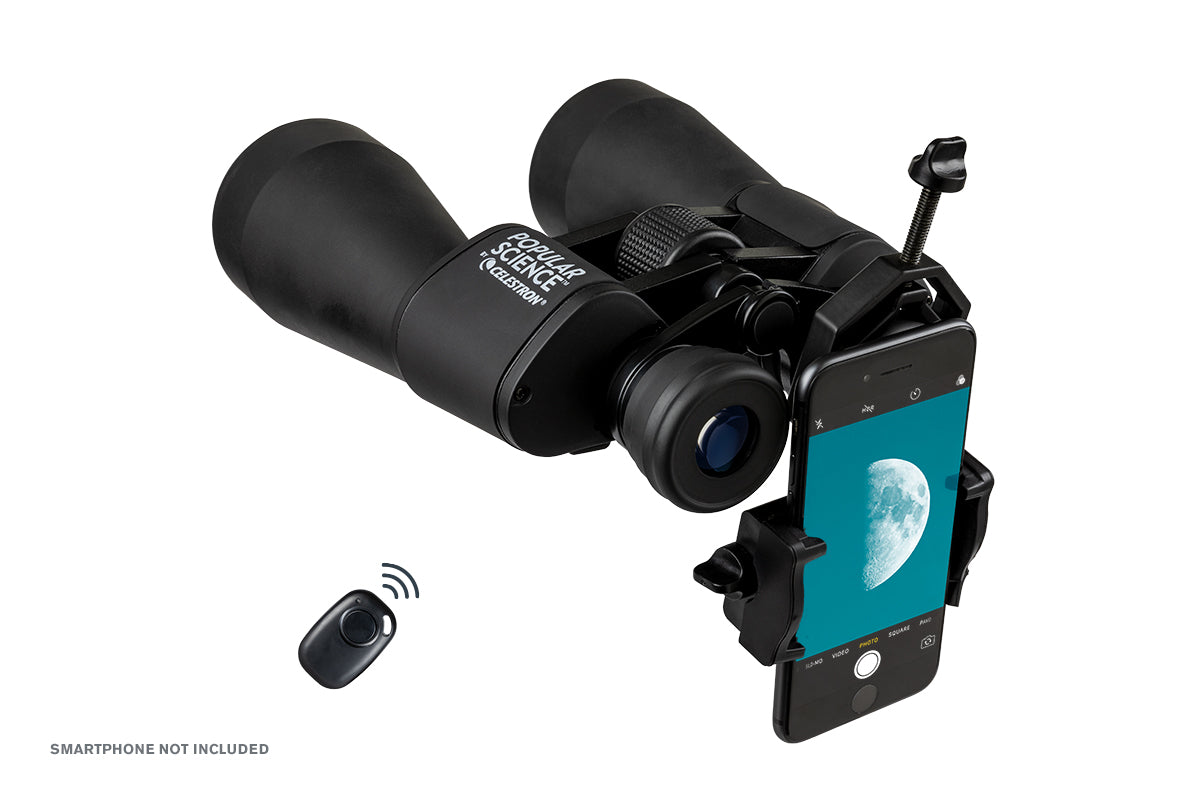
Explore this need in the finder →Celestron’s Popular Science by SkyMaster 9x60 (item 71023) is a discontinued reference pair, not a current buying recommendation. Its distinguishing package was an eyepiece-clamped smartphone adapter and Bluetooth shutter remote supplied with a 9x60 Porro binocular. That accessory difference is real, but the manufacturer’s published field figures conflict, and the exact U.S. page now says out of stock.
What the 9x60 designation means
Nine-power magnification is a lower hand-held power than a 12x60, while the 60 mm objective diameter remains the same. Celestron lists a 6.7 mm exit pupil. That is a large nominal light bundle on paper, not a measured guarantee of twilight brightness: the observer’s eye, alignment, coatings, sky conditions and the instrument itself all affect the view. The pair weighs 39.2 oz (1,111 g) before its case, phone, adapter and other carried items. It is not a pocket binocular, and a phone attached to the eyepiece adds handling risk.
There is a source problem that should change how you compare it. Celestron’s specification table lists a 5.5° angular field, 263.2 feet at 1,000 yards and 96.0 metres at 1,000 metres. Those linear numbers do not convert to each other, and neither agrees precisely with the angular figure. I retain the published values but do not promote one as a corrected field measurement. The 21 mm eye relief and 38 ft closest focus are also manufacturer-listed figures, not independent measurements. Celestron does not provide a verified optical test here.
The phone kit has practical conditions
The exact product page lists the smartphone adapter and Bluetooth shutter release among included items. The six-page, item-specific Celestron manual explains the workflow: first establish a sharp binocular view, clamp the phone adapter to the eyepiece, align the phone camera over the eyepiece, then retune focus if needed. Its instructions say flat phone-case surfaces are important; folio cases, raised rings, stands and grips can prevent a good fit. Celestron warns not to carry the binocular with the phone adapter attached because a bump could dislodge the phone.
The remote pairs as “GBshutter” through the phone’s Bluetooth settings and triggers a phone camera shutter; the manual also describes starting and stopping video. It uses a CR2032 battery, which the manual says is included and not rechargeable. This is a way to record a view through the eyepiece, not evidence of astrophotography quality or a replacement for a dedicated camera. The phone is not included, and phone width, case shape, camera-lens placement and the user’s ability to align the camera remain practical constraints.
Support and weather still matter
At nearly 2.5 pounds, 9x may be easier to hold steadily than a higher-power 12x under otherwise similar conditions, but the large body is still a lot to carry and the manufacturer does not claim stabilization. For long sessions, Celestron says it is tripod-adaptable. The exact model manual describes a built-in threaded socket under a cap; a separate binocular tripod adapter screws into it and attaches to a photographic tripod. The listed carton includes no such tripod adapter. Do not confuse that mount fitting with the phone adapter included in the box.
Celestron calls the body water resistant, but does not publish an immersion depth or duration and does not say it is nitrogen-filled. That is not a waterproof or fogproof rating. The manual covers center focus, right-eye diopter adjustment, hinge/IPD alignment and folding the eyecups down for eyeglasses; its 21 mm eye-relief specification is not a guarantee that every frame sees the entire field. The manual also says never to look at the Sun through this binocular, and the product is intended for users aged 14 or older.
How it differs from the standard 12x60 SkyMaster
The standard SkyMaster 12x60 item 71007 shares the 60 mm aperture and the 39.2 oz published body weight, but has a different purpose. Twelve-power magnification offers more apparent reach and typically demands steadier support; Celestron lists 17 mm eye relief and 59 ft close focus for 71007, versus 21 mm and 38 ft for 71023. The 71007’s exact page lists a 5.3° field and a tripod adapter sold separately. It does not include the PopSci phone-adapter/remote kit. The 71023’s field conflict means I would not declare one model wider based on the disputed numbers.
The U71023 used listing is the same optical profile
Celestron also lists Used Outlet item U71023 and links it to original item 71023. The used page repeats the same 9x60/60 mm optics and accessories, so this is a condition variant of the same optical design. Celestron says used units are gently used, inspected and in full working order, with the same comprehensive warranty; that is a seller claim, not an examination of an individual copy. The listing showed out of stock when checked. Its image is the same base-model graphic, not a photo of a particular used unit; verify condition and included parts if the listing returns. Neither listing is a current pick.
Keep 71023 for identification, not availability
The exact Celestron collection record classifies SKU 71023 as discontinued and unavailable, and the U.S. product page says out of stock. If you already own one, match the item number, check the collimation and focus before using it, inspect the phone clamp and remote, and verify that any used package actually retains its listed accessories. Celestron’s manual directs repairs to the manufacturer or a qualified binocular repairer and warns against opening the optics.
If you need a current pair, do not treat 71007 or a generic phone adapter as identical substitutes. Choose the actual magnification, objective size, weight and support plan you need; the finder will not return discontinued 71023 as a buyable model. This assessment preserves its distinct package and handling details while leaving the inconsistent field figures unresolved.
Key specifications
Key details at a glance
| Magnification | 9× |
|---|---|
| Objective diameter | 60 mm |
| Real field of view | 5.5° |
| Field width at 1,000 m | 96 m |
| Eye relief | 21 mm |
| Exit pupil | 6.7 mm |
More specifications and setup details
| Close focus distance | 38 ft |
|---|---|
| Manufacturer-published weight | 39.2 oz |
| Lens and prism coatings | Exact page calls the optics multi-coated and specifies BaK-4 prisms; it does not establish ED, phase or dielectric coatings, or full multi-coating of every optical surface. |
| Manufacturer-rated waterproof | No |
| Included smartphone eyepiece adapter confirmed | Yes |
| Included Bluetooth shutter confirmed | Yes |
| Tripod adapter in package | No |
Use the exact model’s instructions for operating limits, supplied equipment and version differences.
Sources for this review
Sources for this assessment
- Celestron exact US product page for Popular Science by Celestron SkyMaster item 71023
- Celestron SkyMaster collection product object for item 71023
- Celestron instruction manual, model 71023, 9x60 binocular with smartphone adapter and Bluetooth remote
- Celestron SKU-specific page-linked image for item 71023
- CPSC exact item-number ProductName query for 71023
- Celestron exact US Used Outlet listing for item U71023, linked to original item 71023

Choose your optical trade-off first.
Choose viewing purpose first, then magnification, objective size, scene width and any fit, weather or mounting constraint. A direct-Sun requirement is separate: only exact manufacturer-confirmed solar binoculars can pass it.