
On this page
Your needs, this model
Does it fit your priorities?
Does the ED 12x50 provide 12x/50mm viewing with ED glass and a 14 mm eye-relief minimum?
Yes. The exact item page identifies ED glass and gives 14.3 mm eye relief.
Explore this need in the finder →Does ED 12x50 reach a nine-foot close-focus limit and fit a 29 oz ceiling?
Yes. Celestron publishes an 8.2 ft close focus and 28.4 oz body weight.
Explore this need in the finder →Does the 12x ED model satisfy waterproofing without requiring a tripod adapter in the box?
The model is listed as waterproof, but its included-items list does not include the separately sold adapter.
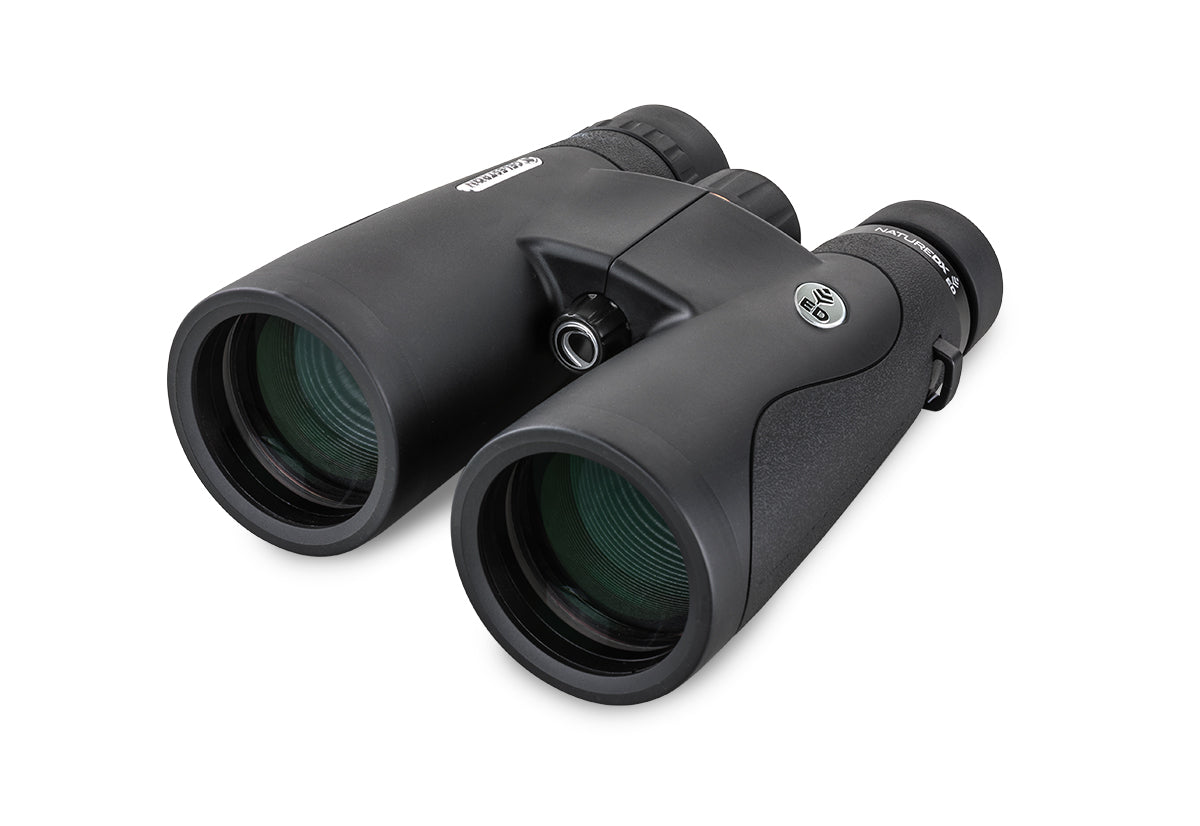
Explore this need in the finder →Nature DX ED 12x50 item 72336 is the strongest-magnification ED roof configuration in this four-model Celestron family. It is intended for a viewer who accepts a relatively narrow field and wants 12x reach with a 50 mm objective and ED glass. Its 28.4 oz weight, 4.8° field and 14.3 mm stated eye relief make it a specialized handheld option rather than an automatic all-day birding choice.
12x reach comes with a narrower scene
Celestron publishes 12x magnification, 50 mm objective lenses, a 4.8° angular field and 252 ft at 1,000 yd / 84 m at 1,000 m. The listed exit pupil is 4.1 mm, consistent with the approximate 50 mm divided by 12 magnification. The closest focus is 8.2 ft. Those figures can suit distant stationary subjects, but 12x enlarges hand movement as well as the subject. When scanning along a shoreline, following birds in flight or locating a small subject in foliage, the smaller field may slow acquisition. A tripod adapter can help for long fixed viewing, but the adapter is separate and the binocular has no stated built-in stabilization.
Compared with ED 10x50 item 72335, the ED 12x50 has a narrower listed field (4.8° versus 5.9°), shorter eye relief (14.3 versus 17.8 mm) and the same listed 28.4 oz weight. It brings more magnification, but not a lighter pack or an easier glasses fit. Compared with standard item 72326, this ED model publishes 252 ft versus 246 ft and 14.3 mm versus 14 mm of eye relief; its specification table gives a ±3 diopter range, where standard 72326 lists ±4. Celestron does not explain those small profile differences. They belong to the exact model pages; they do not establish a generation hierarchy or an independent optical winner.
What ED means here
The product page calls out ED (extra-low-dispersion) objective glass, fully multi-coated optics and phase-coated BaK-4 prisms. Celestron describes ED glass as reducing chromatic aberration or color fringing, particularly at edges and in dim conditions. That is a manufacturer account of its design, not an independently measured promise about how much improvement a buyer will see. A shopper who requires the ED feature can filter for it; someone who does not should compare the 12x standard version and its distinct support/fit specifications. The model is not stabilized, and ED glass does not prevent blur from a moving hand, poor atmospheric conditions or missed focus.
Eye relief, build and weather limits
At 14.3 mm, its stated eye relief is somewhat longer than the standard 12x50’s 14 mm, but still shorter than the 10x50 options. The eyecups twist through positions; glasses wearers should lower them and check whether their eye can reach the exit pupil without losing the edges. The listed interpupillary range is 63–74 mm. The ED manual explains the hinge adjustment, center-focus and right-eye diopter sequence; this page specifies ±3 diopters. Celestron also lists a rubber-armored polycarbonate housing, waterproof construction and nitrogen fill. It does not publish depth or immersion duration, so do not use the waterproof term as a diving specification.
The 163 × 135 × 61 mm body and 806 g mass are the exact manufacturer values. The package list includes strap, objective caps, rainguard, case, lens cloth and manual, but not a binocular tripod adapter. The ED manual shows that an adapter is needed to attach the threaded body socket to a photographic tripod. Before a purchase, check the adapter and support hardware separately if your main use is a fixed observation point or astronomy. For routine care, the manual says to use lens caps when idle, store the optics cool and dry, protect moving parts from impact, and remove dust before wiping the lenses. Celestron’s Sun warning is categorical: never view or project the Sun through this optic.
How filters should change your answer
Choosing 12x and 50 mm includes this model. A waterproof requirement is supported; a 9 ft closest-focus ceiling accepts its 8.2 ft specification, but 7 ft does not. An ED-required choice keeps it and excludes standard 72326. A minimum of 14 mm eye relief includes its published figure; a 17 mm minimum excludes it. A maximum weight of 29 oz keeps it, while 27 oz does not. A wide-real-field requirement of at least 6° and an adapter-in-box requirement both exclude it. These answer changes follow the model’s documented limits rather than assumptions about its optical quality.
Consider this model if higher magnification is truly the priority and you can brace your arms or add separately purchased support. The ED 10x50 72335 is the more forgiving 50 mm ED choice for broader scene coverage and longer stated relief. The standard 12x50 72326 preserves the 12x reach without an ED designation and has its own 4.7° field and 14 mm relief, but note its manufacturer table’s inconsistent exit-pupil line. If you are undecided between reach and comfort, test hand-holding and eye placement in person if practical; specifications alone cannot forecast your steadiness or glasses fit.
Exact item 72336 specification: Celestron Nature DX ED 12x50 product page. Setup, cleaning and safety: Celestron Nature DX ED series manual.
Key specifications
Key details at a glance
| Magnification | 12× |
|---|---|
| Objective diameter | 50 mm |
| Real field of view | 4.8° |
| Field width at 1,000 m | 84 m |
| Eye relief | 14.3 mm |
| Exit pupil | 4.1 mm |
More specifications and setup details
| Close focus distance | 8.2 ft |
|---|---|
| Manufacturer-published weight | 28.4 oz |
| ED glass confirmed for this exact model | Yes |
| Phase coatings confirmed | Yes |
| Lens and prism coatings | Celestron lists ED objective lenses, fully multi-coated optics and phase-coated BaK-4 prisms on the exact ED page. ED is a manufacturer-described glass configuration, not a measured performance result. |
| Water and fog protection | Celestron lists waterproof construction and nitrogen fill. Exact page gives no depth/duration for submersion; do not treat the rating as an underwater-use specification. The relevant series manual advises dry storage and lens protection. |
| Tripod use | The exact page lists tripod adaptability and states the binocular adapter is sold separately. The series manual illustrates attaching an adapter to a photo tripod. The standard included-items list does not name the adapter. |
| Published weight note | Celestron publishes 28.4 oz (806 g) and dimensions [163, 135, 61] mm. The dimensions are an unlabeled tuple; no measurement axes or packed-weight adjustment are inferred. |
| Manufacturer-rated waterproof | Yes |
| Tripod adapter in package | No |
Use the exact model’s instructions for operating limits, supplied equipment and version differences.
Sources for this review
Sources for this assessment
Choose your optical trade-off first.
Choose viewing purpose first, then magnification, objective size, scene width and any fit, weather or mounting constraint. A direct-Sun requirement is separate: only exact manufacturer-confirmed solar binoculars can pass it.