
On this page
Your needs, this model
Does it fit your priorities?
What lighter 8x42 choices replace the old 8x56 for walking?
Nature DX 8x42 item 71332 is listed at 22.2 oz, well below the discontinued 8x56’s 36.2 oz; the smaller aperture is a different compromise.
Explore this need in the finder →Which current 8x42 models focus at 7 ft or closer?
Several current Nature DX/TrailSeeker 8x42 models list close focus around 6.5–7 ft. An 18 oz carry cap rejects full-size 8x42s.
Explore this need in the finder →Can a 12x56 remain below 37 oz if a 56 mm objective matters?
Nature DX 12x56 item 71336 is listed at 36.2 oz. It shares the objective size but not the 8x magnification or handling.
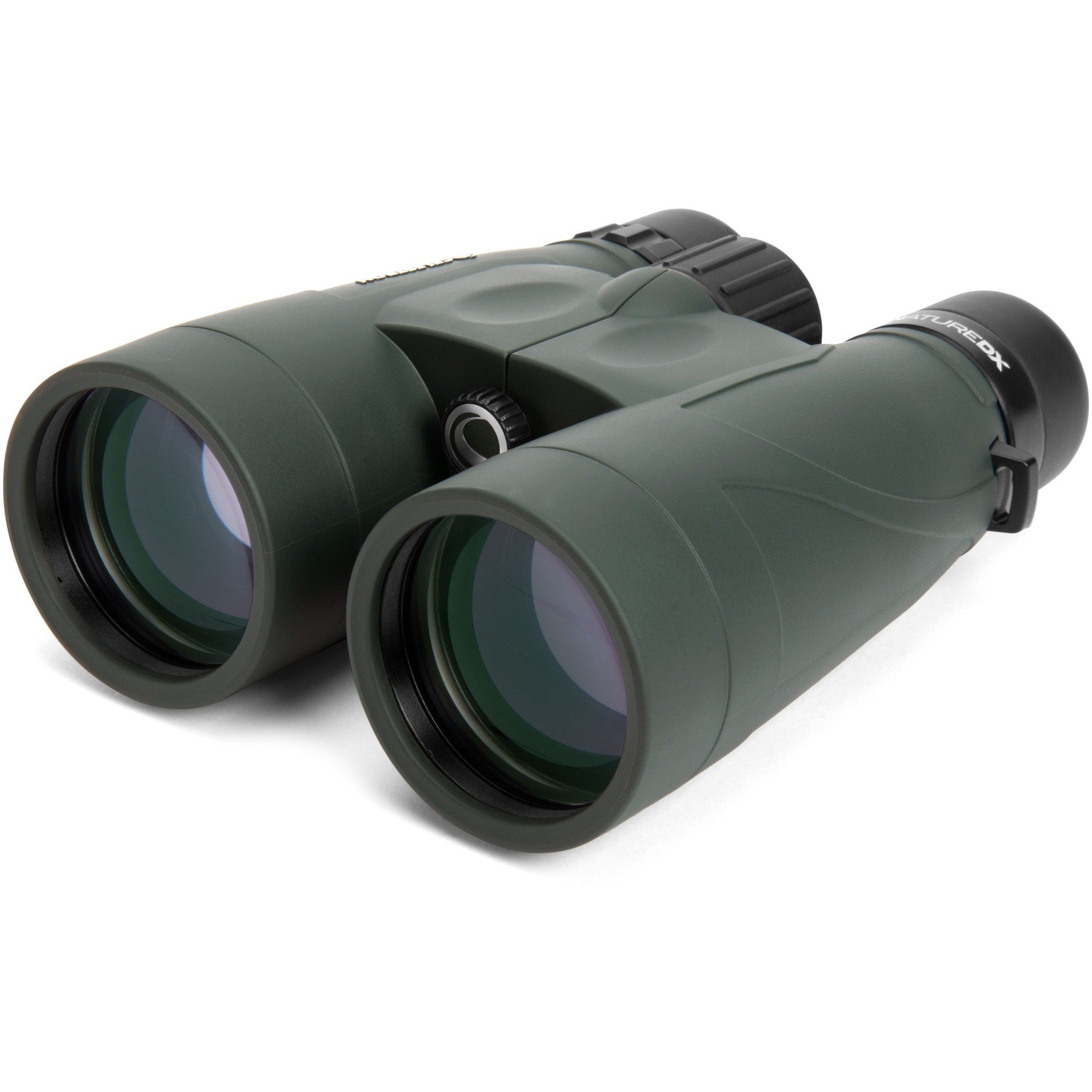
Explore this need in the finder →The Nature DX 8x56 item 71334 is a discontinued Celestron roof binocular built around modest 8x magnification and unusually large 56 mm objectives. The exact page lists a 7 mm exit pupil, 23 mm eye relief and weight of 36.2 oz. Those figures describe a large, substantial instrument, not a light general-purpose pair. Celestron’s collection metadata calls item 71334 discontinued and its exact product page shows it out of stock, so this review is for identifying an existing pair and weighing its design against current alternatives rather than recommending it as a new purchase.
What the 8x56 format is trying to do
At 8x, this model is less demanding of hand steadiness than a 10x56, while a 56 mm objective and 7 mm exit pupil make the body large. A broad exit pupil can make eye positioning less exact for some viewers, but it does not guarantee a brighter or sharper view: the observer’s eye, the light, internal transmission, focus and optical condition all matter. The 36.2 oz listing is the more decisive everyday constraint. Carrying it for a long walk or holding it overhead at a game may matter more than its low-light marketing language suggests.
The product table lists fully multi-coated optics, phase-coated BaK-4 roof prisms and waterproof/nitrogen-filled construction. Celestron does not specify an immersion depth or duration; do not treat the waterproof label as permission to use the binocular underwater. The exact page lists a 9.8 ft close-focus distance, which is adequate for many nearby outdoor subjects but not a specialized close-up optic. It also lists ±4 diopter compensation and 56–74 mm interpupillary adjustment.
Read the field numbers carefully
The 71334 specification table labels 6.1° as “Apparent Field of View,” then gives “320 ft (107 m) @1000 yds/m.” These labels do not form a clean, conventional real-field statement: the apparent-angle label and the linear width do not match a straightforward wide apparent-view interpretation. Preserve the table wording instead of silently relabeling 6.1° as true field or using the 107 m value as a normalized comparison. The manufacturer does not explain this presentation. This profile therefore does not make a strict real-field claim for 71334.
That uncertainty is not the only reason to avoid using the old number as a shortcut. A 56 mm pair can show more of a dim scene than a smaller objective under suitable conditions, but actual image quality depends on the condition and alignment of the individual instrument. The exact page makes no independent bench-test claim. A used specimen can also have collimation, coating, fungus, haze or mechanical issues that no product-page specification predicts.
Mounting and wearing the instrument
Celestron marks the model tripod adaptable. The Nature DX series manual describes access to a tripod thread under the hinge logo plate and attachment through a separate binocular adapter. The archived 71334 specification table does not enumerate carton contents, so it does not establish whether any adapter or other accessory was included with a particular package. If a long stationary watch is part of the plan, verify the actual adapter and tripod separately rather than assuming tripod adaptability means everything needed is in the box. The heavy body makes support especially practical for extended sessions.
The 23 mm eye-relief figure is comparatively generous on paper, but a number cannot guarantee a full field for every eyeglass frame. Lower the twist-up eyecups for glasses and check the view with the exact pair. For setup, the series manual says to align the hinge for one merged image, focus the left eye using the center wheel, then set the right-eye diopter while looking at the same distant subject. Keep the protective caps on between uses, remove grit before wiping, and store the unit dry. Never point it at the Sun or project sunlight through it.
Questionnaire choices and present-day alternatives
If you choose an 8x56 objective class and a generous exit pupil, the reference item explains that preference but does not become a current buying result. Current Nature DX 8x42 item 71332 is much lighter at a listed 22.2 oz, while the current-reference Nature DX 12x56 item 71336 preserves a 56 mm objective with a different power and field. Neither is an optical duplicate of the old 8x56. If the large aperture matters but 36 oz is too much to carry, try the current 10x50 Nature DX 72325 or another documented 50 mm model; lowering objective size changes the viewing trade-off.
A maximum-weight answer of 25 or 30 oz should reject 71334 outright, not pass it because the magnification is only 8x. If an answer allows a separate adapter and a stationary setup, tripod use remains possible for an individually verified specimen, but the instrument itself is not made lighter. The product page’s incomplete real-field wording should also prevent a hard “wide scene” requirement from relying on its 6.1° line.
For an existing 71334, the page and shared manual help identify the configuration and explain its operation. For a used example, test the hinge, focus, diopter, both barrels and image alignment individually; the manufacturer’s general used-item inspection statement is not a unit-level condition report. This is an older reference, not a promise of seller stock, accessory completeness or a warranty on a secondhand instrument.
Exact identity and published figures: Celestron Nature DX 8x56 item 71334. Operation and care: Celestron Nature DX series manual.
Key specifications
Key details at a glance
| Magnification | 8× |
|---|---|
| Objective diameter | 56 mm |
| Apparent field of view | 6.1° |
| Eye relief | 23 mm |
| Exit pupil | 7 mm |
| Close focus distance | 9.8 ft |
More specifications and setup details
| Manufacturer-published weight | 36.2 oz |
|---|---|
| ED glass confirmed for this exact model | No |
| Phase coatings confirmed | Yes |
| Lens and prism coatings | Manufacturer lists fully multi-coated optics and phase-coated BaK-4 roof prisms; this is not an independent transmission or resolution test. |
| Water and fog protection | Waterproof/fogproof/nitrogen wording does not set an underwater depth or time. Protect optics per the Nature DX family manual. |
| Tripod use | The exact page calls the model tripod adaptable; the family manual shows the required separate binocular adapter. It is not in the 71328, 71329 or 71335 Included Items list; the 71334 page does not enumerate box contents. |
| Published weight note | Celestron lists 36.2 oz (1026 g); manufacturer specification, not independent packed-weight measurement. |
| Manufacturer-rated waterproof | Yes |
Use the exact model’s instructions for operating limits, supplied equipment and version differences.
Sources for this review
Sources for this assessment
- Celestron dedicated Nature DX collection products JSON, 26 objects, limit 250
- Celestron Nature DX collection page 2 archived shell; row grid blank
- Celestron exact US item 71334 product page
- Celestron Nature DX five-language series manual, English operating/care section
- Celestron Nature DX quick setup guide, English section
- CPSC exact item ProductName query 71334; empty result only
Choose your optical trade-off first.
Choose viewing purpose first, then magnification, objective size, scene width and any fit, weather or mounting constraint. A direct-Sun requirement is separate: only exact manufacturer-confirmed solar binoculars can pass it.