
On this page
Your needs, this model
Does it fit your priorities?
Will a current 8x25 fit a 12 oz carry ceiling?
The former 71328 weighs 12.1 oz and is discontinued. Current 8x25s are the practical alternatives; tighten the carry cap to 10.5 oz and neither currently documented option qualifies.
Explore this need in the finder →Which compact 8x25 focuses within 10 ft?
The old 71328 page lists 6.5 ft but is no longer eligible. Among current options, Nikon Trailblazer II lists 8.2 ft; Celestron Outland X 8x25 lists 16.4 ft.
Explore this need in the finder →Can a current 8x25 meet a 9 mm eye-relief threshold when 71328 is conflicted?
The exact old page claims 14 mm in its table and 17.5 mm in text, so use neither as a hard guarantee. Current alternatives list their own values; with an 11 mm minimum, these two compact choices do not pass.
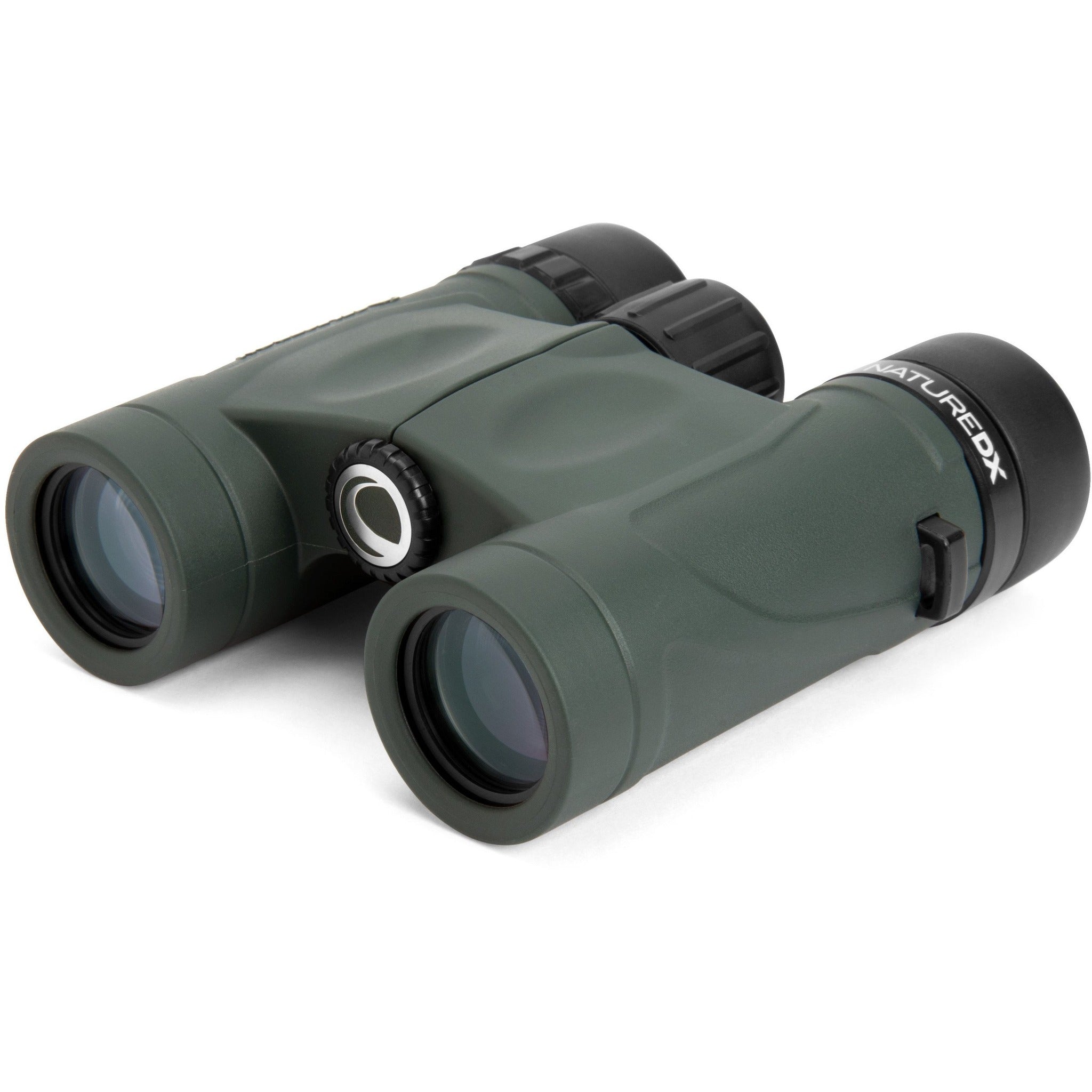
Explore this need in the finder →The Celestron Nature DX 8x25 item 71328 is an older compact roof-prism binocular: fixed 8x magnification, 25 mm objectives, a 12.1 oz listed weight and a 7.2° angular-field claim on its exact product page. Its small folded package and broad-for-this-size view explain the appeal, but the maker now labels the product discontinued and the direct page says out of stock. This review helps identify and assess an existing or secondhand pair; it is not a recommendation to buy a discontinued 71328.
A pocket-size format with an 8x view
The 8x25 combination favors finding and following a nearby bird or performer more than extracting a highly magnified view of a distant subject. At 8x, hand movement is generally less intrusive than with the 10x25 sibling, and Celestron lists a 7.2° angular field. Its table also prints “378 ft (126 m) @ 1,000 yds.” The imperial width at 1,000 yards and metric width at the same stated distance do not convert to each other; keep the two values as printed rather than using 126 m in a precise field-width comparison. The 8x25 has a 3.1 mm exit pupil, still a small-aperture format rather than a full-size dusk instrument.
Celestron lists a 25 mm objective, fully multi-coated optics, BaK-4 roof prisms and phase coatings. Those are manufacturer specifications, not independent image-quality measurements. The housing is described as rubber-armored polycarbonate; the product table lists waterproof and nitrogen-filled construction. No immersion depth or duration is stated, so “waterproof” should not be translated into an underwater-use promise.
Fit details need a real check
The item page gives an unusual fit conflict. Its specification table says 14 mm eye relief, while its feature copy says “17.5 mm.” Because those are meaningfully different for a glasses wearer, do not treat either as a reliable hard-fit guarantee for item 71328. The table lists a 56–72 mm interpupillary range and says the body is tripod adaptable. The shared Nature DX manual explains that the hinge must be adjusted to merge the two images and that the eyecups can be set for glasses; it does not resolve this SKU’s contradictory eye-relief claims or guarantee an individual face fit.
Focus is listed at 6.5 ft, useful when looking at a close feeder or plant as well as across a field. The direct page lists the binocular, neck strap, objective caps, rainguard, case, lens cloth and instruction manual. The series manual shows that a separate binocular tripod adapter is used between the threaded binocular and a photo tripod; that adapter is not in the page’s included-items list. A compact pair can be carried easily, but a long stationary watch still calls for a stable support plan.
What the smaller objective gives up
The listed 12.1 oz weight and 111 × 115 × 42 mm dimensions make this notably easier to pack than a 42 or 56 mm Nature DX. The 25 mm objective is also the limit: its 3.1 mm exit pupil and 8x power do not guarantee a bright image in deep shade or at dusk. A current 8x42 such as Nature DX item 71332 is larger and listed at 22.2 oz, but its 42 mm objective gives a different light-gathering and eye-positioning envelope. Choose based on how often the pair will actually be carried, not on a claimed “bright” view alone.
Against the 10x25 sibling, the 8x25 presents the wider published angle and a larger exit pupil while keeping the same listed weight. The 10x version gives more magnification but a narrower 6° angular field and a 2.5 mm exit pupil. The exact item pages do not establish that either compact model is a universal substitute for a larger binocular; they make different compromises within a very portable class.
How questionnaire answers change the comparison
If you select an 8x, 25 mm pair and a 12 oz carry ceiling, this discontinued SKU should remain out of current buying results. Current Celestron Outland X 8x25 item 71340 and Nikon Trailblazer II 8x25 are the more appropriate current comparisons; they are separate models, not relabeled Nature DX units. A close-focus requirement of 10 ft separates the Trailblazer II’s published 8.2 ft from the Outland X’s 16.4 ft. If eyeglass eye relief is essential, neither compact alternative should be assumed to pass without checking its own exact specification and a real fit.
This page is most useful when the printed item number on a pair or box reads 71328, or when considering a used instrument whose exact condition can only be checked unit by unit. Celestron’s standard used-item wording is general handling policy, not an inspection report for a particular pair. Verify collimation, hinge tension, focus movement, lens condition and the accessories actually offered before evaluating an individual used example. Do not infer that an old retail price or a current third-party listing describes the condition of the specimen in front of you.
Exact identity and specifications: Celestron Nature DX 8x25 item 71328. Setup and care: Celestron Nature DX series manual.
Key specifications
Key details at a glance
| Magnification | 8× |
|---|---|
| Objective diameter | 25 mm |
| Real field of view | 7.2° |
| Exit pupil | 3.1 mm |
| Close focus distance | 6.5 ft |
| Manufacturer-published weight | 12.1 oz |
More specifications and setup details
| ED glass confirmed for this exact model | No |
|---|---|
| Phase coatings confirmed | Yes |
| Lens and prism coatings | Manufacturer lists fully multi-coated optics and phase-coated BaK-4 roof prisms; this is not an independent transmission or resolution test. |
| Water and fog protection | Waterproof/fogproof/nitrogen wording does not set an underwater depth or time. Protect optics per the Nature DX family manual. |
| Tripod use | The exact page calls the model tripod adaptable; the family manual shows the required separate binocular adapter. It is not in the 71328, 71329 or 71335 Included Items list; the 71334 page does not enumerate box contents. |
| Published weight note | Celestron lists 12.1 oz (343 g); manufacturer specification, not independent packed-weight measurement. |
| Manufacturer-rated waterproof | Yes |
| Tripod adapter in package | No |
Use the exact model’s instructions for operating limits, supplied equipment and version differences.
Sources for this review
Sources for this assessment
- Celestron dedicated Nature DX collection products JSON, 26 objects, limit 250
- Celestron Nature DX collection page 2 archived shell; row grid blank
- Celestron exact US item 71328 product page
- Celestron Nature DX five-language series manual, English operating/care section
- Celestron Nature DX quick setup guide, English section
- CPSC exact item ProductName query 71328; empty result only
Choose your optical trade-off first.
Choose viewing purpose first, then magnification, objective size, scene width and any fit, weather or mounting constraint. A direct-Sun requirement is separate: only exact manufacturer-confirmed solar binoculars can pass it.