
On this page
Your needs, this model
Does it fit your priorities?
Does the standard Nature DX 12x50 offer waterproof use and an 8.2-foot listed close focus?
Yes. The exact page lists waterproof construction and an 8.2 ft close-focus distance.
Explore this need in the finder →Does item 72326 meet a 14 mm eye-relief minimum and a 29 oz carry ceiling?
Celestron lists 14 mm eye relief and 28.4 oz, which meet those stated limits without promising a universal glasses fit.
Explore this need in the finder →Does the standard 12x50 meet a 17 mm eye-relief or in-box adapter requirement?
No. Its page gives 14 mm eye relief and lists the tripod adapter as an optional accessory, not an included item.
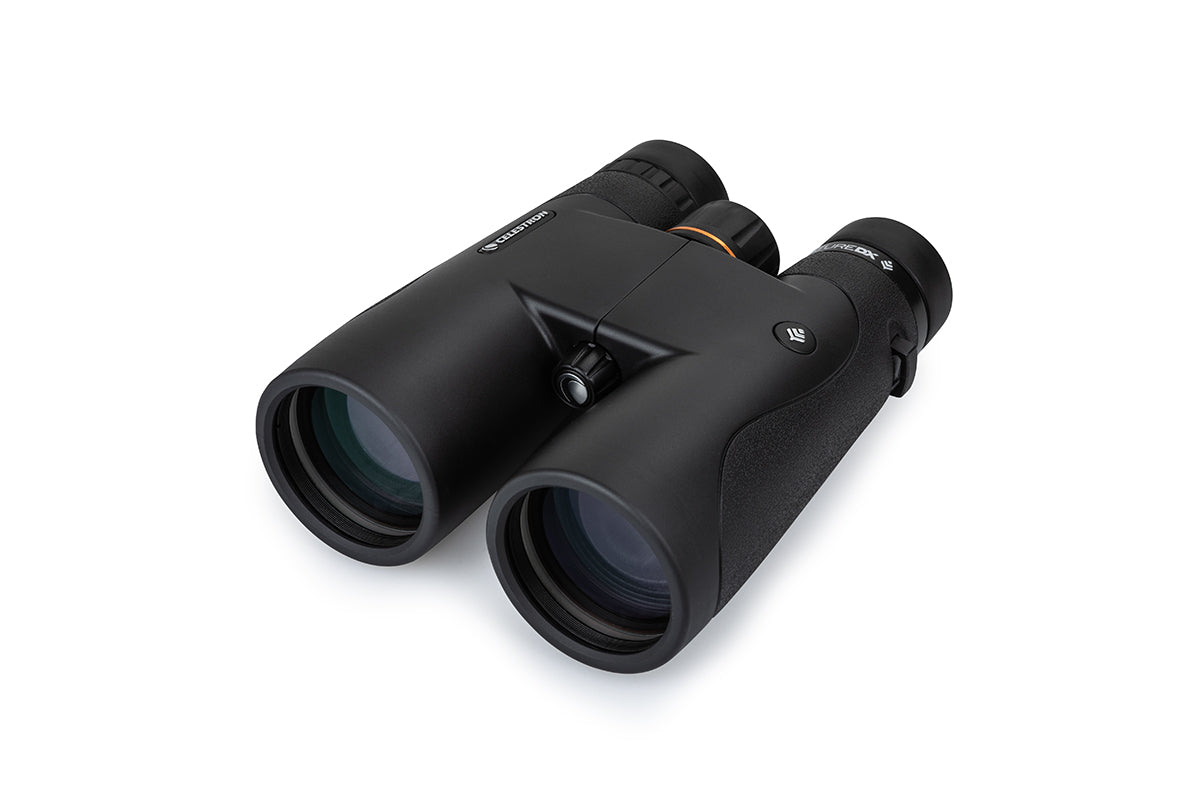
Explore this need in the finder →The Celestron Nature DX 12x50 item 72326 is the standard, non-ED member of this family with the most magnification among the four 50 mm roof models covered here. It makes sense when the subject is distant and relatively stable and you value extra apparent reach over a broad, easy-to-sweep scene. The trade is not subtle: its 4.7° field is the narrowest of the four, and the 28.4 oz body has no image stabilization.
Reach, field and a specification conflict worth knowing
The exact Celestron page lists 12x magnification, 50 mm objectives, a 4.7° field, 246 ft at 1,000 yd (75 m at 1,000 m), 14 mm eye relief and an 8.2 ft close-focus distance. Celestron’s specification table labels the exit pupil as 5 mm, but that conflicts with the stated magnification and objective: 50 divided by 12 gives about 4.2 mm. The same table’s relative-brightness value of 16.81 is consistent with about a 4.1 mm exit pupil, not 5 mm. I therefore use roughly 4.2 mm only as the geometric calculation and preserve the published 5 mm as a manufacturer-table inconsistency, not as a verified comfort or low-light advantage.
The narrower field is a more direct practical decision point. Compared with the 10x50 models, this 12x shows less of the scene at once, so acquiring a small bird in a busy canopy or following a fast-moving subject may take more work. The higher magnification also makes ordinary hand tremor more visible. A tripod can help for extended viewing, but it does not come built in: the series manual shows a separate binocular adapter between the threaded socket and a photo tripod, and the product page says the adapter is sold separately. If you want one carry-anywhere pair for mixed birding and travel, the standard 10x50 or a more compact 8x42 is a safer starting comparison.
Optical and body configuration
This is a standard Nature DX, not the ED item 72336. Celestron lists fully multi-coated optics and phase-coated BaK-4 prisms. The ED version adds documented extra-low-dispersion objective lenses and a 4.8° field, with 14.3 mm of stated eye relief. Both 12x50 items share the same listed 28.4 oz weight, 163 × 135 × 61 mm body, 63–74 mm interpupillary range and 8.2 ft closest focus. Both are tripod adaptable with a separate adapter. The standard 12x50 lists ±4 diopter adjustment; the ED 12x50 lists ±3. The manufacturer does not explain why the ranges differ, so treat them as model-specific published values rather than assuming one version is a revision of the other.
The 14 mm eye-relief number is relatively short compared with the 10x50 siblings. Celestron describes twist-up eyecups with several positions and calls the design eyeglass-friendly, but fit depends on the observer’s frames and eye position. If you wear glasses, keep the cups lowered, align your eyes, and check that you see the whole field. A 17 mm minimum removes both 12x50 versions from a result; it does not make the 10x50s universally comfortable, only better supported by their stated eye-relief numbers.
Weather, care and the package
Celestron lists waterproof construction and nitrogen filling for the standard model. No submersion depth or duration is specified, so “waterproof” should not be read as a permission to dive with it. The included-items list names caps, rainguard, strap, padded nylon case, lens cloth and manual; the tripod adapter is not on that list. The standard Nature DX manual gives useful routine steps: set the IPD before focusing, focus the left barrel with the center wheel, then set the right-eye diopter; use the caps when storing; remove dust before rubbing a lens; and keep the instrument dry and away from excessive heat. The exact manual is a series document, while the optical specifications above come from the item 72326 page.
Sun safety is absolute. Celestron warns not to look directly at the Sun through the binocular or to project an image of the Sun. The large objectives collect concentrated light; this product is not a solar viewer.
Where this model belongs in a shortlist
Choose 12x and 50 mm if the viewing role really calls for that combination. A waterproof requirement is supported; an 8.2 ft maximum close-focus distance of 9 ft works, but a 7 ft threshold does not. A 14 mm eye-relief minimum and 29 oz maximum weight are met exactly or better; an 18 mm eye-relief minimum or 27 oz weight ceiling excludes it. A required ED element rules out 72326, as does requiring a tripod adapter in the box. Its field is below 6°, so any “wide real field” requirement also excludes it. These are useful boundaries rather than quality grades: the model should match an operating plan, not every observer.
For the same 12x50 format with ED listed, compare item 72336 and inspect the separate 14.3 mm relief and 4.8° field; the small changes do not remove the normal hand-held steadiness issue. For a wider field and longer listed eye relief within Nature DX 50 mm, compare the 10x50 standard or ED products. If your use is prolonged astronomy or a fixed observation point, plan for a compatible adapter and tripod from the outset rather than treating mounting as an in-box feature. If the main need is scanning wildlife on foot, an 8x42 alternative can be much easier to acquire and hold steadily.
Exact identity, item number and published specifications: Celestron Nature DX 12x50 item 72326 product page. Setup and care: Celestron Nature DX series manual.
Key specifications
Key details at a glance
| Magnification | 12× |
|---|---|
| Objective diameter | 50 mm |
| Real field of view | 4.7° |
| Eye relief | 14 mm |
| Exit pupil | 4.2 mm |
| Close focus distance | 8.2 ft |
More specifications and setup details
| Manufacturer-published weight | 28.4 oz |
|---|---|
| ED glass confirmed for this exact model | No |
| Phase coatings confirmed | Yes |
| Lens and prism coatings | Celestron lists fully multi-coated optics and phase-coated BaK-4 prisms on the exact standard Nature DX page. This item is not labeled ED; no comparative optical measurement is inferred. |
| Water and fog protection | Celestron lists waterproof construction and nitrogen fill. Exact page gives no depth/duration for submersion; do not treat the rating as an underwater-use specification. The relevant series manual advises dry storage and lens protection. |
| Tripod use | The exact page lists tripod adaptability and states the binocular adapter is sold separately. The series manual illustrates attaching an adapter to a photo tripod. The standard included-items list does not name the adapter. |
| Published weight note | Celestron publishes 28.4 oz (806 g) and dimensions [163, 135, 61] mm. The dimensions are an unlabeled tuple; no measurement axes or packed-weight adjustment are inferred. |
| Manufacturer-rated waterproof | Yes |
| Tripod adapter in package | No |
Use the exact model’s instructions for operating limits, supplied equipment and version differences.
Sources for this review
Sources for this assessment
- Celestron Nature DX US collection page 1; exact linked product row observed
- Celestron US exact Nature DX product page, item 72326
- Celestron Nature DX five-language manual; English operations and care pages personally inspected
- CPSC exact item-number ProductName query; empty JSON array on 2026-10-23
- Celestron Nature DX QSG; English IPD/center focus/right-eye diopter section personally inspected
Choose your optical trade-off first.
Choose viewing purpose first, then magnification, objective size, scene width and any fit, weather or mounting constraint. A direct-Sun requirement is separate: only exact manufacturer-confirmed solar binoculars can pass it.