
On this page
Your needs, this model
Does it fit your priorities?
What lighter current 10x50 choices fit a 30 oz ceiling?
Nature DX 10x50 item 72325 is listed at 28.4 oz; the discontinued 10x56 weighs 36.3 oz and is not eligible for recommendations.
Explore this need in the finder →Is any current 10x56 under a 37 oz cap confirmed?
No current profile is confirmed for the exact 10x56 combination in this authored library; discontinued 71335 must remain excluded even at its listed weight.
Explore this need in the finder →Can a current 12x56 stay below 37 oz if power can change?
Nature DX 12x56 item 71336 is listed at 36.2 oz; higher magnification changes steadiness and field compared with the old 10x56.
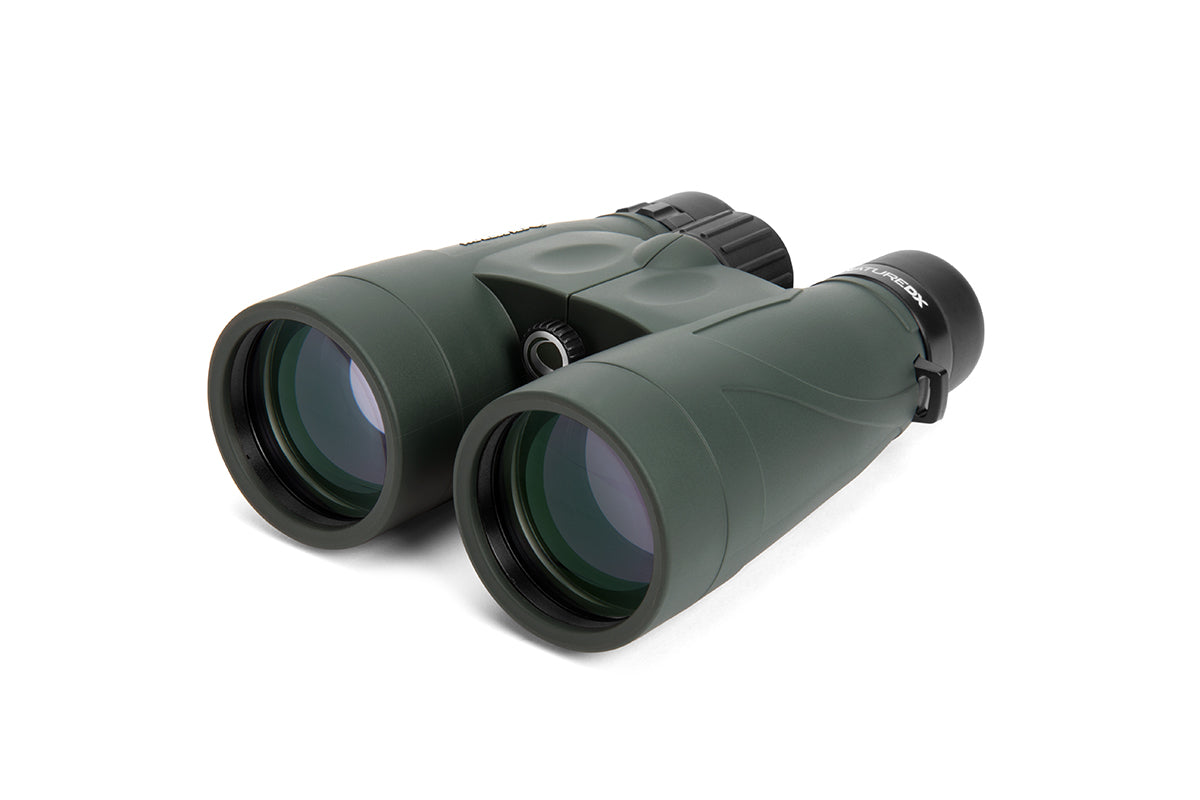
Explore this need in the finder →Celestron Nature DX 10x56 item 71335 is a discontinued, full-size roof binocular with 10x magnification, 56 mm objectives and a listed weight of 36.3 oz. Its exact product page publishes a 6.0° angular field, 5.6 mm exit pupil and 18.2 mm eye relief. This gives a more specific field description than the related old 8x56 listing, but the substantial weight is still a central decision. Celestron’s collection data classifies 71335 as discontinued and the exact page says out of stock; this review is a useful reference for an existing instrument, not a present-day recommendation.
More reach, but not a lighter 56 mm binocular
Compared with an 8x56, ten-power magnification brings more apparent subject detail at a distance but makes hand movement easier to notice. The 5.6 mm exit pupil comes from the 56 mm objective and 10x power. That is a different eye-positioning and light-use compromise from the 8x56’s listed 7 mm exit pupil, not a numerical score for real-world brightness. The 10x56 has a 6.0° angular-field listing and a separate field line of 315 ft (105 m); Celestron labels the linear field at 1,000 yards / 1,000 metres. The pair of units is reasonably understood as two distance conversions, not as a new measured test.
Celestron lists BaK-4 glass, phase-coated prisms, fully multi-coated lenses, waterproof construction and nitrogen fill. The exact page gives no immersion depth or duration, so use the protection wording as weather sealing rather than underwater capability. The 9.8 ft close-focus figure is a stated minimum distance, not an indication that this heavy 10x instrument is a macro-viewing tool. A 56 mm aperture does not erase the trade-offs of 10x magnification or the difficulty of locating a moving subject in a narrow scene.
Weight changes the operating plan
The exact table lists 36.3 oz (1,030 g) and 167 × 146 × 65 mm dimensions. It is less convenient for travel, long hikes or one-handed use than a 42 mm pair. For stationary viewing, Celestron marks the model tripod adaptable and the shared Nature DX manual explains the separate adapter needed to connect the binocular to a photographic tripod. The included items list does not name an adapter. A tripod can reduce the burden of holding a long 10x view, but it is an additional support component rather than a feature built into the optical image.
Eye relief is listed at 18.2 mm. This may be more promising for glasses than the two compact 25 mm models, whose exact page tables conflict with their feature text, yet an 18.2 mm value still cannot guarantee a full field for every frame. The twist-up eyecups are adjustable; test the eye position with glasses if a complete image is essential. Celestron also lists a 56–74 mm interpupillary range and ±3 diopter adjustment.
The box list names a neck strap, objective caps, rainguard, ballistic-style nylon case, lens cloth and instruction manual. The tripod adapter is separate. The series manual explains initial alignment and focus: merge the circles by adjusting the hinge, focus the left eye using the center wheel, set the right eye’s diopter on the same distant subject, and then use the center focus. It also recommends keeping the lenses capped and removing loose dust before wiping. Never look at the Sun through binoculars or project sunlight through them.
What different answers should do
An answer selecting 10x and 56 mm should not find this discontinued reference in a current shortlist, even if the technical values look attractive. A 30 oz maximum-weight answer should reject it: its published weight exceeds that ceiling by more than 6 oz. If 10x is essential but a 50 mm objective is acceptable, the separately reviewed Nature DX 10x50 item 72325 is listed at 28.4 oz. It is still not a tiny binocular, but it is materially lighter than the 56 mm model. A 10x42 may be more practical for walking and daylight use.
If the 56 mm objective is non-negotiable and a larger body is acceptable, the current-reference Nature DX 12x56 item 71336 shares the nominal aperture and similar listed weight, while increasing magnification and using a 5.5° field listing. It is not an equivalent substitute: the higher power changes handling, and neither model should be judged from nominal aperture alone. If 8x steadiness matters more than 10x reach, compare the separate Nature DX 8x56 item 71334, but its exact page’s field labels are less clear.
The finder should therefore treat this item as historical reference, not as a product that passes merely because the questionnaire asks for 10x and 56 mm. For an existing or used specimen, assess both barrels, diopter, focus travel, hinge and image alignment directly. Celestron’s generic Used Outlet description concerns its normal inspection approach; it does not certify an individual pair, tell you what accessories remain in its carton or promise current stock from a dealer.
Exact identity and specifications: Celestron Nature DX 10x56 item 71335. Operation and care: Celestron Nature DX series manual.
Key specifications
Key details at a glance
| Magnification | 10× |
|---|---|
| Objective diameter | 56 mm |
| Real field of view | 6° |
| Field width at 1,000 m | 105 m |
| Eye relief | 18.2 mm |
| Exit pupil | 5.6 mm |
More specifications and setup details
| Close focus distance | 9.8 ft |
|---|---|
| Manufacturer-published weight | 36.3 oz |
| ED glass confirmed for this exact model | No |
| Phase coatings confirmed | Yes |
| Lens and prism coatings | Manufacturer lists fully multi-coated optics and phase-coated BaK-4 roof prisms; this is not an independent transmission or resolution test. |
| Water and fog protection | Waterproof/fogproof/nitrogen wording does not set an underwater depth or time. Protect optics per the Nature DX family manual. |
| Tripod use | The exact page calls the model tripod adaptable; the family manual shows the required separate binocular adapter. It is not in the 71328, 71329 or 71335 Included Items list; the 71334 page does not enumerate box contents. |
| Published weight note | Celestron lists 36.3 oz (1030 g); manufacturer specification, not independent packed-weight measurement. |
| Manufacturer-rated waterproof | Yes |
| Tripod adapter in package | No |
Use the exact model’s instructions for operating limits, supplied equipment and version differences.
Sources for this review
Sources for this assessment
- Celestron dedicated Nature DX collection products JSON, 26 objects, limit 250
- Celestron Nature DX collection page 2 archived shell; row grid blank
- Celestron exact US item 71335 product page
- Celestron Nature DX five-language series manual, English operating/care section
- Celestron Nature DX quick setup guide, English section
- CPSC exact item ProductName query 71335; empty result only
Choose your optical trade-off first.
Choose viewing purpose first, then magnification, objective size, scene width and any fit, weather or mounting constraint. A direct-Sun requirement is separate: only exact manufacturer-confirmed solar binoculars can pass it.