
On this page
Your needs, this model
Does it fit your priorities?
Which current 10x25 models stay under a 12 oz carry cap?
The discontinued 71329 weighs 12.1 oz; the current Outland X and Trailblazer II 10x25 are each listed below 12 oz. At 10.5 oz, neither passes.
Explore this need in the finder →Which current 10x25 focuses within 12 ft?
The old 71329 description says 6.5 ft but the item is discontinued. Trailblazer II 10x25 lists 11.5 ft, whereas Outland X 10x25 lists 19.7 ft.
Explore this need in the finder →Which current 10x25 has at least 10 mm published eye relief?
The old 71329 relief values conflict. Among current 10x25 alternatives, Trailblazer II lists 10 mm while Outland X lists 9.1 mm; raising the requirement to 11 mm excludes both.
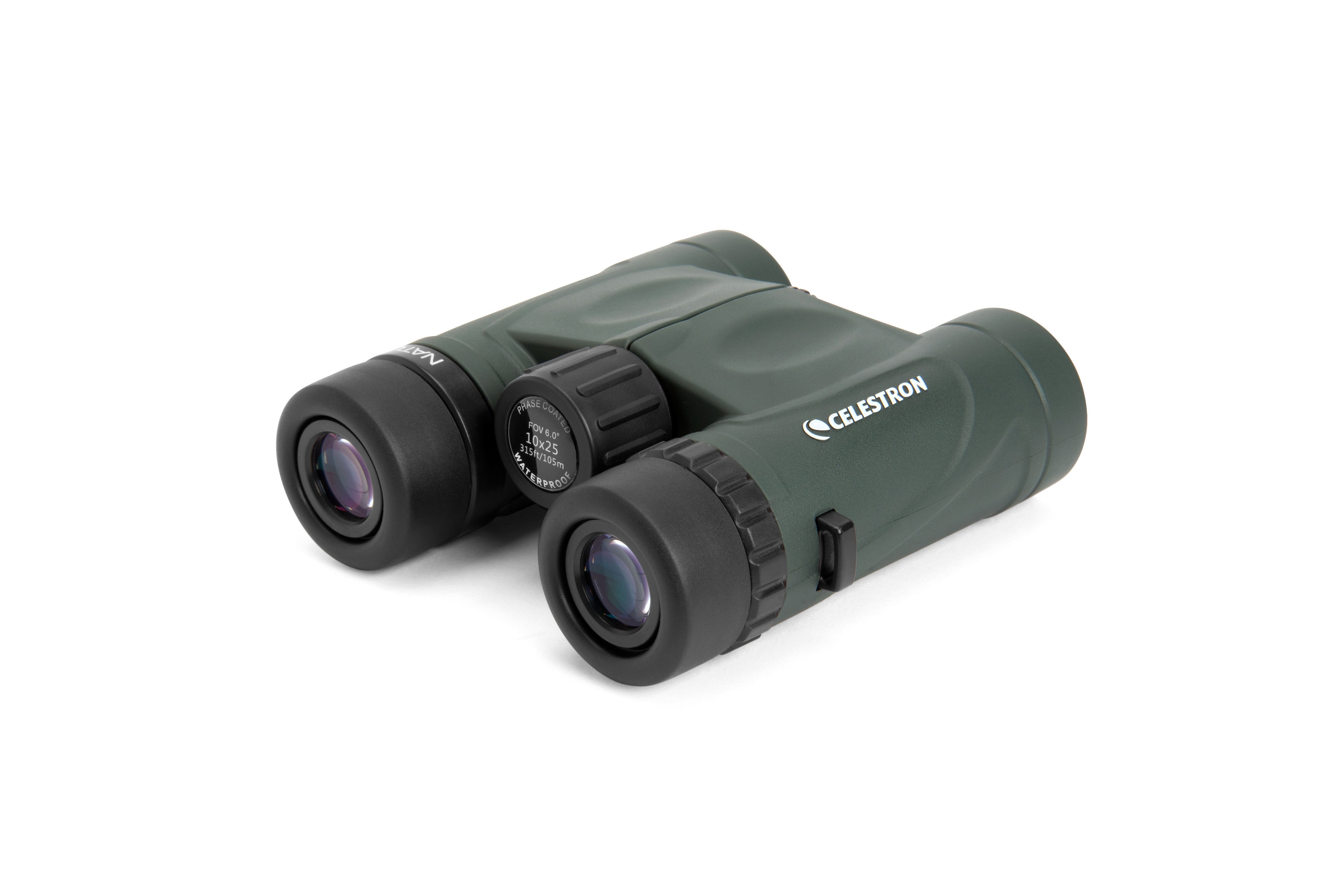
Explore this need in the finder →Celestron’s Nature DX 10x25 item 71329 is a discontinued compact roof binocular with fixed 10x power, 25 mm objectives and a manufacturer-listed weight of 12.1 oz. It suits someone identifying an older pair or comparing the trade-offs of a small 10x instrument, but Celestron’s collection data classifies this exact item as discontinued and its product page says out of stock. Treat this as an identification and reference review, not a current purchase recommendation.
More magnification in the same small objective size
The 10x25 has the same listed 25 mm objective, weight and body dimensions as the 8x25 model, but it asks for a steadier hold and shows a narrower portion of the scene. Celestron lists a 6° angular field for item 71329, compared with 7.2° for the 8x25. Its table does not publish a linear field width, so this review does not invent one or compare it as though it were printed on the page. For following a moving bird through branches, a wider scene and lower power may be easier to use; for reading detail at somewhat greater distance, 10x can be useful if the observer can keep the view steady.
The exit pupil is 2.5 mm, consistent with a 10x view through a 25 mm objective. This is a highly portable daylight-oriented size, not a promise of satisfying dusk performance. A larger objective or lower power may be preferable for prolonged low-light viewing, though it will take up more space. The specification table lists fully multi-coated optics and BaK-4 roof prisms. The product description also claims phase coatings; those are maker-published features, not a substitute for an independent comparison.
Eye relief is not settled by the page
On this exact item page, the specification table lists 14 mm eye relief, while the feature bullet says 17.5 mm. That discrepancy matters to a glasses wearer; do not treat either number as a dependable strict fit value for 71329. Celestron describes twist-up eyecups and the family manual shows how to lower the cups when using glasses, but individual facial geometry and eyeglass lenses still determine whether the full field is visible. If glasses are essential, try the exact instrument with them rather than assuming “eyeglass friendly” proves a complete view.
The exact page lists 6.5 ft close focus in descriptive copy, although its compact specification table omits a close-focus row. The feature is useful for nearby plants or details, but keep the omission visible in the evidence rather than pretending the number appears twice. The page lists 56–72 mm interpupillary adjustment and includes a strap, lens caps, rainguard, carrying case, cloth and instruction manual. The page identifies waterproof construction; its description says the family is fogproof and nitrogen-purged. No submersion rating is provided.
Carry weight, not low-light certainty
Celestron publishes 12.1 oz and dimensions of 111 × 115 × 42 mm. Those figures make the pair easier to take on a walk than a full-size 42 or 56 mm binocular. They do not tell you how long it remains comfortable in one hand, how sharp the image looks at the edge, or whether a particular used unit remains collimated. For a long watch, the shared Nature DX manual describes tripod mounting through a separate adapter; a tripod-adapter item is not on the listed contents. The 10x power can make support more valuable during prolonged stationary viewing.
The series manual supplies a useful initial setup sequence: bring the barrels together until there is one circle, focus the left side on a distant subject with the right lens covered, then adjust the right-eye diopter on that same subject. The manual also advises protecting the optics with caps, keeping the unit dry in storage and removing loose grit before cleaning. It warns never to look at or project the Sun through a binocular. Those are operating instructions for the series; they do not certify a used specimen’s condition.
When answers should point elsewhere
With 10x and 25 mm selected, a 12 oz maximum-weight answer may make current compact options worth comparing, but the discontinued 71329 itself must stay out of the current shortlist. Celestron Outland X 10x25 item 71341 and Nikon Trailblazer II 10x25 are distinct current references. Their published weights are about 11 oz and their own exact-page field, close-focus and eye-relief figures should govern a shopper’s choice. A close-focus ceiling of 12 ft favors the Trailblazer II’s 11.5 ft listing over the Outland X’s 19.7 ft; raising magnification does not solve close-focus needs by itself.
For a 10x option with a larger objective and a more forgiving exit pupil, compare a separately reviewed 10x42 or 10x50 rather than assuming 71329’s small body will behave like one. Nature DX 10x42 items 71333/72323 and the Nature DX 10x50 items are different configurations. They are heavier, but objective size changes the practical compromise. The right answer depends on the outing and carrying tolerance, not on a single magnification figure.
For an existing 71329 or an individually inspected used listing, this review clarifies the product’s small 10x format and its specification conflict. The maker’s Used Outlet inspection wording is general policy; it does not establish a particular pair’s lens condition, accessories, alignment or warranty transfer. Check the exact unit and its seller terms. Do not use the model’s former list price or third-party availability as proof that a current exact item is in stock.
Exact identity and specifications: Celestron Nature DX 10x25 item 71329. Series instructions: Celestron Nature DX binoculars manual.
Key specifications
Key details at a glance
| Magnification | 10× |
|---|---|
| Objective diameter | 25 mm |
| Real field of view | 6° |
| Exit pupil | 2.5 mm |
| Close focus distance | 6.5 ft |
| Manufacturer-published weight | 12.1 oz |
More specifications and setup details
| ED glass confirmed for this exact model | No |
|---|---|
| Phase coatings confirmed | Yes |
| Lens and prism coatings | Manufacturer lists fully multi-coated optics and phase-coated BaK-4 roof prisms; this is not an independent transmission or resolution test. |
| Water and fog protection | Waterproof/fogproof/nitrogen wording does not set an underwater depth or time. Protect optics per the Nature DX family manual. |
| Tripod use | The exact page calls the model tripod adaptable; the family manual shows the required separate binocular adapter. It is not in the 71328, 71329 or 71335 Included Items list; the 71334 page does not enumerate box contents. |
| Published weight note | Celestron lists 12.1 oz (343 g); manufacturer specification, not independent packed-weight measurement. |
| Manufacturer-rated waterproof | Yes |
| Tripod adapter in package | No |
Use the exact model’s instructions for operating limits, supplied equipment and version differences.
Sources for this review
Sources for this assessment
- Celestron dedicated Nature DX collection products JSON, 26 objects, limit 250
- Celestron Nature DX collection page 2 archived shell; row grid blank
- Celestron exact US item 71329 product page
- Celestron Nature DX five-language series manual, English operating/care section
- Celestron Nature DX quick setup guide, English section
- CPSC exact item ProductName query 71329; empty result only
Choose your optical trade-off first.
Choose viewing purpose first, then magnification, objective size, scene width and any fit, weather or mounting constraint. A direct-Sun requirement is separate: only exact manufacturer-confirmed solar binoculars can pass it.