
On this page
Minimum listed mass for a dry-weather child option
The Celestron Kids 4x30 is the sole exact 4x match and the 4.7 oz carry-first option in the child comparison, but its 4.3° field and 5 mm eye relief are narrower and shorter on paper than the Bantam's; minimum IPD, close focus and waterproofing are not established. Check actual eye position before choosing it.
Explore the needs this model fits
Your needs, this model
Does it fit your priorities?
Does this child-oriented 4x30 stay under five ounces?
Yes. Celestron lists 4.7 oz and markets the model for small hands; fit still depends on the user.
Explore this need in the finder →Would a six-millimeter eye-relief minimum fit this model?
No. The page lists 5 mm. That number does not predict a particular face or glasses fit.
Explore this need in the finder →Does the child-focused 4x30 satisfy a waterproof requirement?
Waterproofing is not confirmed for item 72044; it should not pass a waterproof-essential request.
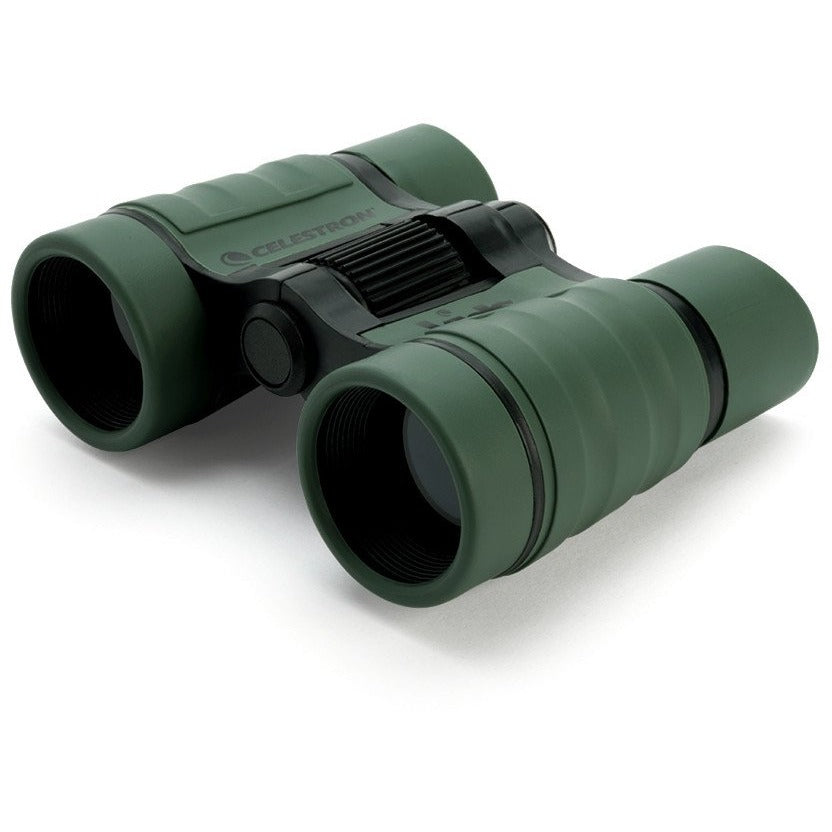
Explore this need in the finder →Celestron Kids 4x30 item 72044 is a small, low-power roof binocular marketed for young users. Celestron lists 4x magnification, 30 mm objectives, a 4.3° real field, 225 ft at 1,000 yards (68.58 m at 1,000 m), and a weight of 4.7 oz (133 g). The exact U.S. page and catalogue snapshot showed the item available on 2026-10-24. The manufacturer describes the size and controls as intended for small hands; that is a product-positioning claim, not a guarantee that every child can align or use it comfortably.
Four power prioritizes a small, forgiving-looking setup
The low 4x magnification makes a target appear much less enlarged than an 8x or 10x binocular. That also reduces the apparent movement from hand shake as a general optical consequence. A child trying binoculars for the first time may find it easier to locate a large, nearby scene than through higher-power glass, but this exact comfort outcome has not been independently tested. The model’s 4.3° field is relatively narrow in the real-angle terms listed here, so low magnification should not be mistaken for a wide panorama. Its 7.5 mm exit pupil is the 30 mm objective divided by four; that is a geometric size, not a brightness guarantee or a claim about what a child’s eye can use.
Celestron lists 5 mm eye relief, notably short beside full-size designs. People who wear glasses should not assume they can see the full field; if glasses must stay on, an adult should check the fit carefully before relying on this model. The manufacturer does not publish a close-focus number or an interpupillary range in the reviewed product table, and it does not give a numeric diopter adjustment. Those are unknowns, not evidence that the binocular will fit all faces or focus at a particular nearby distance.
What the small body does and does not include
The listed 4.7 oz instrument is far lighter than the roughly 27 oz Regal ED and Cometron models reviewed alongside it. The exact page lists a woven nylon case, strap and lens cloth; the strap is attached in the product description. That compactness is the practical distinction, not premium glass claims. Celestron lists the lens coating simply as “Coated” and does not identify the prism glass type. It does not claim ED objectives, phase correction, fully multi-coated optics, or waterproof construction for this item. The body is not identified as tripod adaptable and the page does not state an environmental protection rating. Keep it to dry, supervised use rather than assuming it can handle rain or being dropped in water.
The manufacturer’s product page describes the easy, child-oriented design, and the exact-model image visibly shows a central ribbed control; no dedicated model manual was linked on the page we inspected. I therefore do not assign a close-focus ability, eye-position adjustment range, or detailed setup sequence beyond the facts Celestron publishes. A parent can help the user find a distant stationary object, hold the barrels safely and turn the focus control slowly, but this is practical supervision rather than a manufacturer-specified procedure. Never point standard binoculars toward the Sun.
When a child-focused choice should change the shortlist
Selecting a child-oriented model is a different question from selecting the smallest objective. If the intended user is a young child and a very light, lower-power pair is important, item 72044 is the only model in this group marketed specifically for that purpose. A 4x/30 mm answer under a 5-ounce ceiling can fit the listed numbers. If the task requires a waterproof binocular, this item should be excluded because water protection is not confirmed. A required 6 mm eye-relief floor also excludes it; the published 5 mm is below that threshold. If the child wears glasses, do not overrule this caution with the large 7.5 mm exit pupil.
For an older child or adult who can handle a larger instrument, compare the Celestron Regal ED 8x42 or another exact model based on face fit, protection and field rather than assuming “adult” construction is automatically easier. Those designs list much longer eye relief, but weigh roughly six times as much. A short, supervised trial is useful because alignment and body size are individual. The numbers cannot predict whether a specific user will merge the two images easily.
This is an accessible entry point only when its narrow capabilities match the activity. The small package and modest magnification are not a substitute for a weatherproof wildlife model, close-focus feeder binocular, low-light observation tool or astronomy setup. If a child is learning about distant objects in fair weather, the 4x scale may be easier to understand and hold; if detail, glasses fit or long outings are priorities, its unknowns and limits point elsewhere. The exact page’s listed availability is a dated manufacturer observation, not a promise of stock or a price quote.
Identity and specifications: Celestron Kids 4x30 item 72044. Image creation method is not identified by Celestron; no dedicated product manual was linked from the exact page.
Key specifications
Key details at a glance
| Magnification | 4× |
|---|---|
| Objective diameter | 30 mm |
| Real field of view | 4.3° |
| Field width at 1,000 m | 68.58 m |
| Eye relief | 5 mm |
| Exit pupil | 7.5 mm |
More specifications and setup details
| Manufacturer-published weight | 4.7 oz |
|---|---|
| ED glass confirmed for this exact model | No |
| Lens and prism coatings | Celestron lists the lens coating as Coated; exact prism glass and full multi-coating claims are not stated. |
| Water and fog protection | The exact product table does not confirm waterproof construction or environmental sealing. Keep to dry use; no water rating is provided. |
| Tripod use | No tripod-adaptability claim is confirmed for this exact item. |
| Published weight note | Celestron lists 4.7 oz (133 g) instrument weight; no independent scale measurement is claimed. |
| Manufacturer-rated waterproof | No |
| Tripod adapter in package | No |
Use the exact model’s instructions for operating limits, supplied equipment and version differences.
Sources for this review
Sources for this assessment
Choose your optical trade-off first.
Choose viewing purpose first, then magnification, objective size, scene width and any fit, weather or mounting constraint. A direct-Sun requirement is separate: only exact manufacturer-confirmed solar binoculars can pass it.
Your needs, this model
Binoculars for young viewers: weight, field and fit
Choose it when: Celestron markets this exact 4x30 model for young users and lists 4.7 oz, the lower instrument mass of these two. It is the candidate to consider when minimum carry mass and a fixed 4x view matter and dry-weather use is acceptable.
Binoculars for young viewers: weight, field and fit →A fixed 4x binocular: light carry, limited detail
Choose it when: This exact Celestron model is the sole match for 4x and has the lowest listed weight in this power-specific answer. It is the candidate to consider only when the light instrument and low magnification fit the intended viewing task.
A fixed 4x binocular: light carry, limited detail →