
On this page
Your needs, this model
Does it fit your priorities?
Would the old 20x50 item 71240 still make a current direct-solar buying match?
No. The Celestron product JSON classifies exact item 71240 as Discontinued; its source remains a useful reference, not a current recommendation.
Explore this need in the finder →Does its 8 mm stated eye relief meet 12 mm for glasses use?
No. The exact product page lists 8 mm. Folding eyecups cannot change the listed eye-relief distance.
Explore this need in the finder →Does its narrow 3.4° field match a wide-scanning requirement?
No; the product page lists a 3.4° angular field and 180 ft at 1,000 yd. It remains discontinued and must not be offered as a current item.
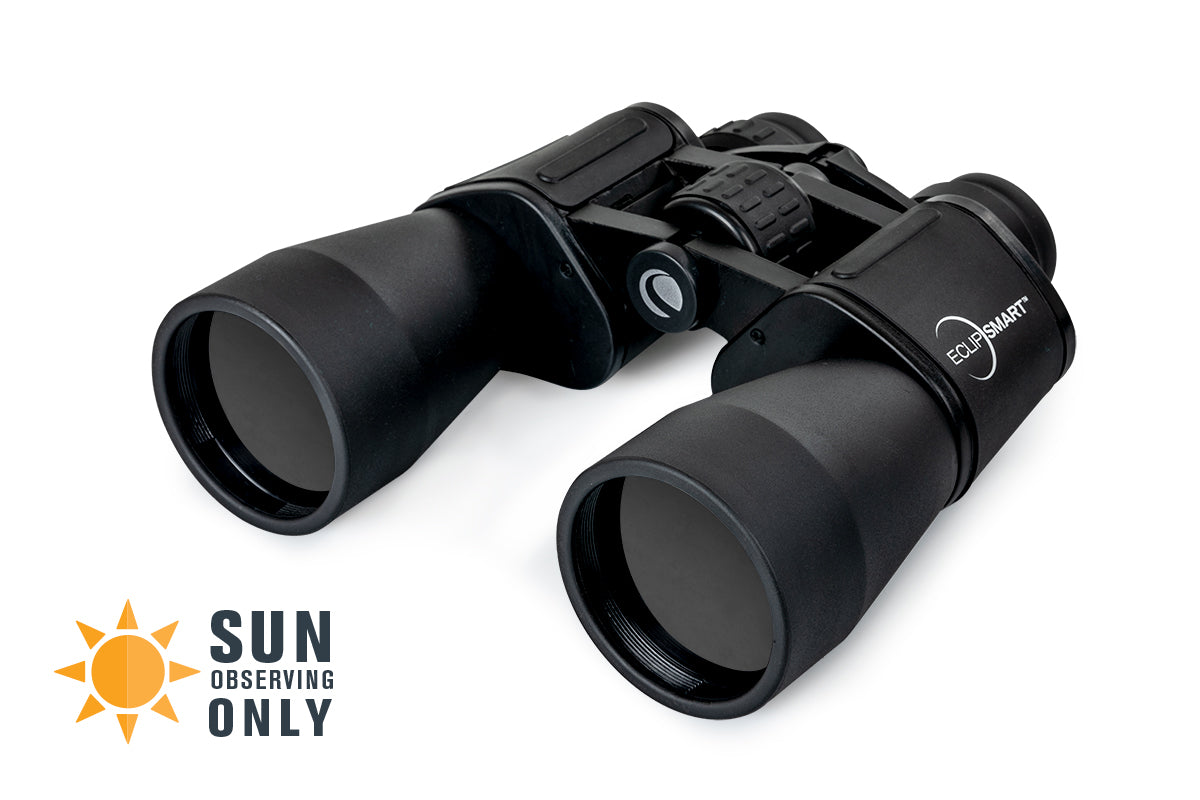
Explore this need in the finder →The Celestron EclipSmart 20x50 item 71240 is a discontinued solar Porro binocular retained here as a model reference, not a current buying suggestion. Its permanent built-in filters were designed for direct Sun viewing. Celestron lists a narrow 3.4° field, 8 mm eye relief and 31.5 oz weight. Those specifications help identify an old offer; they do not make it interchangeable with the current 10x25, 10x42 or 12x50 models.
Keep the 20x50’s high power in context
At 20x, item 71240 doubles the nominal magnification of the current 10x EclipSmart pair and exceeds the current 12x50. Celestron lists a 3.4° field and 180 ft at 1,000 yards (60 m at 1,000 m). That is the narrowest published field in this four-model solar group. The solar disk remains small relative to ordinary outdoor objects, but a 20x view makes hand movement more apparent and gives less room to find the target. The model’s tripoding adaptability is therefore relevant, though Celestron’s standard included-items list does not name an adapter.
Celestron lists an exit pupil of 1.95 mm and eye relief of 8 mm. The eye-relief figure is short for glasses, and the 31.5 oz listed mass is not a lightweight travel setup. The manual says to set the diopter with the binocular held safely in front of the eyes; folding eyecups down for glasses does not alter the specified eye relief. If an archived used listing is under consideration, the exact condition page and package contents need separate checks rather than assuming they match a new carton.
Why it stays a reference rather than a recommendation
Celestron’s US collection JSON gives exact item 71240 the product type “Discontinued.” Its exact product page is still accessible and shows the optical configuration, but out-of-stock or retailer links do not revive it as a current offer. The review stays available for identifying a secondhand instrument and understanding what the historical specification sheet says. No Amazon purchase search is attached to this profile, and the model is excluded from current matching results.
That distinction matters when selecting a 20x solar binocular. In this family, the only 20x50 is the discontinued configuration. A finder request for 20x may therefore produce no current EclipSmart result. That is the accurate answer, not a reason to return the reference item as a substitute. Users who prioritize magnification may need to broaden the model range, but cannot assume that another 20x binocular has the same solar filter design.
Permanent solar filters define every use
Item 71240 shares the family’s permanent objective-filter design. Celestron says the filters are built into the objectives and should not be removed or modified; the manual states that no scene other than the Sun should be visible through a functioning EclipSmart. This is not a multipurpose astronomical binocular. The permanent filters make it unsuitable for ordinary landscape, bird, lunar and night-sky viewing. AAS guidance likewise notes that built-in non-removable solar filters are not usable for totality.
Celestron says its Solar Safe technology meets the transmission requirements it associates with ISO 12312-2 and states that it was independently tested. The AAS clarifies that ISO 12312-2 formally applies to non-magnifying solar viewers, not filters for binoculars. This page therefore reports Celestron’s claim but does not present it as an independent certification of this exact optical unit. NASA’s guidance for binoculars calls for a purpose-made filter in front of the optics. Do not point an unfiltered optic at the Sun, and do not use ordinary eclipse glasses behind binoculars as a workaround.
Inspect the objective filters before every use. If a filter is scratched, loose, damaged or separated, do not look through the instrument at the Sun. Follow the manual’s safe aiming sequence: get both eyes behind the eyecups before raising the binocular and never remove it from your eyes while facing the Sun. Celestron says to stop if anything besides the Sun can be seen. Keep an adult familiar with the instrument’s procedure present when children are nearby.
Water, mount and package are not the reason to buy it
The exact page lists water resistance, no nitrogen filling and tripod adaptability. It does not publish a waterproof depth, submersion duration or fogproof rating. The listed items are a soft case, strap, eyepiece covers, objective covers, lens cloth and quick setup guide; no tripod adapter appears in that list. Because the item is discontinued, availability or package completeness on the secondhand market cannot be inferred from this historical original package.
The published exit pupil of 1.95 mm is retained as Celestron’s stated value; the page gives no independent explanation of its effective aperture. No field test is represented here. The safest use of these numbers is identifying the exact old configuration and rejecting a requirement when it conflicts with the stated field, weight or eye relief. Do not treat a matching 20x50 label as proof of solar compatibility or current availability.
What the finder should do
A direct-solar filter requirement identifies manufacturer-designated solar configurations, but lifecycle still matters: the 20x50 does not enter a current buying shortlist. A request for 20x, 50 mm and direct solar observation should return no current EclipSmart match. If your needs allow 10x or 12x, current models remain available for comparison: the 10x42 is lighter and has a broader field, while the 12x50 raises magnification and is tripod adaptable. Both use permanently fixed solar filters and are still unsuitable for ordinary binocular viewing.
Keep this reference if you are checking an existing item number, old listing or accessory package. For any actual direct-solar use, prioritize the condition of the filters and the manufacturer’s instructions over the age of this review. A damaged or modified filter is not a small optical defect; it is a stop-use condition.
Model identity and discontinuation: Celestron item 71240 and its US family collection record. Solar guidance: NASA and the American Astronomical Society.
Key specifications
Key details at a glance
| Magnification | 20× |
|---|---|
| Magnification range | Fixed 20x; no zoom. |
| Objective diameter | 50 mm |
| Real field of view | 3.4° |
| Field width at 1,000 m | 60 m |
| Eye relief | 8 mm |
More specifications and setup details
| Exit pupil | 1.95 mm |
|---|---|
| Manufacturer-published weight | 31.5 oz |
| Lens and prism coatings | Celestron lists multi-coated optics and BK7 prisms; prism coatings are N/A. No ED or phase-coating claim is imported from another model. |
| Tripod use | Celestron exact page marks tripod adaptability Yes. For Yes, no tripod adapter is listed in the package and the manual does not identify a required adapter model/interface. |
| Published weight note | Exact manufacturer-listed instrument mass only; no independent measurement and no accessory-weight estimate. |
| Manufacturer-rated waterproof | No |
| Tripod adapter in package | No |
Use the exact model’s instructions for operating limits, supplied equipment and version differences.
Sources for this review
Sources for this assessment
- Celestron US EclipSmart solar binocular collection: seven rows observed; one page
- Celestron US Shopify collection JSON: four optical configurations and three Used Outlet rows
- EclipSmart 20X50mm Porro Solar Binoculars; Celestron item 71240
- Celestron EclipSmart solar binocular manual; English pages 1–12 personally read: exact SKU index; safety; IPD, focus, diopter, eyecups and Sun-pointing steps; damaged-filter warning; care. Shared manual includes this exact SKU.
- NASA eclipse eye-safety guidance for binoculars and other magnifying optics
- American Astronomical Society guidance for solar filters on binoculars and telescopes
- Dated exact-item CPSC ProductName query (empty array; not a comprehensive recall guarantee)
- Official Celestron image URL enumerated from the exact item page/collection JSON

Choose your optical trade-off first.
Choose viewing purpose first, then magnification, objective size, scene width and any fit, weather or mounting constraint. A direct-Sun requirement is separate: only exact manufacturer-confirmed solar binoculars can pass it.