
On this page
Your needs, this model
Does it fit your priorities?
Can I get the current Echelon’s 20x view in a 70 mm binocular?
Yes. Item 71454 is the current reviewed 20x70 Echelon with a tripod-supported long-distance plan.
Explore this need in the finder →If 20x is essential but a closer focus limit is needed, what current 80 mm alternative is reviewed?
The SkyMaster Pro ED 20x80 lists 98.4 ft close focus; the Echelon 20x70 lists 328.1 ft and fails a 100 ft maximum.
Explore this need in the finder →Do current 20x binoculars include a tripod adapter?
The SkyMaster Pro ED 20x80 has an integrated sliding adapter; Echelon item 71454 needs a separately purchased adapter.
Explore this need in the finder →The current Celestron Echelon 20x70 (item 71454) is the series’ highest magnification and the natural fit for a fixed, distant view. Its 20x power, 70 mm objectives, 3.0° published angular field and 65 oz weight point toward a tripod-supported astronomy or long-range setup. The trade is a narrow frame, very long 328.1 ft close focus and an adapter that Celestron lists separately rather than in the box.
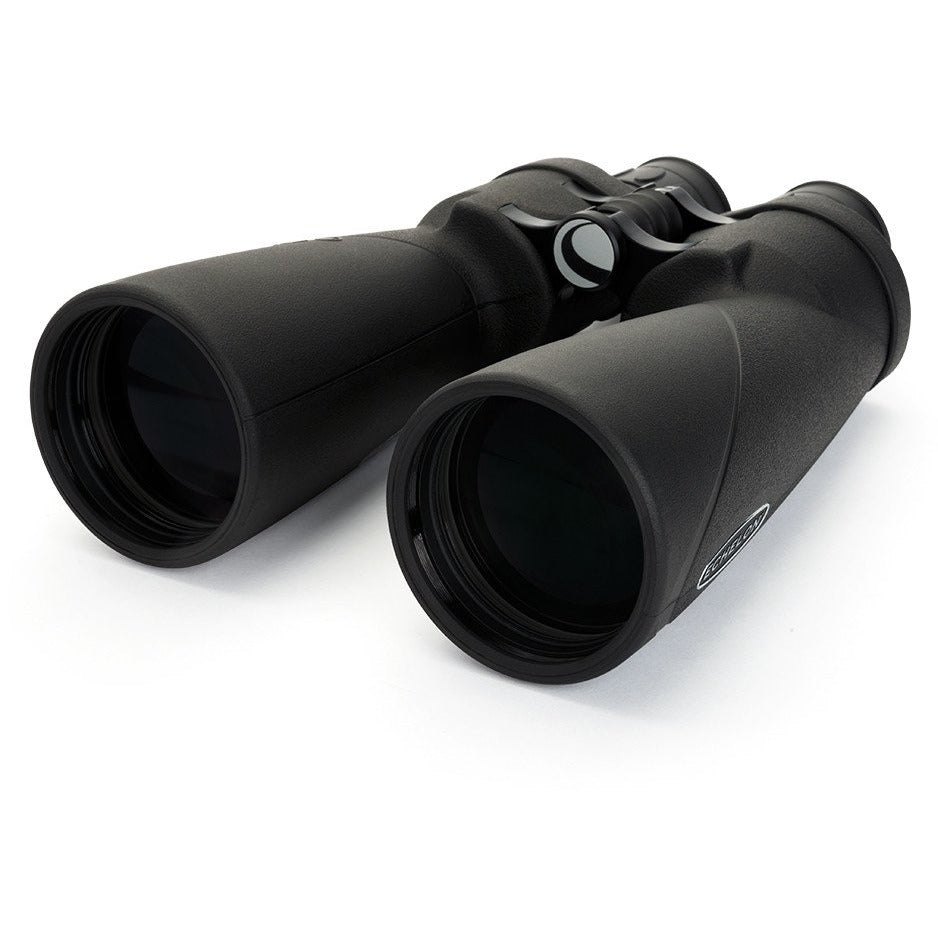
Image source and model notes
Reserve the 20x view for a stationary target
At 20x, small angular movement is magnified and locating a moving subject takes more care than with the Echelon 10x70. Celestron lists a 3.0° angular field and 157 feet at 1,000 yards, the narrowest published view in this family. That is a reasonable trade for selecting a small distant object or a tight celestial region; it is a poor match for scanning a broad horizon, following fast wildlife or viewing an object that repeatedly slips out of frame. A steady tripod makes the high power more useful over time.
The 70 mm objectives and 3.5 mm exit pupil give this model less pupil width than the 10x70’s 7 mm and the 16x70’s 4.38 mm. The power here is not simply “brighter because 70 mm”: exit pupil depends on both aperture and magnification. Celestron markets the model for low-light and astronomical observing, but that does not establish an independently measured brightness advantage over another binocular. The useful decision is whether the added scale and narrower field serve your object and viewing conditions.
Set up the adapter and focus before observing
The instrument weighs 65 ounces (1,840 g). Celestron calls it tripod adaptable and says the binocular tripod adapter is sold separately; the shared Echelon manual shows how to access the threaded socket beneath the logo plate. The adapter is not a built-in rod and is not listed as included. If your must-have is an in-box tripod interface, this model does not meet that requirement on the evidence available. Plan for the adapter and a stable photographic tripod if you expect long sessions.
Echelon uses individual focus rather than a central wheel. Each eyepiece has its own diopter setting; the manual explains how to focus each eye separately on a distant subject. Once adjusted for a distance, the focus does not work like a center wheel for quickly moving between nearby and far subjects. Celestron’s 328.1 ft minimum-focus listing makes the boundary plain: this is not suitable for close wildlife, garden detail or near objects. The series is waterproof and nitrogen filled, and Celestron says a waterproof hard case is included. These features help in damp conditions and storage but do not turn the binocular into an underwater instrument.
Eye fit and field labels deserve a check
Celestron states 19.5 mm eye relief and ±4 diopter adjustment. That is the longest listed eye relief among the Echelon models after the 10x70’s 21.5 mm, and it may suit some eyeglass wearers better than a short-relief long-range glass. Still, frame shape and where the eyes sit against the foldable eyecups determine whether the full view is visible. If you wear glasses, verify eye placement rather than relying on the manufacturer’s “comfortable” phrasing.
The exact product table identifies a real angular field of 3.0°, unlike the 10x70 and 16x70 pages, whose tables label their 5.3° and 3.8° values as apparent field. Those labels should not be silently interchanged. For comparison, use the listed linear widths when they are available, and keep each product’s stated field type attached to its number. The 20x70’s 157 ft at 1,000 yards is a useful frame-width figure; the manufacturer does not provide independent test data here for edge sharpness, glare or color correction.
How it differs from the other Echelons
The discontinued 16x70 sits between this model and the 10x70: 199 ft per 1,000 yards and a 4.38 mm exit pupil, but its exact-page close-focus distance is unknown. The discontinued 10x70 offers the lowest family power, widest listed linear scene and longest eye relief, but a 7 mm exit pupil is not fully used by every observer in every condition. All three are 70 mm, 65 oz bodies with individual focus and a separately purchased tripod adapter. The significant choice is how much enlargement and field width matter, not whether one is a portable compact.
For a current alternative with more magnification and 80 mm objectives, Celestron’s SkyMaster 20x80 is a distinct, larger model with a published 3.7° field and a center support rod, but it is also heavy and water resistant rather than listed as nitrogen-purged waterproof. A separate choice is the SkyMaster Pro ED 20x80: it adds ED glass and an integrated sliding tripod adapter, with a heavier listed mass. Compare their actual reviews and package details rather than treating any as an interchangeable Echelon. Buy the 20x70 if the exact 20x/70 mm compromise, waterproof case and individual-focus routine fit a stable long-range plan; choose a lower power or a conventional center-focus glass for a moving, nearby or walk-around subject.
Exact-model evidence: Celestron Echelon 20x70 item 71454; its Used Outlet item U71454 condition page; Celestron’s Echelon US collection; and the English section of the Celestron Echelon manual.
Key specifications
Key details at a glance
| Magnification | 20× |
|---|---|
| Objective diameter | 70 mm |
| Real field of view | 3° |
| Field width at 1,000 m | 52 m |
| Eye relief | 19.5 mm |
| Exit pupil | 3.5 mm |
More specifications and setup details
| Close focus distance | 328.1 ft |
|---|---|
| Manufacturer-published weight | 65 oz |
| Lens and prism coatings | Celestron describes all air-to-glass surfaces as multi-coated with its XLT coatings; this is the manufacturer specification, not an independent transmission or sharpness measurement. |
| Water and fog protection | Exact product page lists waterproof, nitrogen filled and rubber armor; no IP rating or underwater use is specified. The manual warns not to view the Sun directly. |
| Tripod use | The product page says tripod adaptable and the Echelon manual shows threads under the logo plate; Celestron says the binocular adapter is sold separately. |
| Manufacturer-rated waterproof | Yes |
| Tripod adapter in package | No |
Use the exact model’s instructions for operating limits, supplied equipment and version differences.
Sources for this review
Sources for this assessment
- Celestron US Celestron Echelon 20x70 product page (item 71454)
- Celestron Echelon US binocular collection, all four row objects
- Celestron Echelon collection product JSON; individually inspected three optical items plus Used Outlet row
- Celestron Echelon binocular manual, 52-page multilingual PDF; English section inspected (PDF pages 4–11 / printed pp. 2–9)
- Dated exact-item CPSC ProductName query for Celestron item 71454 (empty array; narrow query only)
- Official Celestron image asset linked by the exact item 71454 page and corresponding collection product object

Choose your optical trade-off first.
Choose viewing purpose first, then magnification, objective size, scene width and any fit, weather or mounting constraint. A direct-Sun requirement is separate: only exact manufacturer-confirmed solar binoculars can pass it.