
On this page
Your needs, this model
Does it fit your priorities?
Does the 8x20 provide a wider real scene than the 10x20 IS sibling?
Yes. Canon lists 6.6° for the 8x20 and 5.3° for the 10x20, and the 8x version has the larger 2.5 mm exit pupil. The 8x20 is retained as a discontinued reference, not a current shortlist recommendation.
Explore this need in the finder →Can this compact 8x20 meet a waterproofing requirement?
No. Canon’s shared manual says it is not waterproof and should be kept away from rain and water spray. Consider a currently documented weather-sealed 8x25 if wet-weather use is essential; that changes the objective size and gives up built-in IS.
Explore this need in the finder →Does its powered stabilization still work without a cell?
No. One CR123A powers the lens-shift stabilizer, although Canon says the binocular remains usable as ordinary optics without batteries. The camera-style stabilizer helps with hand shake, not subject movement or severe vibration.
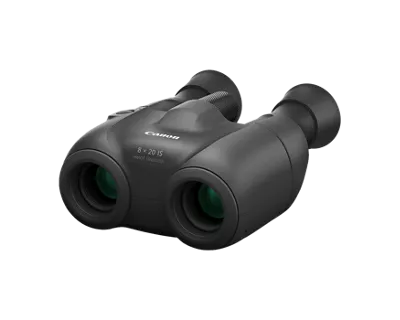
Explore this need in the finder →The Canon 8x20 IS pairs a small 20 mm objective with optical image stabilization, aiming at a steadier handheld view in a compact body. Its strongest case is an 8x picture that shakes less than a passive compact binocular—not rain-ready travel or dim-light performance. Canon lists a broad 6.6° real field and 2.5 mm exit pupil, both more forgiving than the 10x20 sibling. Canon now labels it discontinued and no longer available, so this page is a model reference, not a current buying recommendation.
Why choose the 8x version?
Eight power is the more relaxed choice for scanning a moving subject or finding a bird again after lowering the binocular. Canon's measured specification is a 6.6° real field, or 115 m (377 ft) across at 1,000 m (1,000 yd). The 10x20 shares a 49.5° apparent field but narrows the real scene to 5.3° (93 m / 305 ft at 1,000 m / 1,000 yd). This 8x model also has a 2.5 mm exit pupil rather than the 10x20's 2.0 mm. Those numbers suggest an easier view to hold and scan; they do not measure resolution, edge sharpness or twilight performance.
Both models use 20 mm objectives, so neither should be mistaken for a low-light glass. The 8x20's slightly larger exit pupil is a modest comfort advantage, not a substitute for a 32 mm or 42 mm objective when daylight fades. Its 13.5 mm eye relief is a useful published dimension, but eyeglass fit depends on how the eyecups and a particular frame meet your face. Try a sample if a full field with glasses is essential.
What the stabilizer does
Canon describes a lens-shift optical Image Stabilizer with a correction angle of ±0.9°. With a button press and release, the shared 8x20 / 10x20 instruction manual says stabilization runs continuously for five minutes; holding the button provides stabilization only while it is held. A single CR123A lithium battery powers the stabilizer. The manual estimates about 12 hours of continuous use at 23°C and 8 hours at −10°C under Canon's conditions, while warning that battery duration varies by brand. Even without a battery, the binocular still works as ordinary optics, but the view is no longer stabilized.
Stabilization is most useful when hand motion makes a distant stationary detail hard to inspect. It cannot freeze a moving bird or performer, and Canon cautions that it may not compensate for severe body movement, vibration or excessive hand shake. Users still need to acquire the target, focus and hold the instrument with care. The stabilizer changes how a handheld view behaves; it does not turn the 20 mm lenses into a large-aperture instrument.
Fit, focus and carry weight
Canon lists the 8x20 at 420 g (14.82 oz) without its battery, with a 118 × 142 × 69 mm (4.6 × 5.6 × 2.7 in) body. For a 20 mm binocular, that is not featherweight: stabilization hardware adds a real carrying cost compared with small passive compacts. The passive Nikon TRAILBLAZER II 8x25, for example, is listed at 310 g and has waterproof construction, while giving up built-in stabilization. If steady 8x viewing is the priority, the Canon feature may justify the bulk; if low carry weight and weather protection lead, the trade changes.
The Porro I optical design uses a center focusing knob and manual diopter adjustment. Canon's instructions walk the user through matching interpupillary width until the two circles merge, focusing the left eye, then setting the right-eye diopter before focusing both eyes together. Canon lists a 56–72 mm interpupillary adjustment and a 2 m / 6.6 ft close-focus distance. These are straightforward controls, but the official manual—not a quick glance at the body—should guide initial setup and battery installation.
Keep it dry—and heed the safety limits
The English manual is explicit: the binocular is not waterproof and should be kept away from rain and water spray. Canon advises drying incidental contact promptly and using a dry, ventilated place for storage. No fogproof rating is established in the inspected product specifications, so do not assume one. If outdoor weather sealing is non-negotiable, compare a current waterproof 8x25 such as the Nikon TRAILBLAZER II, understanding that this alternative has no built-in IS. Never look at the Sun through these or any ordinary binoculars.
Canon's package list in the shared manual names a case, strap, two eyepiece caps and one CR123A battery. Listings can vary by seller or condition, so an existing or secondhand item should be checked against the exact model and actual included pieces. Inspect the battery compartment, lens condition and moving controls in person; the published manual gives care guidance, not a guarantee about a used unit.
Who should consider this model?
The 8x20 IS makes the most sense to someone comparing compact image-stabilized binoculars who values a wider real scene and a larger exit pupil more than 10x reach. It is less suited to rainy routes, twilight watching, users who need a very light pocket pair or anyone expecting stabilization to remove subject motion. Canon's U.S. page now states that the product is discontinued and no longer available; a conflicting stock flag also appears on that page. Treat it as an identification reference and do not infer that a listing is a current Canon offer. For another documented compact stabilizer, see the Nikon STABILIZED 10x25 S; for a lighter, weatherproof 8x compact without stabilization, see the TRAILBLAZER II 8x25.
This assessment summarizes Canon's product specifications and shared 8x20 / 10x20 instructions; it does not claim personal ownership or a hands-on stabilization test. Compare exact model markings and the seller's condition before considering an older unit.
Key specifications
Key details at a glance
| Magnification | 8× |
|---|---|
| Objective diameter | 20 mm |
| Real field of view | 6.6° |
| Apparent field of view | 49.5° |
| Field width at 1,000 m | 115 m |
| Eye relief | 13.5 mm |
More specifications and setup details
| Exit pupil | 2.5 mm |
|---|---|
| Close focus distance | 6.6 ft |
| Manufacturer-published weight | 14.82 oz |
| Lens and prism coatings | Canon lists Super Spectra Coating; no other coating or glass type is assumed. |
| Manufacturer-rated waterproof | No |
| Built-in image stabilization confirmed | Yes |
| Image-stabilization method | Optical correction with lens-shift |
| Power source | CR123A lithium |
| Batteries required to power stabilization | Yes |
Use the exact model’s instructions for operating limits, supplied equipment and version differences.
Sources for this review
Sources for this assessment
- Canon U.S. binoculars directory, one-page eight-product snapshot
- Canon U.S.A. exact product page: 8 x 20 IS
- Canon exact-model technical specification PDF
- Canon shared 8x20 IS / 10x20 IS English instruction manual
- Canon official binocular manual listing
- Canon official support page for shared manual
- Canon image CDN primary image linked from exact U.S. product page
Choose your optical trade-off first.
Choose viewing purpose first, then magnification, objective size, scene width and any fit, weather or mounting constraint. A direct-Sun requirement is separate: only exact manufacturer-confirmed solar binoculars can pass it.