
On this page
Your needs, this model
Does it fit your priorities?
Does the 18x50 trade a narrower scene for more nominal reach than 15x50?
Yes. Canon lists 18x and 3.7° real field for this model versus 15x and 4.5° for the sibling. The 18x50 keeps the same 50 mm objectives and 1,180 g battery-excluded weight, but its exit pupil is 2.8 mm rather than 3.3 mm.
Explore this need in the finder →Can this discontinued Canon 18x50 be returned as a current buying match?
No. Canon identifies SKU BINO18X50IS as discontinued and no longer available. Keep it as a reference; do not let a residual Out of Stock/offer badge imply a current offer or a buying recommendation.
Explore this need in the finder →Does “All Weather” confirm waterproof submersion protection?
No. The manufacturer comparison calls the pair “All weather specs” and its product page says water-resistant construction, while its separate waterproof row is distinguished for a different Canon model. The 18x50 is not confirmed for underwater use.
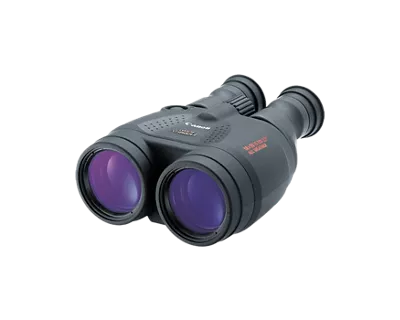
Explore this need in the finder →The Canon 18x50 IS All Weather is a high-power binocular built around a difficult trade: unusually strong handheld reach with optical stabilization, in a large, heavy body that has a relatively narrow real field. Canon now labels this exact U.S. configuration discontinued and no longer available. It remains useful as a model reference, but it should not be treated as a current Canon offer.
What the 18x50 specification means
Canon lists 18x magnification, 50 mm objectives, a 3.7° real field, 60.3° apparent field and a 2.8 mm exit pupil. The 18x power brings distant details closer than a typical 8x or 10x pair, which can help when a subject is stationary or far away. The same magnification makes the visible landscape narrower than the 15x50 sibling: Canon lists 3.7° for this model and 4.5° for the 15x50. It can take more deliberate pointing to find a bird, vessel, or landmark again after lowering the binocular.
The 50 mm objective gives the 18x50 a larger front aperture than compact stabilized models, but magnification also matters. The exit pupil is 2.8 mm, smaller than the 15x50's 3.3 mm. These dimensions are a way to compare the available light bundle, not a measured low-light score. A larger objective does not guarantee a brighter view if the exit pupil is smaller, and no product-page specification establishes edge sharpness or resolution in real conditions.
Stabilization and support
Canon confirms a built-in Image Stabilizer that uses a vari-angle prism. Its comparison chart lists two AA batteries as the IS power source and a tripod socket. Stabilization is relevant at 18x because small hand movements appear more obvious at higher power; it can steady the image of a stationary subject. It cannot freeze subject motion, remove severe movement, or turn an 18x binocular into a wide-field scanner. When an exact operating mode, battery runtime, or whether ordinary optical viewing remains possible without cells is important, confirm it in the instruction manual for the exact unit rather than assuming based on another Canon model.
The body weighs 1,180 g (41.6 oz) before batteries. That is not a casual pocket carry, and batteries add a little more. A tripod socket permits a mounted viewing plan, although the chart does not establish that an adapter is included. For a long observation of the moon, a distant ridge, or a fixed landmark, a mount or firm support can make a high-power view less tiring. For tracking moving wildlife on a walk, the narrower field and mass are significant compromises.
All Weather is not the same as a waterproof rating
Canon calls the construction water-resistant and markets the pair as All Weather. Its comparison chart distinguishes “All weather specs” from a “Waterproof specs” designation used for a different Canon configuration. Treat this as weather-resistant outdoor equipment, not as a promise of sealed immersion or underwater use. If a waterproof rating is essential, this product should not satisfy that requirement based on the available specifications. The non-slip rubberized grip is useful to know, but it does not establish fogproofing or a nitrogen purge; those details are not confirmed here.
How it differs from 15x50—and alternatives
The Canon 15x50 IS All Weather is the closest family comparison. Both models list a 50 mm objective, 15 mm eye relief, a vari-angle-prism stabilizer, a tripod socket and the same 1,180 g pre-battery weight. The 15x sibling gives up three-power magnification for a wider 4.5° real field and 3.3 mm exit pupil. If scanning, target acquisition, or a somewhat larger exit pupil matters more than maximum reach, that is the more balanced of the two. Neither is currently offered by Canon.
For an alternative high-power design, compare the Vortex Kaibab HD 18x56 when a matching 18x view is more important than built-in stabilization. It keeps the same listed 3.7° real field but changes to 56 mm objectives and a passive, waterproof configuration with an included tripod adapter. That is a different operating plan: you gain weather protection and objective size, but give up powered stabilization and should plan to support the binocular. Verify current availability and package details before purchase.
Who should keep this model on a shortlist?
Because Canon marks the exact BINO18X50IS SKU discontinued and no longer available, it belongs in a library for identifying an existing unit or comparing older designs—not in a current purchase shortlist. Someone considering a used example should confirm the marking, check the battery compartment and controls, inspect the optics, and verify what accessories are actually included. Canon's published 1,180 g weight excludes batteries, so carrying weight in a real kit will be higher.
This assessment uses Canon's exact U.S. product and support pages and Canon's first-party comparison chart. It does not claim personal ownership, a field trial, or lab measurements. Never look at the Sun through an ordinary binocular.
Key specifications
Key details at a glance
| Magnification | 18× |
|---|---|
| Objective diameter | 50 mm |
| Real field of view | 3.7° |
| Apparent field of view | 60.3° |
| Field width at 1,000 m | 65 m |
| Eye relief | 15 mm |
More specifications and setup details
| Exit pupil | 2.8 mm |
|---|---|
| Close focus distance | 19.7 ft |
| Manufacturer-published weight | 41.6 oz |
| Lens and prism coatings | Canon lists UD glass elements and a field-flattener; the comparison chart lists UD for the All Weather pair. |
| Manufacturer-rated waterproof | No |
| Built-in image stabilization confirmed | Yes |
| Image-stabilization method | Optical correction with a vari-angle prism |
| Power source | AA |
| Batteries required to power stabilization | Yes |
Use the exact model’s instructions for operating limits, supplied equipment and version differences.
Sources for this review
Sources for this assessment
Choose your optical trade-off first.
Choose viewing purpose first, then magnification, objective size, scene width and any fit, weather or mounting constraint. A direct-Sun requirement is separate: only exact manufacturer-confirmed solar binoculars can pass it.