
On this page
Your needs, this model
Does it fit your priorities?
Does this 15x50 give a wider real view and larger exit pupil than Canon 18x50?
Yes. Canon lists 4.5° and 3.3 mm for 15x50 versus 3.7° and 2.8 mm for 18x50; both use 50 mm objectives, vari-angle-prism IS and weigh 1,180 g without batteries. The difference is scene width and nominal reach, not lower carry weight. Both are discontinued references.
Explore this need in the finder →Will the 15x50 remain in a current stabilized shortlist?
No. Canon marks the exact SKU BINO15X50IS discontinued and no longer available. It stays in the library for identification and technical comparison but is not eligible for current buying matches.
Explore this need in the finder →Is the All Weather 15x50 a manufacturer-rated waterproof binocular?
No waterproof depth or rating is published for it. Canon describes water-resistant construction and its comparison chart says “All weather specs,” while distinguishing this from a waterproof specification. Do not use it underwater.
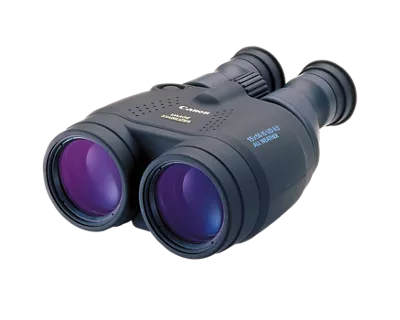
Explore this need in the finder →The Canon 15x50 IS All Weather is the lower-power member of Canon's discontinued high-magnification 50 mm stabilization pair. It keeps substantial reach while showing a wider real scene and larger exit pupil than the 18x50. The trade is substantial carry weight: Canon lists 1,180 g before batteries. Canon now identifies this exact U.S. SKU as discontinued and no longer available, so this page is for model reference, not a current buying recommendation.
Why consider 15x instead of 18x?
Canon lists 15x magnification, a 50 mm objective, a 4.5° real field, 61° apparent field and a 3.3 mm exit pupil. Its 18x50 sibling raises power to 18x but narrows the real field to 3.7° and the exit pupil to 2.8 mm. Both bodies weigh the same according to Canon's battery-excluded weight figure, so the 15x is not the lighter carry option. Its advantage is a more open scene and slightly larger exit pupil, while the 18x offers greater nominal reach. These are useful specification differences, not a claim that one has better resolution or wins a hands-on test.
Fifteen power is still high for a casual walk. The 4.5° field is narrower than the 6–7° region common in many 8x and 10x birding binoculars. If the intended subject moves quickly or disappears behind cover, locating it can require patient aiming. If the subject is distant and relatively stationary—an animal across a wide valley, a ship, a cliff face, or the moon—the extra magnification can make fine details easier to inspect. It remains binocular, not a substitute for a telescope or a spotting scope on a mount.
Stabilized viewing, batteries and mounting
Canon confirms built-in optical stabilization using a vari-angle prism, with a listed correction angle of ±0.7°. Its comparison chart lists two AA cells as the power source for IS and a tripod socket. At 15x, stabilization can reduce some hand shake while inspecting a stationary subject. It cannot stop a bird from moving, erase severe body motion, or make a narrow field broad. The provided socket also supports a different plan: mount the binocular for extended observation rather than carrying it continuously. The source does not confirm an adapter in the box, so do not assume one is included.
Canon rates the binocular at approximately 1,180 g (41.6 oz) without batteries. Add two AA cells and any strap or case before judging the actual kit. If a long observation is the goal, the tripod socket and image stabilizer are relevant choices; if the instrument must stay on a neck through a full day of walking, the mass is a real compromise. Battery runtime, supplied battery status and detailed no-cell behavior should be checked in the exact owner's instructions; they are not inferred from the power-source table.
Weather protection and optical claims
The product page says water-resistant construction and describes a non-slip rubberized grip. The Canon comparison chart calls the pair “All weather specs,” while distinguishing that wording from a “Waterproof specs” entry on a different model. That does not establish an immersion rating or underwater use. If the questionnaire's waterproof-rating requirement is essential, this 15x50 is not confirmed to meet it. Likewise, the presence of UD glass and a field flattener is a manufacturer feature description, not evidence of a measured edge-to-edge sharpness result under all conditions.
Canon lists 15 mm eye relief. Some eyeglass wearers may find that workable, but the full apparent field visible through glasses depends on eye placement and frame shape; a dimension alone cannot guarantee fit. A 3.3 mm exit pupil is larger than the 18x50's 2.8 mm, yet still smaller than the 5 mm exit pupil of a 10x50. Consider that difference for dawn or dusk, and do not translate the number into a guaranteed brightness rating.
Alternatives that change the operating plan
For current high-power 15x viewing, compare the Vortex Vulture HD 15x56 if a 56 mm objective and a mount-first approach are acceptable. Its published 4.3° field is a little narrower than Canon's 4.5°, but it is a passive 15x56 design with manufacturer-described waterproof protection and an included tripod adapter. You gain a different weather and support setup while giving up built-in image stabilization; check actual seller availability and package terms before deciding.
Within Canon's older pair, the 18x50 is the higher-reach choice; this 15x50 is preferable when the wider real field and larger exit pupil matter more than those three extra powers. Neither provides a current Canon offer. A lower-power 10x42 such as Canon's 10x42 L IS WP also changes the balance substantially: it gives up magnification but is the distinct configuration Canon calls waterproof. That model requires its own exact assessment and should not be treated as a variant of this 50 mm pair.
Who should keep it in view?
Keep the exact BINO15X50IS identity useful when evaluating a used example or comparing older stabilized binoculars. Before considering a secondhand unit, verify the model marking, inspect objective and eyepiece glass, check the battery compartment and button operation, and confirm the actual accessories and condition. Canon's page currently says discontinued and no longer available; residual stock, sale or shipping text is not evidence that a new Canon supply can be ordered.
This assessment is based on Canon's exact U.S. PDP, support specifications and first-party comparison chart. It does not claim ownership, a field trial, or lab measurement. Never look at the Sun through an ordinary binocular.
Key specifications
Key details at a glance
| Magnification | 15× |
|---|---|
| Objective diameter | 50 mm |
| Real field of view | 4.5° |
| Apparent field of view | 61° |
| Field width at 1,000 m | 79 m |
| Eye relief | 15 mm |
More specifications and setup details
| Exit pupil | 3.3 mm |
|---|---|
| Close focus distance | 19.7 ft |
| Manufacturer-published weight | 41.6 oz |
| Lens and prism coatings | Canon lists UD glass elements and a field-flattener; the comparison chart lists UD for the All Weather pair. |
| Manufacturer-rated waterproof | No |
| Built-in image stabilization confirmed | Yes |
| Image-stabilization method | Optical correction with a vari-angle prism |
| Power source | AA |
| Batteries required to power stabilization | Yes |
Use the exact model’s instructions for operating limits, supplied equipment and version differences.
Sources for this review
Sources for this assessment
- Canon U.S. binoculars directory, one-page eight-product snapshot
- Canon U.S. exact product page: 15 X 50 IS All Weather Binoculars
- Canon U.S. support page for 15 X 50 IS All Weather Binoculars
- Canon binoculars comparison chart
- Canon image CDN primary image linked from exact 15 X 50 IS All Weather Binoculars U.S. page
Choose your optical trade-off first.
Choose viewing purpose first, then magnification, objective size, scene width and any fit, weather or mounting constraint. A direct-Sun requirement is separate: only exact manufacturer-confirmed solar binoculars can pass it.