
On this page
Your needs, this model
Does it fit your priorities?
Does 12x36 buy more reach at the cost of a narrower real scene than the 10x30?
Canon lists 12x and a 5° real field for the 12x36, compared with 10x and 6° for the 10x30. The 12x36 is 60 g heavier before cells and focuses less closely; both list 3 mm exit pupils and AA-powered vari-angle-prism IS.
Explore this need in the finder →Can the exact 12x36 IS III be used where waterproofing is essential?
Canon’s exact product page gives no waterproof rating. Because weather protection is unknown, it cannot pass an essential waterproof requirement.
Explore this need in the finder →Will Canon’s discontinued 12x36 IS III appear in a current buying shortlist?
No. Canon marks the exact U.S. page discontinued and no longer available; it remains available here only as an identification and comparison reference.
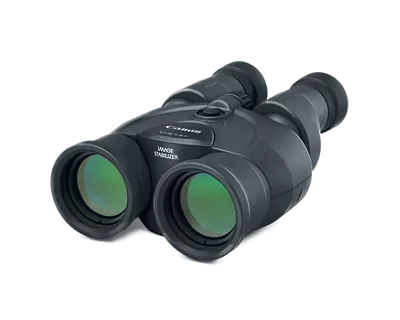
Explore this need in the finder →The Canon 12 x 36 IS III pairs 12x magnification with built-in optical Image Stabilization in a 36 mm Porro II body. Its 5-degree real field, 3 mm exit pupil and 660 g bare weight make it the reach-oriented sibling of the 10 x 30 IS II. Canon marks this exact U.S. model out of stock, discontinued and no longer available. This page is a sourced identification and comparison, not a current purchase recommendation.
Reach, with a narrower frame
Canon lists 12x magnification, 36 mm objectives, a 5-degree real field and a 55.3-degree apparent field calculated using the manufacturer’s stated ISO method. Moving from 10x to 12x enlarges the apparent subject, which may help when watching an animal across a field or following a performer from a distant seat. But five degrees is narrower than the 6 degrees of the 10 x 30 IS II. Finding a bird in branches or keeping a fast-moving subject centered can take more deliberate pointing than with a wider 8x or 10x view.
The exit pupil is 3 mm, the same published value as the 10 x 30 IS II. The 36 mm front lenses are larger, but the increase is paired with 12x magnification, so it does not yield a larger exit pupil. That is why the objective diameter alone is not a dependable shortcut for judging the view. Image stabilization can reduce the distraction of hand tremor at 12x; it cannot make the image brighter than the optics allow, recover a subject outside the field, or substitute for a stable posture.
What the stabilizer does—and what is not documented
Canon specifies optical correction by vari-angle prisms and a correction angle of plus or minus 0.8 degree. The specification identifies the system; it does not report an independent test or a percentage of shake removed. Canon describes handheld viewing without the need for a tripod. That can be a meaningful benefit when a passive 12x binocular feels difficult to hold steady, but the model still depends on the user’s grip and the motion of the subject. Severe movement is not solved by magnification or stabilization alone.
The power specification is two AA alkaline or NiMH cells. Canon’s package list names an alkaline LR6 battery but does not establish the included quantity in that line; the published body weight of 660 g explicitly excludes batteries. Canon’s support page lists one English instruction file shared with the 10 x 30 IS II, dated July 16, 2015, but says that file is unavailable. I therefore do not infer its battery duration, timed modes, control sequence, storage precautions or manual-only operating limits. For a used unit, check condition and battery compartment for yourself rather than assuming an old package is complete.
Comfort, focus and carry weight
Canon lists 14.5 mm eye relief and an interpupillary adjustment from 55 to 75 mm. Its overview describes extended-use comfort, including for glasses wearers, but eye relief alone cannot ensure that every spectacle frame sees the full field. If glasses stay on while viewing, test eye position when possible. The diopter correction is plus or minus 3.0 D and focus is adjusted manually at the central knob. Closest focus is 6 m (19.69 ft), which is much less convenient than a short-focus birding binocular for subjects nearby.
The dimensions are 127 x 174 x 70 mm, and the weight is 660 g before two AA cells. It is a manageable hand-held format for some people, but the number is not a promise of comfortable extended use for every person. Canon also lists a case, strap, eyepiece cap, instruction book and warranty card in the package, alongside a battery. Those are original package contents, not a guarantee that a secondhand unit still includes them. No tripod socket or waterproof rating is confirmed on the inspected product page; do not assume either from the image or from the stabilization feature.
Choosing it over the 10 x 30 IS II
The 12 x 36 IS III is the option for users who put more nominal reach ahead of a wider real field and lower carry weight. Its 5-degree field is one degree narrower, its closest-focus distance is longer, and it weighs 60 g more before cells than the 10 x 30 IS II. Both have a 3 mm exit pupil and 14.5 mm eye relief; both use two AA cells and vari-angle-prism stabilization. Canon lists different correction angles—plus or minus 0.8 degree for the 12x36 and plus or minus 1.0 degree for the 10x30—but that difference is not an effectiveness ranking. The right fit turns on subject distance, pointing comfort and whether the field feels broad enough.
If you watch fast birds or want to scan a broad landscape, prioritize a wider real field and a lower-power model. If distant, relatively stationary subjects dominate and stabilization is an essential feature, the 12x36’s design is more aligned with that use, provided its 36 mm objective and 3 mm exit pupil suit the light. For dimmer conditions, do not confuse the stabilization system with additional light gathering; compare a lower-power, larger-exit-pupil design instead. If you need rainproofing or underwater use, this Canon page does not supply the necessary rating, so a model with an explicit exact-model waterproof specification is the safer questionnaire fit.
Reference status matters more than residual stock text
Canon’s exact page displays “Out Of Stock,” “Discontinued” and says that the product is no longer available. The model therefore stays in the reference library and out of current matches, even if an older dealer listing appears elsewhere. Buyers who need stabilization should compare presently supported alternatives and verify exact specifications and availability; buyers who do not need it may find a current passive 10x or 12x binocular more straightforward to source and maintain.
This assessment uses Canon U.S. product/support material, not hands-on testing or a laboratory comparison. Confirmed fields are 12x, 36 mm, 5-degree field, two-AA power and 6 m close focus. Weather protection and manual details remain unknown and cannot satisfy essentials.
Key specifications
Key details at a glance
| Magnification | 12× |
|---|---|
| Objective diameter | 36 mm |
| Real field of view | 5° |
| Apparent field of view | 55.3° |
| Eye relief | 14.5 mm |
| Exit pupil | 3 mm |
More specifications and setup details
| Close focus distance | 19.69 ft |
|---|---|
| Manufacturer-published weight | 23.28 oz |
| Lens and prism coatings | The exact inspected Canon pages do not identify objective or prism coatings; none are inferred. |
| Built-in image stabilization confirmed | Yes |
| Image-stabilization method | Optical correction by vari-angle prisms |
| Power source | 2 AA alkaline or NiMH |
| Batteries required to power stabilization | Yes |
Use the exact model’s instructions for operating limits, supplied equipment and version differences.
Sources for this review
Sources for this assessment
Choose your optical trade-off first.
Choose viewing purpose first, then magnification, objective size, scene width and any fit, weather or mounting constraint. A direct-Sun requirement is separate: only exact manufacturer-confirmed solar binoculars can pass it.