
On this page
Your needs, this model
Does it fit your priorities?
Does the 12x32 design provide 12x hand-held stabilization?
Canon lists 12x, 32 mm objectives and lens-shift Image Stabilization with a distinct Powered IS mode. The exact U.S. listing is discontinued, so this reference does not enter current match results.
Explore this need in the finder →Can the exact 12x32 listing satisfy essential waterproofing?
No waterproof or rain rating appears on the exact U.S. page. The shared family manual warns against immersion and strong rain/splash; unknown protection cannot meet an essential waterproof condition.
Explore this need in the finder →When is a 12x25 alternative a real tradeoff?
Nikon STABILIZED 12x25 S is a current 12x stabilized alternative only if a 25 mm objective is acceptable. It is lighter and smaller, but its 2.1 mm exit pupil and 12.3 mm eye relief differ materially from Canon’s 32 mm design; it does not replace the discontinued Canon profile.
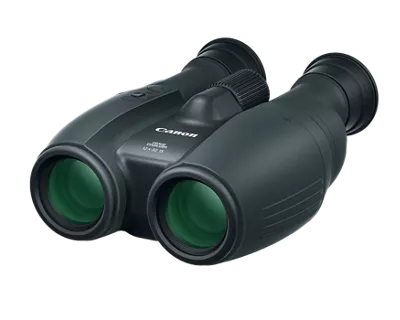
Explore this need in the finder →The Canon 12 x 32 IS is a discontinued 12x binocular with 32 mm objectives and Canon’s lens-shift Image Stabilizer, including a separate Powered IS mode. Its 5-degree real field, 2.7 mm exit pupil and 780 g body give a more precise picture than the “compact” label alone: this is a stabilized hand-held instrument, not a light pocket pair. Canon’s U.S. page marks the SKU discontinued and says it is no longer available, so this is a reference for identification and comparison rather than a current recommendation.
Reach in a relatively small objective class
Canon lists 12x magnification, 32 mm objectives, a 5-degree real field and a 55.3-degree apparent field under its stated ISO calculation method. That mix is useful when the target is distant but a tripod would be awkward: a bird across open water, a performer from a far seat or a landmark that is too small in an ordinary 8x view. The higher power also makes it slower to locate a moving subject and makes hand movement more apparent. Stabilization can steady the view, but Canon does not say it can compensate for severe shaking.
The exit pupil is 2.7 mm. That follows from 32 mm objectives at 12x and is smaller than the exit pupils of lower-power 42 mm binoculars. The objective size therefore does not make this a low-light substitute for a 10x42. Canon’s listed 14.5 mm eye relief is a fit consideration, not a guarantee that a particular pair of glasses will show the full field. If you need a reliably open view with eyewear, test the eyecup and eye position rather than relying on magnification or marketing language.
Two stabilization modes change how you observe
The exact product page identifies lens-shift stabilization and Powered IS. Canon’s Japanese shared manual for the 10x32, 12x32 and 14x32 family explains that ordinary IS suits general viewing while Powered IS is intended for sustained attention on one point. Either mode can be activated for about five minutes with a press-and-release, or operated only while its button is held. Canon gives a correction angle of plus or minus one degree; that is a manufacturer specification, not a measured success rate in every posture.
The binoculars use two AA alkaline cells, with AA Ni-MH also allowed in the manual. Canon’s test estimates for alkaline cells are about 10 continuous hours at 23°C and two hours at minus 10°C; actual life varies. The optics still work as ordinary binoculars without batteries, but stabilization does not. At 780 g before cells, the body is heavier than the discontinued Canon 12 x 36 IS III despite the smaller objectives. The 12 x 36 is therefore an important reference if carry weight matters; the 12 x 32’s distinguishing case is Powered IS, not a proven weight advantage.
Weather and ownership limits are material
Do not treat the name or an image of a sealed-looking body as a weather rating. Canon’s Japanese 10x32/12x32/14x32 manual cautions against immersion and strong rain or splashing; no waterproof depth is listed. That makes the 12 x 32 a poor fit when waterproofing is essential. The manual also calls for keeping batteries dry, removing them during long storage, and avoiding some AA lithium cells because of a possible overheating hazard. These are practical ownership details for an older battery-powered design, not reasons to assume its stabilized function works without fresh power.
Canon’s U.S. technical sheet lists a 2 m close-focus distance, 55–76 mm interpupillary adjustment, plus or minus three diopters, dimensions of 142 x 171 x 77 mm and 780 g excluding batteries. Those numbers help set expectations, but they do not replace a fit check. A 5-degree field is narrower than many general-purpose 8x or 10x binoculars, and nearby butterflies or a bird suddenly moving between branches will take more deliberate pointing.
How it compares—and who should keep looking
If you want stabilized 12x but can accept a 25 mm objective, Nikon’s STABILIZED 12x25 S is a distinct alternative with a smaller 4.5-degree real field and much lower listed body weight. It is not a weatherproof substitute, and the smaller objective changes the viewing tradeoffs. If 32 mm objectives and Canon ergonomics are non-negotiable, the Canon 12 x 32 remains useful as a specification reference, but Canon’s discontinued notice means residual “In Stock” wording is not a current purchase offer. Do not use a reference-only profile as evidence of a supported replacement.
The questionnaire choices that matter most are whether 12x is essential, whether 32 mm objectives are acceptable, whether powered stabilization is worth the battery routine, and whether waterproofing is a hard requirement. This model can illustrate the first three; it cannot satisfy a waterproof essential. A viewer who values a wider, easier-to-find scene may prefer lower magnification. Someone who observes in wet environments should choose a model with an explicit rating instead. The exact U.S. page and linked specification sheet support the numbers above; the English family manual listed on Canon U.S. support was unavailable. The Japanese Canon manual supplies family operating guidance, but no unverified coating, depth rating, or U.S. package count is inferred.
Key specifications
Key details at a glance
| Magnification | 12× |
|---|---|
| Objective diameter | 32 mm |
| Real field of view | 5° |
| Apparent field of view | 55.3° |
| Field width at 1,000 m | 87 m |
| Eye relief | 14.5 mm |
More specifications and setup details
| Exit pupil | 2.7 mm |
|---|---|
| Manufacturer-published weight | 27.51 oz |
| Lens and prism coatings | Canon lists Super Spectra coating and a field-flattener lens; coating composition is not specified in the technical table. |
| Built-in image stabilization confirmed | Yes |
| Image-stabilization method | Lens-shift optical correction |
| Power source | AA alkaline or NiMH cells |
| Batteries required to power stabilization | Yes |
Use the exact model’s instructions for operating limits, supplied equipment and version differences.
Sources for this review
Sources for this assessment
Choose your optical trade-off first.
Choose viewing purpose first, then magnification, objective size, scene width and any fit, weather or mounting constraint. A direct-Sun requirement is separate: only exact manufacturer-confirmed solar binoculars can pass it.