
On this page
Your needs, this model
Does it fit your priorities?
Does the 10x20 show as broad a real scene as the 8x20 sibling?
No. Canon lists a 5.3° real field for this 10x model versus 6.6° for the 8x20. Its extra nominal reach asks for more careful pointing and subject reacquisition.
Explore this need in the finder →What documented compact alternative combines stabilized 10x viewing with a 25 mm objective?
Nikon’s STABILIZED 10x25 S is a documented alternative with optical lens-shift IS, 14 mm eye relief and a 5.4° real field. It is also non-waterproof, requires two AA cells for stabilization, and is 10x25 rather than 10x20.
Explore this need in the finder →Can this Canon 10x20 meet a waterproof requirement?
No. The shared Canon manual says the body is not waterproof. If weather sealing is essential, compare a current waterproof 10x25 such as the Nikon TRAILBLAZER II 10x25, accepting that it is a passive, non-stabilized design.
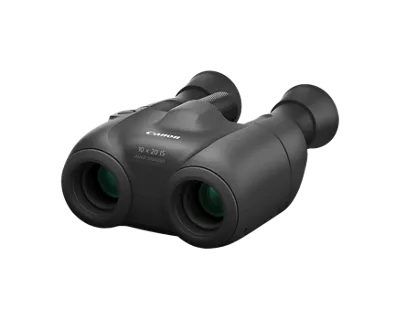
Explore this need in the finder →The Canon 10x20 IS is a stabilized compact for people who value extra nominal reach in a small-objective binocular. Its 10x image can make distant details appear larger, but the trade is a narrower 5.3° real field and a 2.0 mm exit pupil. The 20 mm objectives and 13.5 mm eye relief set practical limits, and the 430 g bare weight is substantial for a compact. Canon labels this model discontinued and no longer available, so this is an identification reference rather than a current buying recommendation.
Reach comes with a narrower view
Canon specifies 10x magnification and a 5.3° real field, equivalent to 93 m (305 ft) across at 1,000 m (1,000 yd). That is more nominal reach than the 8x20 IS, but its real field is narrower: the 8x sibling spans 6.6° (115 m / 377 ft). Both models list a 49.5° apparent field. With a moving bird or a performer crossing a stage, 10x can demand more accurate pointing to find and follow the subject. If relaxed scanning matters more than apparent size, the 8x20's broader field is the more forgiving of these two.
The 10x20's 2.0 mm exit pupil is the ratio implied by 20 mm objectives and 10x power; the 8x20's is 2.5 mm. These are not laboratory brightness ratings, but they clarify why the higher-power model is less tolerant of imperfect eye placement and dim conditions. A 20 mm objective is easy to carry relative to a full-size glass, yet it gathers less light than common 32 mm and 42 mm formats. Stabilization can reduce visible hand shake; it cannot brighten a genuinely dark scene or stop a moving subject.
Stabilization, power and the five-minute mode
Canon uses optical correction with lens shift and publishes a ±0.9° correction angle. The shared English manual offers two ways to run it: tap the Image Stabilizer button for continuous operation up to five minutes, or hold the button for stabilization only while it remains pressed. Canon specifies one CR123A lithium cell. The manual rates continuous operation at approximately 12 hours at 23°C and 8 hours at −10°C under Canon's test conditions; actual battery life can vary with brand. The binocular remains usable as normal optics without a battery, but its powered stabilizer does not.
This system addresses the movement of hands while looking at a relatively stationary subject. It does not stabilize a bird flying through the view, cure an unstable stance or promise a perfectly motionless image. Canon's manual specifically warns that strong body movement, vibration or excessive hand shake can exceed what the stabilizer compensates for. If battery independence matters, a passive compact removes that complication. If powered stabilization is central, compare the Nikon STABILIZED 10x25 S: it is also 10x and uses lens-shift stabilization, but has a 25 mm objective, a 5.4° real field and 14 mm listed eye relief. Nikon also specifies two AA cells and a non-waterproof body.
Body dimensions and viewing fit
At 430 g (15.17 oz) before the cell, the 10x20 is not unusually light simply because the objectives are small. Canon gives a 118 × 142 × 69 mm (4.6 × 5.6 × 2.7 in) body. The Nikon STABILIZED 10x25 S is listed at 405 g without its two AA cells, so the Canon does not automatically win on bare carry weight; compare the complete powered setup and the exact features you need rather than the word “compact.”
Canon lists 13.5 mm eye relief and 56–72 mm interpupillary adjustment. That eye-relief number can help narrow a shortlist, but it cannot guarantee an unvignetted view through every pair of glasses. The focusing system is manual: set the eyepiece width, focus one eye, adjust the other eye's diopter and then focus both together. Canon's specification gives a close-focus distance of approximately 2 m (6.6 ft). The manual's setup directions are worth following rather than relying on a fast out-of-box impression.
Weather, safety and the real use boundary
The shared Canon instructions say the 8x20 and 10x20 bodies are not waterproof and should not be exposed to rain or water spray. No fogproof claim appears in the inspected material. A weatherproof compact is the better direction if accidental wetting is likely; the passive Nikon TRAILBLAZER II 10x25 is a current 10x25 alternative with a waterproof rating, but it does not provide built-in stabilization. The Canon's product name and electronic feature do not imply sealing. Never look at the Sun through these binoculars, and keep the cell safely installed and stored as Canon instructs.
The shared manual lists a case, strap, two eyepiece caps and one CR123A battery as package items. That is Canon's manual list, not proof that every used or reseller package still contains those pieces. Check the exact model marking, the body, optics and battery compartment if inspecting a pre-owned unit. Canon's published specifications do not establish image quality after years of storage or the condition of any particular specimen.
Who should compare it?
Choose the 10x20 IS when you want a 10x view, compact dimensions and hand-shake correction, and accept a small exit pupil, narrower field and battery-managed operation. Choose the 8x20 sibling if easier subject-finding and a wider scene matter more. For a current stabilized 10x compact, compare Nikon's STABILIZED 10x25 S; for waterproofing in a similar 10x25 format, compare a sealed passive option and accept the loss of IS. The U.S. Canon page has contradictory stock information but also labels the 10x20 discontinued and says it is no longer available. Do not treat that as a present Canon offer or assume a secondhand listing is complete.
This is a source-based model assessment built from Canon's exact technical sheet and the shared English operating manual. It does not claim personal ownership, measured shake performance or independent optical testing.
Key specifications
Key details at a glance
| Magnification | 10× |
|---|---|
| Objective diameter | 20 mm |
| Real field of view | 5.3° |
| Apparent field of view | 49.5° |
| Field width at 1,000 m | 93 m |
| Eye relief | 13.5 mm |
More specifications and setup details
| Exit pupil | 2 mm |
|---|---|
| Close focus distance | 6.6 ft |
| Manufacturer-published weight | 15.17 oz |
| Lens and prism coatings | Canon lists Super Spectra Coating; no other coating or glass type is assumed. |
| Manufacturer-rated waterproof | No |
| Built-in image stabilization confirmed | Yes |
| Image-stabilization method | Optical correction with lens-shift |
| Power source | CR123A lithium |
| Batteries required to power stabilization | Yes |
Use the exact model’s instructions for operating limits, supplied equipment and version differences.
Sources for this review
Sources for this assessment
- Canon U.S. binoculars directory, one-page eight-product snapshot
- Canon U.S.A. exact product page: 10 x 20 IS
- Canon exact-model technical specification PDF
- Canon shared 8x20 IS / 10x20 IS English instruction manual
- Canon official binocular manual listing
- Canon official support page for shared manual
- Canon image CDN primary image linked from exact U.S. product page
Choose your optical trade-off first.
Choose viewing purpose first, then magnification, objective size, scene width and any fit, weather or mounting constraint. A direct-Sun requirement is separate: only exact manufacturer-confirmed solar binoculars can pass it.