
On this page
Your needs, this model
Does it fit your priorities?
Do you want the exact R7 15x56 magnification and objective combination?
The exact US page identifies Bushnell R7 15x56, product ID BU-R7-1556, with fixed 15x power and 56 mm objectives. This is a source-checked configuration identity, not an optical-performance test.
Explore this need in the finder →Does a 53.3 oz tripod-oriented R7-1556 fit your support and carry plan, despite its narrower field?
The page lists 53.3 oz and 235 ft at 1,000 yd; the shared manual describes this model for tripod-mounted glassing. The manual and page disagree on eye relief, so no minimum-eye-relief match should be inferred.
Explore this need in the finder →Do you need a confirmed direct tripod socket, and is it acceptable to buy the adapter separately?
The shared R7 manual confirms a covered 1/4-20 tripod socket and calls for a compatible 90-degree binocular adapter such as BU-BAHQRADPT. The adapter and tripod are not in the standard kit; adapter-in-box is not a match. The R7-1556 BridgeSet is an IPD stabilizer, not this mounting bracket.
Explore this need in the finder →The Bushnell R7 15x56 (U.S. product ID BU-R7-1556; manual SKU R7-1556) is the specialized end of the R7 line: high power for stationary, tripod-mounted glassing, not a lighter substitute for the 8x42 or 10x42. Bushnell lists a 235-foot field at 1,000 yards and an instrument weight of 53.3 ounces (1,510 g). Plan the support system and the nearly 3.4-pound optical instrument together before choosing this configuration.
A narrow, high-power view with real support needs
The 15x56 uses fixed 15x magnification, 56 mm objectives, and a 3.5 mm published exit pupil. Its field is 235 feet at 1,000 yards (78 m at 1,000 m), about 4.5 degrees of real field. The manual lists a 13-foot close-focus distance. These dimensions favor looking across distant country from a fixed position over quick handheld scanning. At 15x, hand motion is magnified along with the subject; Bushnell describes this model as designed for tripod-mounted glassing, and a stable support is a sensible operating plan rather than an optional convenience for every user.
The R7 12x50 is the nearest lower-power alternative. It weighs 32.4 ounces and lists 290 feet of field, while the 15x56 jumps to 53.3 ounces and narrows to 235 feet. The 15x56’s 56 mm objectives and Abbe-Koenig prism design distinguish it from the smaller Schmidt-Pechan R7 models. Bushnell lists ED Prime objective glass, PC-3 phase coating, fully multi-coated optics, and Ultra Wideband coating; the page does not list dielectric prism coating for this Abbe-Koenig model. Those are specifications, not proof of any particular low-light or edge-sharpness result.
BridgeSet, tripod port, and what is in the box
The shared R7 manual confirms the exact R7-1556 kit includes a case, BridgeSet IPD stabilizer, neck strap, lens covers, and Spudz cleaning cloth. It does not list the 90-degree binocular-to-tripod adapter or a tripod. The BridgeSet keeps an adjusted interpupillary spacing from changing as easily; it is not the separate bracket needed to mount the binocular on a standard tripod. The manual shows a 1/4-20 threaded socket under a cover and names Bushnell’s compatible BU-BAHQRADPT as an example of the required adapter. Budget for the correct adapter and a support rated for the instrument, rather than treating “tripod compatible” as an all-in-one package.
There is a model-name inconsistency on the exact product page: a paragraph about BridgeSet calls the 15x56 a “Match Pro ED” binocular, while the page title and product ID identify R7-1556 and the manual lists R7-1556 among R7 configurations. I rely on the manual for the R7 kit contents and do not transfer Match Pro attributes. The exact page lists eye relief as 19 mm, while the manual table lists 18.5 mm. Because both are manufacturer sources for this model, the precise value remains unresolved; anyone who needs a minimum eye-relief threshold should not treat either number as a settled matcher pass.
Weather and setup limits
Bushnell lists IPX7 water resistance and nitrogen purging for fog resistance. The manual cautions against deep or prolonged immersion, so the rating should not be interpreted as underwater use or immunity to long-term seal wear. It also warns never to look at the Sun through the optics. The EXO Barrier coating is not a scratch-proof surface: brush or blow away grit before gently cleaning with microfiber, and avoid household window cleaner. The interchangeable eyecups include low, medium, and winged designs; the manual recommends the low profile for glasses, but its fit still depends on the observer and eyeglasses.
Who should consider it?
Choose the R7 15x56 when distant detail and a stationary tripod setup are more important than carry weight, broad field, or quick one-handed observation. If you walk while viewing, carry equipment for long distances, or require an included tripod adapter, the 8x42, 10x42, 10x50, or 12x50 may be a better operational fit. The smaller models still require a separate tripod adapter when mounted, but their instrument weights range from 27.2 to 32.7 ounces. Compare the whole line in the R7 configuration guide. This review does not claim field-tested steadiness, brightness, or resolution; inspect the eye fit and the adapter geometry before committing to the high-power setup.
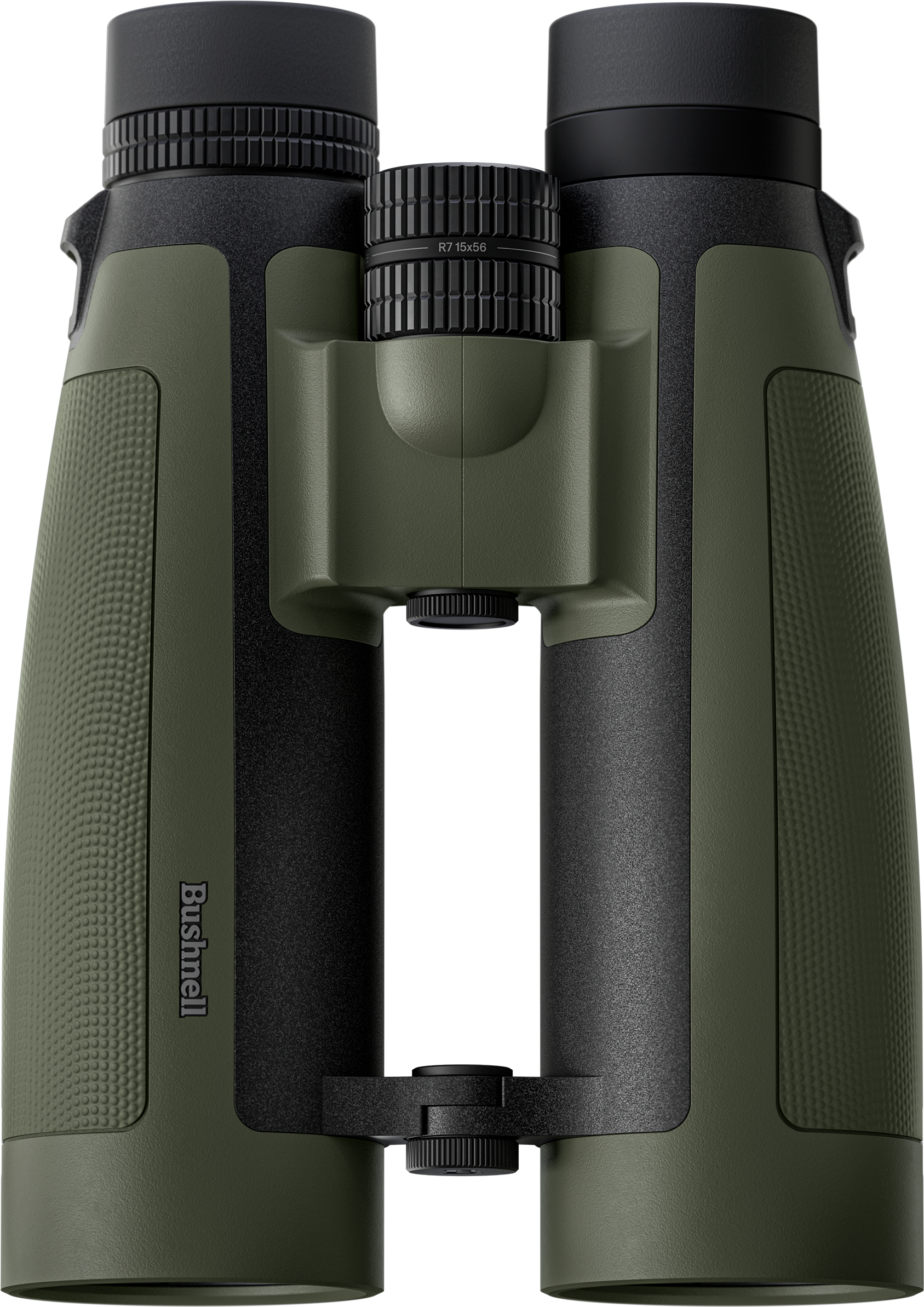
Manufacturer references: the exact R7 15x56 product page and the shared R7 owner’s guide, English pages 3–6. The exact page-linked image is visually identified as R7 15x56; its photo/render method and permission to republish are not established.
Key specifications
Key details at a glance
| Magnification | 15× |
|---|---|
| Objective diameter | 56 mm |
| Real field of view | 4.49° |
| Field width at 1,000 m | 78 m |
| Exit pupil | 3.5 mm |
| Close focus distance | 13 ft |
More specifications and setup details
| Manufacturer-published weight | 53.3 oz |
|---|---|
| ED glass confirmed for this exact model | Yes |
| Phase coatings confirmed | Yes |
| Locking diopter ring confirmed | Yes |
| Lens and prism coatings | Exact page lists ED Prime glass, fully multi-coated optics, Ultra Wideband coating, PC-3 phase treatment and EXO Barrier. The 15x56 page lists Abbe-Koenig prisms and PC-3 phase coating but does not list dielectric coating; no dielectric claim is transferred to it. |
| Water and fog protection | IPX7 per the exact R7 manual; avoid deep or prolonged immersion. Do not interpret as an underwater-use rating. |
| Tripod use | The shared exact R7 manual shows a covered direct 1/4-20 socket and a separate compatible 90-degree adapter (such as BU-BAHQRADPT). That adapter and a tripod are absent from the listed standard kit. For 42 mm models, not all adapters fit the rearward position. |
| Published weight note | Bushnell-listed instrument weight only; pack/harness, strap, caps, tripod adapter and support add carried mass. No independent weighing was performed. |
| Manufacturer-rated waterproof | Yes |
| Built-in image stabilization confirmed | No |
| Integrated laser rangefinder | No |
| Onboard ballistic solution display | No |
| Tripod adapter in package | No |
| Direct 1/4-20 tripod thread confirmed | Yes |
Use the exact model’s instructions for operating limits, supplied equipment and version differences.
Sources for this review
Sources for this assessment
Choose your optical trade-off first.
Choose viewing purpose first, then magnification, objective size, scene width and any fit, weather or mounting constraint. A direct-Sun requirement is separate: only exact manufacturer-confirmed solar binoculars can pass it.