
On this page
Your needs, this model
Does it fit your priorities?
Is fixed 12x50 reach your priority for distant, relatively steady viewing?
The exact BU-R5-1250 page and R5-1250 guide row confirm a fixed 12x50 configuration; use support for prolonged viewing.
Explore this need in the finder →Is 15 mm eye relief acceptable as a screening minimum?
The current exact page and R5 owner guide agree on 15 mm; this does not promise full-field glasses fit.
Explore this need in the finder →Can you supply the separate adapter and tripod for the 12x view?
The manual confirms a 1/4-20 port and example separate adapter; the standard kit has no tripod adapter.
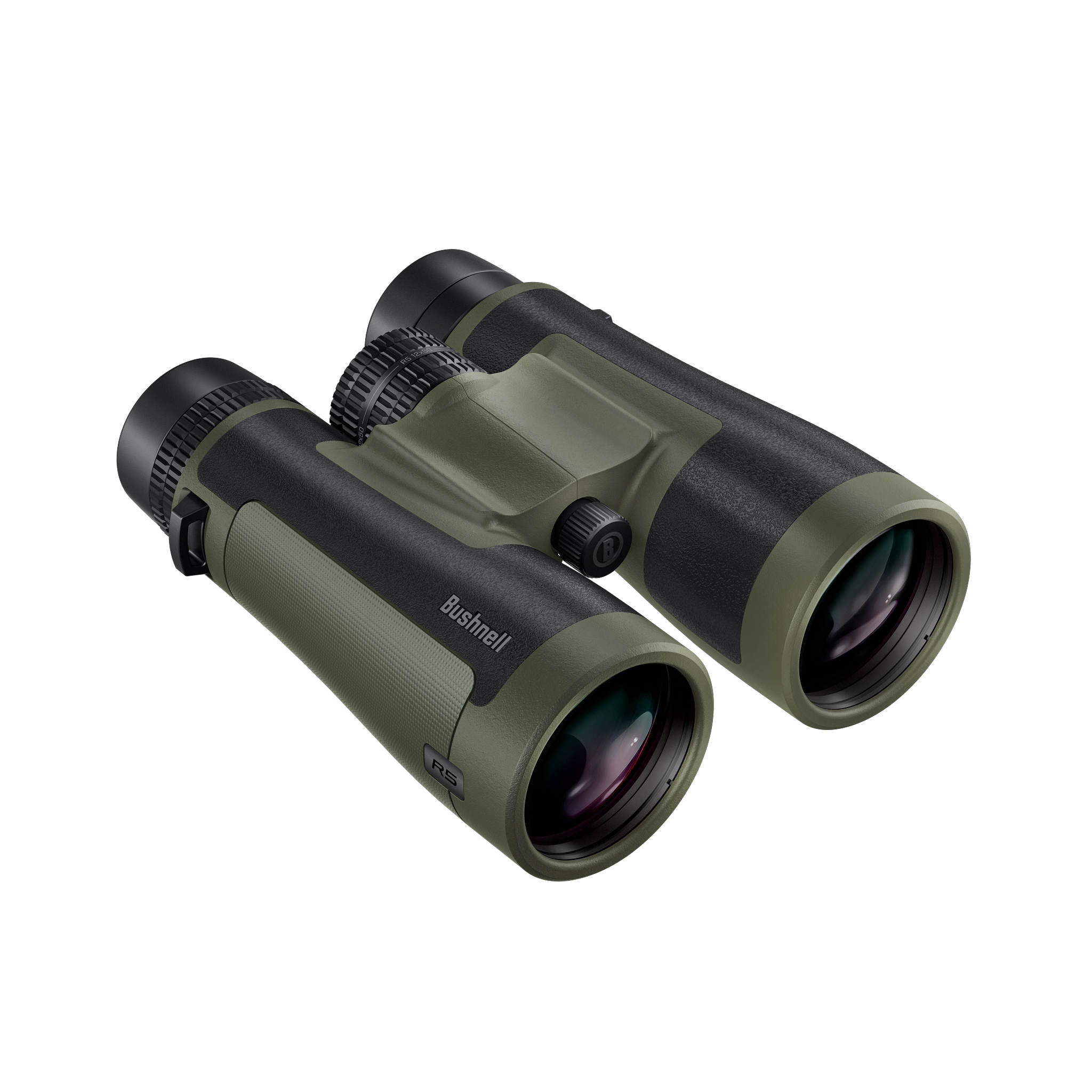
Explore this need in the finder →Bushnell’s R5 12x50 is a fixed-power binocular for more distant viewing than its 8x42 and 10x42 siblings. Its exact U.S. page identifies BU-R5-1250 and currently shows the item out of stock; the owner guide identifies the matching R5-1250 configuration. That stock status is a snapshot, not a reason to erase the model from comparison. The main decision is whether 12x reach and a 50 mm objective justify a heavier, harder-to-steady instrument.
Best suited to open terrain and deliberate viewing
Twelve-power makes distant objects appear larger than in either 42 mm R5. It can be useful when studying an animal across a broad valley or checking a far slope where a lower power leaves too little detail. At 12x, though, small movement of your hands is magnified too. A wide panorama, a bird flitting through nearby branches or repeated quick views favor 8x or 10x more than this high-power setup. The owner guide specifically describes using a compatible tripod adapter for a stable image during prolonged viewing; for this configuration, that is a practical recommendation rather than an optional technical footnote.
The 50 mm objectives gather more light than the 42 mm lenses in the R5 8x42 and 10x42, all else equal, but they do not promise a brighter view in every condition. Actual perceived brightness also depends on magnification, pupil size, coatings, eye position and ambient light. The product page lists a 4.1 mm exit pupil; the simple 50-to-12 geometry is about 4.2 mm. Since the maker’s page and basic optical calculation do not land on the same rounded figure, I do not use that value for a strict low-light cutoff.
Field width, eye relief and weight
Bushnell’s page gives 275 feet at 1,000 yards, while the owner-guide table says 273 feet. They agree on the general narrower-field character of 12x, but their published figures differ; exact field-width matching is left unknown. The two sources agree on 15 mm eye relief. That can be a tight fit for some glasses wearers, and the manufacturer guide’s instructions—eyecups down for glasses, then careful IPD and eye placement adjustment—are only a starting point. Try your own prescription frames before treating the model as a comfortable glasses binocular.
For carry mass, the product page lists 30.6 ounces and the guide lists 30.9 ounces. This is noticeably heavier than the 42 mm R5 models by their published figures, even though the exact threshold remains uncertain. The manual lists dimensions of roughly 6.29 by 5.5 inches and close focus at 10 feet. These are specifications, not a promise of a particular handheld experience. If you plan to hike far or hold the binocular up for extended periods, compare the size and weight in person and plan for a harness or support.
Weather-resistant construction and a separate support setup
The page identifies roof prisms, BaK-4 glass, phase and dielectric prism coatings, fully multicoated lenses, EXO Barrier and IPX7 water resistance. Bushnell describes the coating as repelling water, oil, dust and debris. The owner guide says these binoculars are tested to IPX7 but advises avoiding immersion beyond one meter or 30 minutes. This rating is not permission to use them underwater. The product page’s feature text says nitrogen purging, but its specification block says argon gas purged; the internal fill gas is therefore unresolved even though fogproof construction is described.
The kit described by the guide includes a Vault LITE binocular pack with harness, neck strap, lens cloth, and objective and eyepiece covers. A 1/4-20 socket is covered by a cap and accepts a compatible 90-degree binocular tripod adapter such as Bushnell #161002CM. Neither that adapter nor the tripod is part of the standard kit. Budget and pack for those pieces if a stable 12x image is central to your use. The guide also recommends removing dust before wiping, using a soft microfiber cloth, and avoiding rough paper or household window cleaners.
Should you wait for this model?
Consider the R5 12x50 if distant open-country observation is your priority, you accept the extra size, and you can steady it on a support or in a deliberate rest. Its current page shows it out of stock, so any eventual availability, price or retail offer must be checked at the time of shopping. Do not substitute another R5 size simply because the badge is the same: the 8x42 is more forgiving for broad, moving scenes, and the 10x42 sits between them in power but has unresolved page/manual conflicts for field, eye relief and weight. If you require a product that is immediately available, choose based on verified stock rather than an outdated listing. None of these ordinary binoculars is safe for direct solar viewing.
Sources: Bushnell’s R5 12x50 U.S. product page, the R5 binoculars collection, and the R5 owner guide, revision 09-25 (English pages 1–6). The exact page-linked image visually appears to be a product rendering. Bushnell does not state image creation method or permission to republish in the reviewed material.
Key specifications
Key details at a glance
| Magnification | 12× |
|---|---|
| Objective diameter | 50 mm |
| Eye relief | 15 mm |
| Close focus distance | 10 ft |
| ED glass confirmed for this exact model | No |
| Phase coatings confirmed | Yes |
More specifications and setup details
| Locking diopter ring confirmed | No |
|---|---|
| Water and fog protection | The page lists IPX7; the R5 owner guide advises avoiding immersion beyond 1 m or longer than 30 minutes. This is not an underwater-use rating. |
| Tripod use | The R5 guide describes a covered direct 1/4-20 socket and a separate compatible 90-degree adapter (Bushnell #161002CM is an example). Neither the adapter nor tripod is listed in the standard kit. |
| Published weight note | Exact page: 30.6 oz. R5 09-25 manual: 30.9 oz. Hard weight remains null; no independent weighing. |
| Manufacturer-rated waterproof | Yes |
| Built-in image stabilization confirmed | No |
| Integrated laser rangefinder | No |
| Onboard ballistic solution display | No |
| Tripod adapter in package | No |
| Direct 1/4-20 tripod thread confirmed | Yes |
Use the exact model’s instructions for operating limits, supplied equipment and version differences.
Sources for this review
Sources for this assessment
Choose your optical trade-off first.
Choose viewing purpose first, then magnification, objective size, scene width and any fit, weather or mounting constraint. A direct-Sun requirement is separate: only exact manufacturer-confirmed solar binoculars can pass it.