
On this page
Your needs, this model
Does it fit your priorities?
Does the 12x50 meet a fixed 12x/50 mm request?
Yes. Athlon’s exact product page and sheet identify 12x50, SKU 113006.
Explore this need in the finder →Can it be tripod-adapted for steadier use?
Athlon and the shared Midas manual confirm a tripod adapter socket. Adapter-in-box status is not established and should be checked separately.
Explore this need in the finder →Can the 113006 meet a strict 29 oz maximum based on Athlon’s published sources?
No reliable weight can be confirmed: the exact page and SKU sheet say 28.5 oz, while the 2025 catalog chart says 32 oz. Unknown does not pass a hard ceiling.
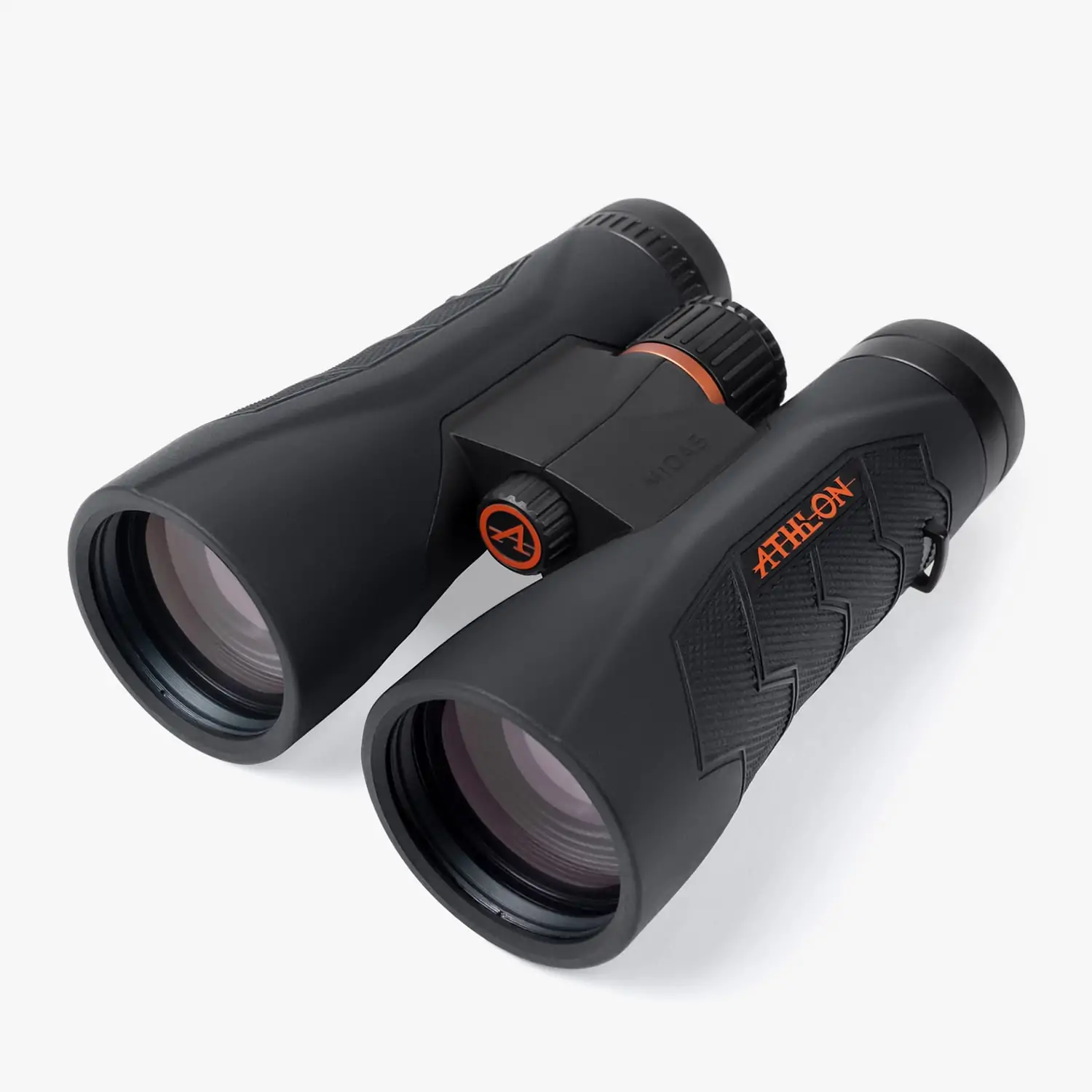
Explore this need in the finder →The Athlon Midas G2 UHD 12x50 is the highest fixed magnification among the five standard Midas G2 UHD binoculars. Its exact product page and 113006 sheet list 28.5 ounces, but Athlon’s 2025 comparison chart lists 32 ounces; the official-source disagreement is unresolved, so weight cannot satisfy a strict maximum. It has 50 mm objectives, 15.0 mm eye relief, a 5.4-degree field (281 feet at 1,000 yards) and an 11.5-foot close-focus distance. It suits someone who deliberately prioritizes more reach over easy subject finding and close viewing. The same 50 mm body is available at 10x, with a substantially wider published field.
More magnification, narrower scene
The 12x label is the key choice. Compared with 10x50, it gives more enlargement on distant objects but reduces the listed field from 341 to 281 feet at 1,000 yards. The angular field drops from 6.5 to 5.4 degrees. That narrowing can make it harder to locate an animal or keep a moving subject in view, especially when beginning a scan. It also makes small hand motion more visible than on the 8x42 or 10x choices; Athlon does not list stabilization for this model, so think about whether your viewing style benefits from a tripod-supported position.
The exact pages and specification sheets list both standard 50 mm Midas models at 28.5 ounces, while Athlon’s 2025 chart lists both at 32 ounces. The sources agree on their relative listed mass but conflict on the absolute value, so neither should pass a strict weight ceiling. The chart gives both bodies as 6.7 by 5.4 inches. If you will wear binoculars for a long outing, account for a strap or harness as well. If you mostly watch birds at close-to-medium distances through brush, the broad-field 8x42 is more forgiving; for distant inspection the 12x50 has a clearer optical case.
Close focus and eye relief are constraints
Athlon gives 15.0 mm eye relief, the shortest figure in the five standard Midas UHD options. It also lists a close-focus distance of 11.5 feet, the longest among them. These specifications place the 12x50 toward distant viewing and away from nearby observation. Anyone who wears glasses should check full-field visibility rather than assume the eye-relief number will work. The 59–74 mm interpupillary adjustment range also deserves attention if the binocular is shared between users.
The other 50 mm option, 10x50, keeps the same listed objective and weight but has 16.9 mm eye relief, focuses to 9.8 feet and provides a 341-foot field. That combination is a better compromise for viewers who want the larger objective without the tightest field and shortest eye-relief figure. The 8x42 goes further toward broad viewing: a 426-foot field, 17.2 mm eye relief and 6.5-foot close focus at a 23.3-ounce listed weight.
Optical claims and tripod setup
Athlon describes the standard Midas G2 UHD family as using extra-low-dispersion UHD glass, fully multi-coated lenses, BaK-4 prisms, phase and ESP dielectric coatings, XPL exterior lens protection, a magnesium chassis and argon purging. The exact page lists waterproof construction. Those are maker specifications, not independent optical measurements or an immersion rating. The manual warns against pointing the binocular at the Sun and advises careful lens cleaning. Clearing dust before wiping is more useful than relying on an exterior-coating label as if it made the glass scratchproof.
The same Midas manual explains eyecup adjustment, center focusing, right-side diopter adjustment and a 1/4-20 tripod-adapter socket. A tripod-compatible socket makes support possible, but the page does not confirm an adapter is included. If your plan depends on a tripod, confirm the required adapter and its compatibility before buying. For handheld use, the higher power may be less comfortable for a viewer who has trouble holding a steady view; that is a handling consideration, not a laboratory result.
Who should keep looking
Choose 12x50 when extra magnification is central, your observations tend to be farther away and you are willing to accept a narrower scene, shorter eye relief and more distant minimum focus. Prefer 10x50 for a wider view at the same objective diameter; exact weight is unresolved for both 50 mm options. Prefer 10x42 if its smaller labeled dimensions matter more than moving up to a 50 mm objective. Prefer 8x42 if quick scanning and close-to-midrange observation dominate. The 10x25 is the pack-light choice but is a very different compact design: it weighs 8.3 ounces, has a 285-foot field and 25 mm objectives. The Midas Pro 12x50 is another 12x50 option, but adds a manual ATBR MIL reticle and has a manufacturer weight discrepancy; it is for users who need that feature, not a drop-in equivalent to this standard binocular.
Manufacturer references: Athlon’s exact Midas G2 UHD 12x50 page, linked 12x50 specification sheet and Midas G2 UHD manual.
Key specifications
Key details at a glance
| Magnification | 12× |
|---|---|
| Objective diameter | 50 mm |
| Real field of view | 5.4° |
| Eye relief | 15 mm |
| Close focus distance | 11.5 ft |
| ED glass confirmed for this exact model | Yes |
More specifications and setup details
| Phase coatings confirmed | Yes |
|---|---|
| Lens and prism coatings | Athlon lists ED objective glass, phase-corrected BaK-4 roof prisms, ESP dielectric reflective coating, and advanced fully multicoated optics. These manufacturer specifications are not independent comparative test results. |
| Water and fog protection | Athlon describes the construction as waterproof and argon-purged. The reviewed exact page/sheet do not publish an IP rating or immersion depth/time; do not infer underwater use. |
| Tripod use | Manufacturer manual confirms a tripod-adapter socket / adaptability; tripod adapter included in the retail box is unknown. |
| Published weight note | Exact 113006 product page and sheet report 28.5 oz; Athlon 2025 catalog printed pp.24–25 reports 32 oz. Unresolved official-source conflict; weight is unknown for hard matching. Not independently weighed; accessory mass is separate. |
| Manufacturer-rated waterproof | Yes |
| Integrated laser rangefinder | No |
| Onboard ballistic solution display | No |
Use the exact model’s instructions for operating limits, supplied equipment and version differences.
Sources for this review
Sources for this assessment
- Athlon U.S. binocular family category index
- Athlon Midas G2 UHD binocular category
- Athlon exact Athlon Midas G2 UHD 12x50 product page
- Athlon exact Athlon Midas G2 UHD 12x50 specification sheet
- Athlon Midas G2 UHD family manual
- Athlon 2025 official product catalog, printed binocular comparison pages 24–25
Choose your optical trade-off first.
Choose viewing purpose first, then magnification, objective size, scene width and any fit, weather or mounting constraint. A direct-Sun requirement is separate: only exact manufacturer-confirmed solar binoculars can pass it.