
On this page
A 12x50 with Athlon's ATBR MIL manual scale
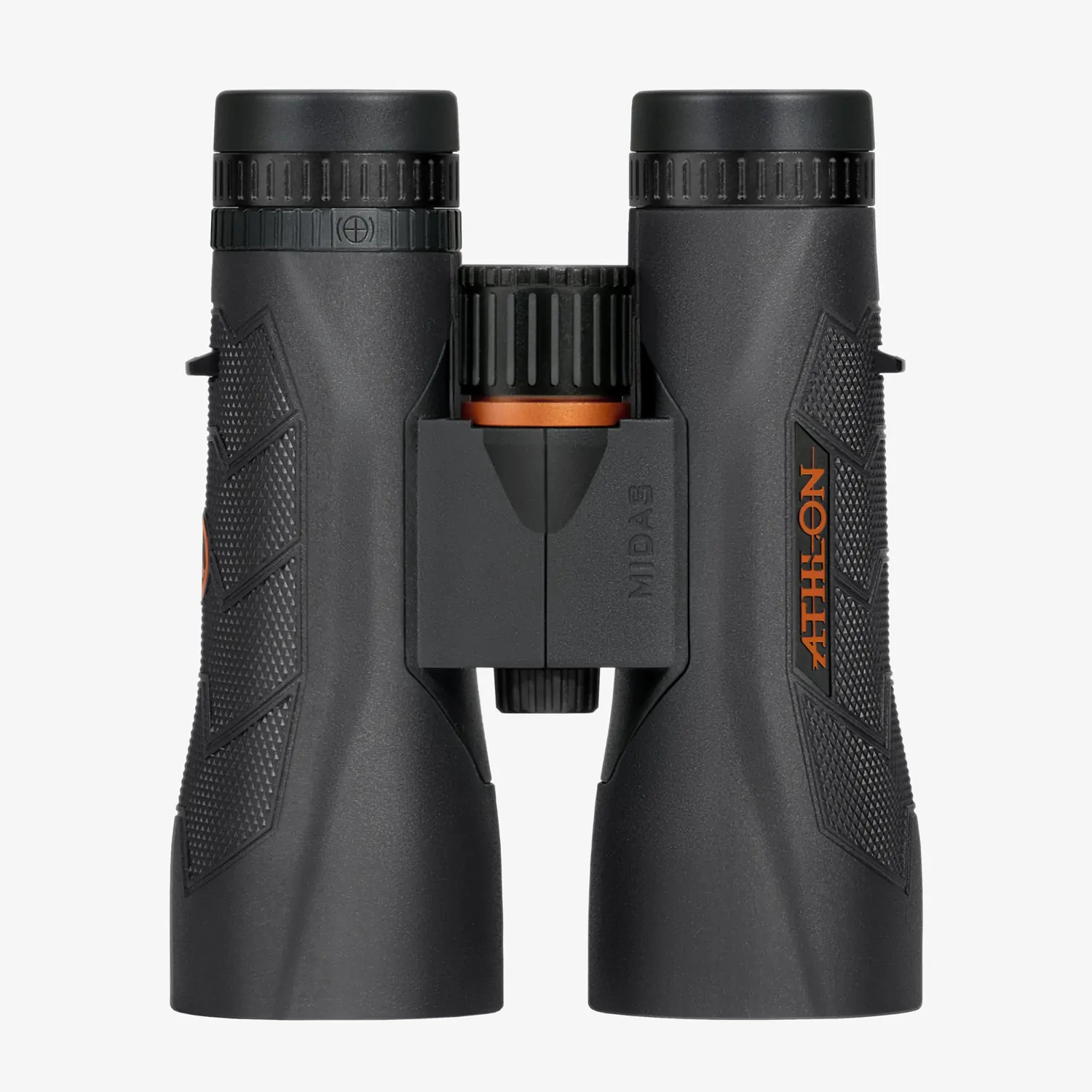
The exact Midas G2 Pro 113011 adds an ATBR MIL reticle to a fixed 12x50 view. Its page lists a 5.4° real field and 15 mm eye relief, while conflicting official weight records leave its mass unresolved; use the MIL answer for the scale and do not treat it as laser ranging.
Explore the needs this model fits
Your needs, this model
Does it fit your priorities?
Does this model confirm a manual optical reticle in MIL?
Yes. The 113011 product page and manual identify Athlon’s ATBR MIL reticle. It requires a known target size for ranging estimates and does not supply a laser distance or computed trajectory.
Explore this need in the finder →Does the Pro match fixed 12x magnification and 50 mm objectives?
Yes. The exact page and spec identify SKU 113011 as a fixed 12x50 configuration, with the added reticle feature.
Explore this need in the finder →Does its published eye relief clear a 15 mm minimum?
The page and exact spec sheet list 15 mm. That is the stated optical figure, not a guarantee that glasses or a particular facial geometry will give the full field.
Explore this need in the finder →The Athlon Midas G2 UHD Pro 12x50 is the specialist member of the Midas binocular family. It combines 12x magnification and 50 mm objectives with an ATBR MIL reticle, which the manufacturer describes as an aid to ranging and correction. Athlon lists a 5.4-degree field (281 feet at 1,000 yards), 15.0 mm eye relief, 11.5-foot close focus and 59–74 mm interpupillary adjustment. Choose it when the manual reticle is a real need; otherwise the standard Midas 12x50 has the same headline power and field without the reticle feature.
A reticle changes the job
Athlon’s product sheet identifies an etched ATBR MIL reticle and its manual includes separate setup steps for diopter, reticle focus and reticle leveling. That matters because this is not just a standard viewing binocular with a decorative mark. The user needs to set the reticle to a clear, level appearance and understand the subtensions before relying on it for ranging or correction. The reticle is manual optical information: the product page and materials do not identify an integrated laser rangefinder, GPS, ballistic computer or trajectory solution. If you require electronic distance measurement or a specific ballistic output, this configuration should not be treated as satisfying that requirement merely because it has an MIL reticle.
The 12x power can help inspect a distant scene, while the 281-foot published field remains comparatively narrow. That trade is shared with the standard Midas 12x50. The 10x50 offers 341 feet at 1,000 yards, and the 8x42 opens the scene to 426 feet. For walking birding or frequent scanning, those wider fields can be easier. For an observation point where the subject is distant and the reticle’s scale is useful, the Pro’s more specialized role is easier to justify.
Size, weight, and the evidence conflict
The current exact product page and linked 113011 specification sheet list the Pro at 32 ounces and 6.5 by 5.1 inches. Athlon’s 2025 catalog instead gives a weight of 30.5 ounces for the same named 12x50 Pro. Because the manufacturer sources disagree, this review does not use either number to claim the Pro meets a strict maximum-weight need. The exact body dimensions, field, power, eye relief and reticle description are consistent across the exact product page, current spec sheet and earlier product literature, but the weight should be checked with Athlon before a weight threshold decides the purchase.
The standard Midas 12x50 is also listed at 32 ounces on its exact page and sheet, while the 2025 catalog gives 32 ounces for that standard version. The Pro manual describes a 1/4-20 tripod-adapter socket; Athlon’s product material also mentions an Arca plate for mounting. Compatibility is supported, but the exact box contents do not confirm that a separate tripod adapter is included. If mounted use is essential, check the interface you plan to use and any adapter you need.
Set up both image and reticle
Standard binocular setup still applies: set eyecups to your viewing position, adjust interpupillary distance until both eyes see one field, and focus the main wheel. Athlon’s Pro manual adds reticle-specific steps. It directs the user to focus the binocular image first, set the diopter for image sharpness, bring the reticle into focus separately, and level the reticle against a level target or horizon. The maker says the interpupillary setting can affect apparent reticle level, so that alignment should be rechecked for the way you hold the binocular. Do not assume that a reticle is ready for use out of the box or that it measures distance by itself without a known target size and correct technique.
Athlon calls the Pro waterproof and argon-purged, and lists UHD extra-low-dispersion glass, fully multi-coated lenses, BaK-4 prisms, phase and dielectric coatings, a magnesium chassis and XPL exterior coating. Those are maker claims, not an independent optical or impact test. No immersion rating appears in the reviewed exact spec sheet, so do not submerge the binocular. The manual also warns against looking directly at the Sun. Its care section advises removing grit before lens wiping and using microfiber rather than rough cloth.
Pro or standard Midas?
If your ordinary use is wildlife, birding or travel and you do not need a ranging reticle, the standard 8x42, 10x42, 10x50 or 12x50 is simpler to match to view width, objective size and carried bulk. The standard 12x50 shares the Pro’s 12x, 50 mm, 5.4-degree field and 281-foot linear field, while its source does not describe the ATBR MIL reticle. The Pro is the one to compare when the reticle’s ranging/correction role is specifically wanted and you are prepared to learn its setup. A strict weight limit or a required electronic range measurement points elsewhere until Athlon resolves the documentation and confirms the feature you actually need.
Manufacturer references: exact Midas G2 UHD Pro 12x50 page, 113011 specification sheet, Pro manual and Athlon’s 2025 catalog weight entry. The conflicting official weights remain unresolved rather than converted into a hard-fit fact.
Key specifications
Key details at a glance
| Magnification | 12× |
|---|---|
| Objective diameter | 50 mm |
| Real field of view | 5.4° |
| Eye relief | 15 mm |
| Close focus distance | 11.5 ft |
| ED glass confirmed for this exact model | Yes |
More specifications and setup details
| Phase coatings confirmed | Yes |
|---|---|
| Lens and prism coatings | Athlon lists ED objective glass, phase-corrected BaK-4 roof prisms, ESP dielectric reflective coating, and advanced fully multicoated optics. These manufacturer specifications are not independent comparative test results. |
| Water and fog protection | Athlon describes the construction as waterproof and argon-purged. The reviewed exact page/sheet do not publish an IP rating or immersion depth/time; do not infer underwater use. |
| Tripod use | Manufacturer manual confirms a tripod-adapter socket / adaptability; tripod adapter included in the retail box is unknown. |
| Published weight note | Exact page and spec sheet list 32 oz, but Athlon’s 2025 catalog lists 30.5 oz; weight left unknown for hard matching. |
| Manufacturer-rated waterproof | Yes |
| Integrated laser rangefinder | No |
| Onboard ballistic solution display | No |
| Optical ranging-reticle format | ATBR MIL |
Use the exact model’s instructions for operating limits, supplied equipment and version differences.
Sources for this review
Sources for this assessment
Choose your optical trade-off first.
Choose viewing purpose first, then magnification, objective size, scene width and any fit, weather or mounting constraint. A direct-Sun requirement is separate: only exact manufacturer-confirmed solar binoculars can pass it.
Your needs, this model
Binoculars with manual known-size ranging reticles
Choose it when: This exact 113011 configuration is the lower-power MIL choice among the two products returned by the MIL-unit question. Athlon's manual identifies the ATBR MIL scale and explains its milliradian subtensions; its product page lists a 5.4° real field and 15 mm eye relief.
Binoculars with manual known-size ranging reticles →Binoculars with a confirmed MIL ranging reticle
Choose it when: Choose the exact 113011 configuration when the ATBR MIL scale is the relevant pattern and a fixed 12x50 is preferable to the B.5's 18x56. The product page lists a 5.4° real field and 15 mm eye relief; Athlon's manual describes the ATBR MIL subtensions and reticle setup.
Binoculars with a confirmed MIL ranging reticle →