
On this page
Your needs, this model
Does it fit your priorities?
Does the exact SKU 111005 meet a fixed 15x56 preference?
Yes. Athlon’s exact product page and 111005 sheet identify a fixed 15x56 configuration.
Explore this need in the finder →Can this setup meet a tripod-support requirement?
Yes for compatibility: the Cronus manual specifies a standard 1/4-20 tripod socket. A mounting adapter is separate unless confirmed in the purchased package.
Explore this need in the finder →Does the published 45.2 oz instrument weight fit a 40 oz maximum?
No. The product-specific sheet lists 45.2 oz before any case, strap, adapter or tripod.
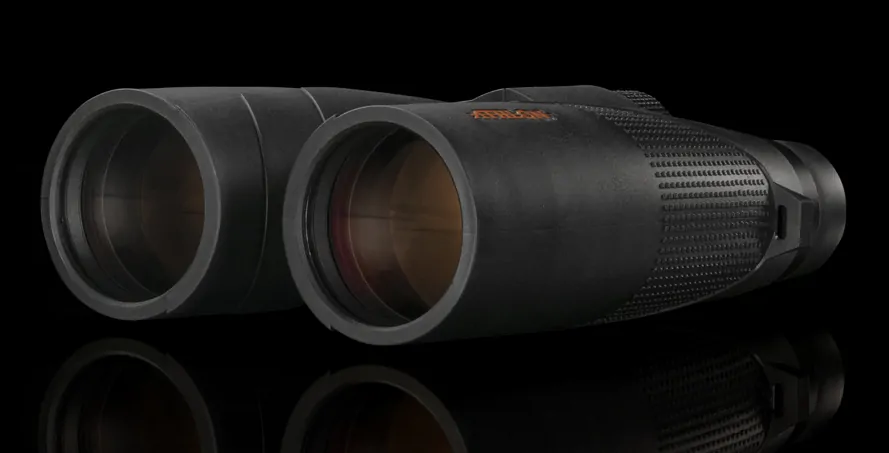
Explore this need in the finder →The Athlon Cronus G2 UHD 15x56 is a fixed 15-power binocular for distant subjects and deliberate viewing positions. Its product-specific sheet lists a 4.5° real field (235 feet per 1,000 yards), 18.5 mm eye relief, a 13.1-foot close-focus distance and 45.2 ounces before a strap, adapter or tripod. That is a different operating choice from a general 10x42: more magnification on paper, but a narrower scene, heavier instrument and much less convenient close focus.
Start with the viewing position
At 15x, a small hand movement takes a larger bite out of the apparent view than it does at 8x or 10x. This is why the maker’s manual and mount interface matter as much as the number on the barrel. The Cronus manual confirms a standard 1/4-20 tripod socket under the center-hinge logo plate. A tripod-supported setup can reduce the burden of holding a 45.2-ounce optic steady for long observation, but the adapter itself is needed and its inclusion in the retail box was not established. For someone who expects to roam and raise the binocular quickly, the lighter 10x42 is the more forgiving choice.
The 4.5° real field works out to 235 feet at 1,000 yards on Athlon’s sheet. That is a relatively narrow window within this pair: the Cronus 10x42 is listed at 6.5° and 338 feet. A stable 15x view can be useful when the target is distant and fairly stationary; locating a moving bird or sweeping a broad hillside will take more deliberate positioning than with the wider 10x42. The magnification does not make an unsteady or poorly aligned view easier to interpret.
Large objectives do not remove every low-light limit
The 56 mm objectives are physically larger than the 42 mm pair, but aperture alone does not establish how bright or detailed a binocular will look to a particular viewer. Athlon publishes this model’s power, field, eye relief, close focus and weight; no independent brightness or resolution result is available here. The practical decision is therefore straightforward: accept the extra mass and narrower field only if the distant-viewing use genuinely rewards 15x. If you need a wide scene or a walk-all-day setup, a lower-power 42 or 50 mm model is a better starting point.
Athlon identifies the optics as UHD/ED glass with phase-corrected Abbe roof prisms, ESP dielectric coating and advanced fully multi-coated lenses. It lists a magnesium chassis and XPL protective exterior lens coating. These are manufacturer-described construction features, not a substitute for a side-by-side test. The exact sheet also lists 18.5 mm of eye relief. That clears an 18 mm numerical requirement, but eyeglass fit still depends on eye position, frame shape and how the eyecups rest against the face.
Check ergonomics, focusing and weather claims
At 45.2 ounces, this is a carried instrument weight, not a complete field kit. A case, strap, adapter and tripod add more. IPD is listed at 59–74 mm, eye relief at 18.5 mm, and close focus at 13.1 feet. The last figure is a meaningful limit for nearby subjects, so do not choose this as a close-range nature companion if your use frequently shifts from distant ridgelines to nearby insects or displays.
The shared Cronus G2 manual describes twist-up eyecups, inter-pupillary adjustment and a locking diopter. Set the eyecups for glasses or no glasses, hinge the barrels until the two circles merge, then set focus for each eye before relying on the center wheel. The manual also confirms the tripod thread and gives simple lens-care instructions. Athlon calls the binocular waterproof and argon purged, but the reviewed page and sheet do not state an IP rating or immersion depth/time. Treat the maker’s weather description as such rather than as an underwater rating.
When this 15x56 is the right answer
This configuration fits a shopper who specifically wants fixed 15x magnification and 56 mm objectives, can view from a support, accepts a field of 235 feet per 1,000 yards and has room for a 45.2-ounce instrument. It should fail a 40-ounce maximum-weight requirement, and its 13.1-foot close focus fails a strict 10-foot maximum. If the aim is a general birding binocular, compare the 10x42: it is lighter by 17.4 ounces, wider in the published field, closer focusing and longer in eye relief. If a tripod-ready long-range view matters more than easy scanning or light carry, this Cronus is the specialized option. The maker’s manual explicitly warns never to look at the Sun; this is an ordinary passive binocular, not a solar-viewing system.
Key specifications
Key details at a glance
| Magnification | 15× |
|---|---|
| Objective diameter | 56 mm |
| Real field of view | 4.5° |
| Eye relief | 18.5 mm |
| Close focus distance | 13.1 ft |
| Manufacturer-published weight | 45.2 oz |
More specifications and setup details
| ED glass confirmed for this exact model | Yes |
|---|---|
| Phase coatings confirmed | Yes |
| Locking diopter ring confirmed | Yes |
| Lens and prism coatings | Athlon specifies UHD/ED glass, phase-corrected Abbe roof prisms, ESP dielectric coating and advanced fully multi-coated optics. These are manufacturer descriptions, not independent comparative test results. |
| Water and fog protection | Athlon describes the instrument as waterproof and argon purged; no immersion depth/time or IP rating was found in the exact page/sheet. |
| Tripod use | The manual confirms the standard 1/4-20 tripod socket. A separate adapter is needed to use a tripod, and whether one is included is unknown. |
| Published weight note | Athlon-listed optical instrument weight only; not independently measured and excludes carrying kit. |
| Manufacturer-rated waterproof | Yes |
| Built-in image stabilization confirmed | No |
| Integrated laser rangefinder | No |
| Onboard ballistic solution display | No |
| Direct 1/4-20 tripod thread confirmed | Yes |
Use the exact model’s instructions for operating limits, supplied equipment and version differences.
Sources for this review
Sources for this assessment

Choose your optical trade-off first.
Choose viewing purpose first, then magnification, objective size, scene width and any fit, weather or mounting constraint. A direct-Sun requirement is separate: only exact manufacturer-confirmed solar binoculars can pass it.