
On this page
A direct-thread 10x42 with support compatibility
The Argos G2 UHD 10x42 manual confirms a direct standard 1/4-20 port and tripod adaptability. Its 6.1° field is an exact-model specification; adapter-in-box status is not established, so confirm the mounting hardware separately.
Explore the needs this model fits
Your needs, this model
Does it fit your priorities?
Would a fixed 10x42 fit a general-viewing choice?
Yes. Athlon names this exact fixed 10x42 configuration and SKU 114011 on its U.S. page and sheet.
Explore this need in the finder →Does its 16.1 mm published eye relief clear a 16 mm minimum?
Yes numerically by 0.1 mm; this is not a guarantee of full-field glasses fit.
Explore this need in the finder →Does the stated 13 ft close-focus distance meet a 13 ft maximum?
Yes at the published boundary; it does not meet a stricter 12 ft maximum.
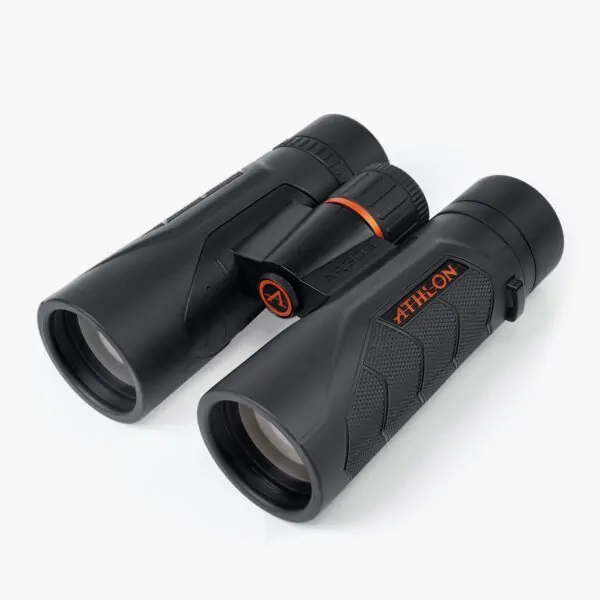
Explore this need in the finder →The Athlon Argos G2 UHD 10x42 is the higher-power option in the Argos pair, with 42 mm objectives, a listed 6.1-degree real field (319 feet at 1,000 yards), 16.1 mm eye relief, 13-foot close focus and a 25.5-ounce instrument weight. It fits a general wildlife or birding plan when you value the extra reach of 10x and accept a narrower scene than the 8x42 version. The pair weighs the same, so magnification—not reduced carry weight—is the key reason to choose it.
Ten power narrows the scene but brings distant subjects closer
When a bird or landmark is far away and relatively still, 10x makes it larger in the view than 8x. The cost is a narrower real field and more sensitivity to hand movement. Athlon lists 319 feet at 1,000 yards for this model and 371 feet for the Argos G2 UHD 8x42. The 8x configuration therefore makes it easier to locate a small subject or keep a moving one in the frame; this 10x model is a better match when you are more often studying distant, stationary details. No specification can tell you which power will feel steady in your hands, so try both if long handheld sessions are central to the plan.
Since both models have the same 42 mm objectives and 25.5-ounce listed mass, the 10x42 does not bring a lighter kit or a larger objective than its sibling. Its 16.1 mm eye relief is also shorter than the 8x42’s 17.3 mm. Those numbers do not prove the 10x will be uncomfortable, but they make the 8x a safer starting point when a wider view or more eye-relief margin is important.
Eye relief and eyecup adjustment
The 16.1 mm manufacturer-listed eye relief clears a 16 mm screening minimum by only 0.1 mm. A number just above a threshold is not an assurance that glasses will fit or that the full field will remain visible. Athlon’s Argos G2 UHD manual explains that the twist-up eyecups should be fully lowered when wearing eyeglasses or sunglasses; it also describes setting interpupillary distance, focusing with the center wheel and fine-tuning the right eye with the diopter ring. That adjustment sequence can help tailor the binocular, but individual face shape and frame thickness still require a hands-on fit check if glasses use is essential.
Thirteen feet is not close focus
Athlon lists a 13-foot close-focus distance for the Argos 10x42. That is a straightforward limitation for nearby observation: a requirement to focus at 12 feet or closer does not fit the published figure. The same 13-foot value applies to the 8x42 sibling, so changing magnification within this pair does not solve a close-focus need. For closer wildlife or objects in a garden, compare models with a shorter manufacturer-listed distance rather than assuming focus travel will compensate.
Construction claims and the weather boundary
The exact product page and specification sheet describe UHD/extra-low-dispersion glass, BaK-4 prisms, phase correction, ESP dielectric prism coating, XPL protective coating and advanced fully multi-coated lenses. A magnesium chassis is listed as well. These facts identify the construction and coatings; they are not an independent measurement of resolution, color fringing, transmission or low-light brightness, and I do not treat them as a substitute for such testing.
Athlon describes this binocular as waterproof and fog-proof and says it is argon-purged. The inspected manufacturer material does not supply an IP rating, immersion depth or exposure duration. Treat the rating as a general weather-resistance claim, not a license to submerge it. The manual’s care instructions are practical: first remove grit with a soft lens brush or air, then use a clean microfiber cloth; coarse or dirty fabric can damage the lens surface.
Mounting and package uncertainty
The standard 1/4-20 tripod socket is confirmed in the shared Argos G2 UHD manual, beneath the center-hinge logo plate. This supports a tripod-mounted operating plan with compatible hardware, but a separate adapter may be needed and whether an adapter is included in the retail package is not confirmed by the reviewed sources. The ordinary plan remains handheld 10x42 use; use support when steadiness matters more than quick movement, not because the maker promises a stabilized image.
Who should choose the 10x42?
Choose it if your everyday answers are fixed 10x, a 42 mm objective, waterproofing and an adequate 16.1 mm eye-relief figure. It is the more reach-oriented Argos 42 mm choice, not a general upgrade over 8x. The Argos 8x42 provides a broader 7.1-degree field and longer 17.3 mm eye relief at the same listed mass and close-focus distance, so it is more persuasive for finding moving subjects or maximizing glasses margin.
Also compare Athlon’s Midas G2 UHD 10x42 if you want 10x but a lighter and wider-listed configuration: its exact sheet reports 23.3 ounces, a 6.5-degree field, 15.2 mm eye relief and 8.2-foot close focus. The Argos reports 25.5 ounces, 6.1 degrees, 16.1 mm and 13 feet. Those tradeoffs may favor different users; they do not establish a tested image-quality winner. Verify that the chosen viewing plan meets your close-focus and fit needs, and do not use either pair to view the Sun.
Manufacturer references: Argos G2 UHD 10x42 product page and 10x42 specification sheet.
Key specifications
Key details at a glance
| Magnification | 10× |
|---|---|
| Objective diameter | 42 mm |
| Real field of view | 6.1° |
| Field width at 1,000 m | 106 m |
| Eye relief | 16.1 mm |
| Close focus distance | 13 ft |
More specifications and setup details
| Manufacturer-published weight | 25.5 oz |
|---|---|
| ED glass confirmed for this exact model | Yes |
| Phase coatings confirmed | Yes |
| Lens and prism coatings | Manufacturer lists UHD/extra-low-dispersion glass, phase-corrected BaK-4 prisms, ESP dielectric coating, XPL protective coating and advanced fully multi-coated lenses. Prism geometry and all-prism multilayer coating status are not separately stated. |
| Water and fog protection | Manufacturer states waterproof, fog-proof and argon-purged; no immersion rating is published in the reviewed page/sheet. |
| Tripod use | The manual confirms a socket beneath the center-hinge logo plate with standard 1/4-20 threads. A separate adapter may be needed; box inclusion is unknown. |
| Published weight note | Instrument weight as published on the product-specific specification sheet; the separately listed 2.5 lb package weight is not the binocular mass. |
| Manufacturer-rated waterproof | Yes |
| Direct 1/4-20 tripod thread confirmed | Yes |
Use the exact model’s instructions for operating limits, supplied equipment and version differences.
Sources for this review
Sources for this assessment

Choose your optical trade-off first.
Choose viewing purpose first, then magnification, objective size, scene width and any fit, weather or mounting constraint. A direct-Sun requirement is separate: only exact manufacturer-confirmed solar binoculars can pass it.
Your needs, this model
Binoculars with a direct standard 1/4-20 tripod port
Choose it when: The exact manual confirms the center-hinge socket uses standard 1/4-20 threads, and this 10x42 remains a conventional field-viewing configuration.
Binoculars with a direct standard 1/4-20 tripod port →