
On this page
Your needs, this model
Does it fit your priorities?
Would a fixed 12x50 suit a long-range general-viewing choice?
Yes. The exact listing and sheet identify the fixed 12x50 configuration, though its field is narrower than the lower-power siblings.
Explore this need in the finder →Does the published 16 mm eye relief clear a 16 mm floor?
Yes exactly at the stated value; it is the shortest eye-relief figure in this four-model family and does not guarantee a glasses fit.
Explore this need in the finder →Does a 13 ft close-focus maximum accept its stated 13 ft limit?
Yes at equality. A stricter 12 ft requirement would reject it.
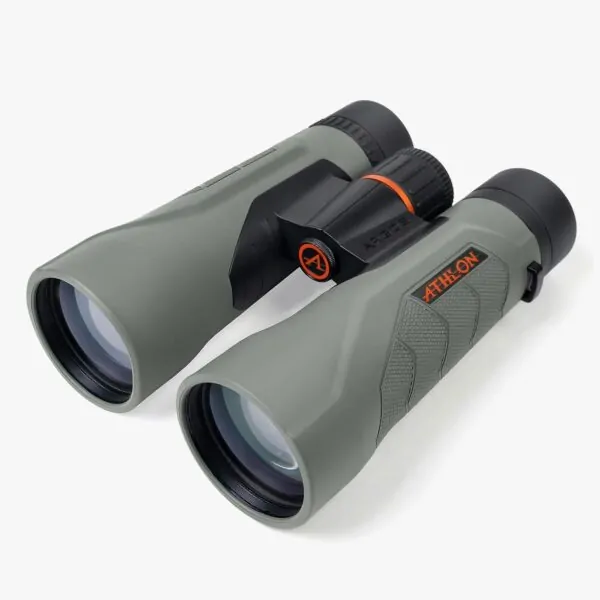
Explore this need in the finder →The Athlon Argos G2 HD 12x50 (SKU 114007) is the highest-power configuration in the four-model Argos HD family. It uses the same 50 mm body and listed 31.5-ounce weight as the 10x50, but narrows the published real field to 4.9 degrees (257 feet at 1,000 yards) and reduces eye relief to 16 mm. Choose it for extra reach on distant, mostly stationary subjects when a tight frame and careful support are acceptable.
What 12x adds—and what it takes away
The 12x50 is not a larger or heavier body than Athlon’s 10x50 on the published specification sheet. Its distinction is power: more apparent reach for a distant landmark, wildlife across a field or other subject that does not move quickly. Higher magnification also magnifies hand motion, and the 257-foot field is the narrowest among the four Argos G2 HD models. Finding a bird in branches or following an animal across a hillside is therefore more demanding than through the 10x50’s 304-foot field, let alone the 8x42’s 371-foot view.
For extended viewing, a stable stance or tripod adapter setup can help. That is a practical use of the manual-confirmed 1/4-20 adapter socket, not a claim that the binocular includes a mount or will always be steady handheld. A 31.5-ounce body is substantial to carry, and this version does not get lighter than the lower-power 10x50. If easy scanning is more important than additional magnification, the 10x50 is the more relaxed choice within the same size class.
Eye relief, nearby subjects and setup
Athlon lists 16 mm eye relief and a 56–76 mm interpupillary range. The 16 mm number is the shortest among these four Argos HD configurations. It is a published value, not proof of full-field access with glasses; frames and eye position differ. The shared 50 mm manual tells users to turn eyecups down for glasses, adjust barrel spacing until a single full circle is visible, focus the left barrel with the center control, and then set the right-eye diopter. If glasses fit is essential, try the exact model rather than assuming a numerical threshold guarantees it.
The listed close-focus distance is 13 feet, just like the rest of this family. A 12x instrument with that near limit is oriented toward distant viewing rather than close-in nature study. If the questionnaire says close focus must be 12 feet or less, this model must be excluded; it does not meet that hard limit by rounding.
Construction claims without invented test results
The exact manufacturer sheet identifies the SKU and lists BaK-4 prisms, phase-corrected prisms, ESP dielectric coating, XPL protection on exterior lenses, advanced fully multi-coated lenses and magnesium chassis. Athlon describes the HD glass family as low-dispersion. Its separate UHD models use the UHD/extra-low-dispersion label; that difference is a reason to compare line names and exact product pages, not to assume a particular real-world advantage without a controlled test. No measured sharpness, color-fringe, durability or low-light results are claimed here.
The product page calls the 12x50 waterproof and argon-purged, and the category describes argon purging as supporting fog-proof capability. The exact sources do not publish an IP rating or immersion depth and duration. Treat the weather wording as a manufacturer construction claim, not an underwater-use rating. Follow the lens-care instructions and remove grit before wiping so debris does not drag across the glass.
When this is the right Argos configuration
Choose the 12x50 when a distant subject benefits from higher fixed power, the narrow field is acceptable and you can support or steady the binocular as needed. The 10x50 is the direct same-weight alternative if you want a wider field and 1 mm more stated eye relief. The 10x42 loses six ounces relative to the 50 mm models and keeps 10x power, although it has a smaller objective. The 8x42 is the scanning-first choice and offers the broadest published field. For a 12x50 with an explicitly UHD-designated glass option, compare the reviewed Athlon Midas G2 UHD 12x50; its family and optical claims differ, so compare its exact specifications rather than assuming the products are the same.
For general birding with quick subject acquisition, frequent carry or close subjects, another configuration may better match the outing. The Argos HD 12x50’s 4.9-degree field and 13-foot close focus should be part of the decision, not footnotes. It is a standard binocular, not a direct-solar instrument; the manual says never to look directly at the Sun.
Manufacturer references: Argos G2 HD 12x50 product page, 12x50 specification sheet, and Argos G2 HD 50 mm manual.
Key specifications
Key details at a glance
| Magnification | 12× |
|---|---|
| Objective diameter | 50 mm |
| Real field of view | 4.9° |
| Field width at 1,000 m | 86 m |
| Eye relief | 16 mm |
| Close focus distance | 13 ft |
More specifications and setup details
| Manufacturer-published weight | 31.5 oz |
|---|---|
| Phase coatings confirmed | Yes |
| Lens and prism coatings | The exact sheet lists HD family glass, BaK-4 prisms, phase correction, ESP dielectric coating, XPL exterior coating and advanced fully multi-coated lenses. Athlon describes HD glass as low dispersion but does not identify this SKU as UHD/extra-low-dispersion; explicit ED glass status is left unknown. |
| Water and fog protection | Athlon describes the Argos G2 HD as waterproof and argon-purged/fog protective; reviewed sources publish no IP rating, immersion depth or underwater-use condition. |
| Tripod use | The shared family manual confirms a socket with standard 1/4-20 threads. A compatible tripod adapter is needed; retail box inclusion is unknown. |
| Published weight note | Instrument weight as published on the exact product-specific specification sheet; package weight is separately stated and is not the binocular mass. |
| Manufacturer-rated waterproof | Yes |
| Integrated laser rangefinder | No |
| Onboard ballistic solution display | No |
| Direct 1/4-20 tripod thread confirmed | Yes |
Use the exact model’s instructions for operating limits, supplied equipment and version differences.
Sources for this review
Sources for this assessment
- Athlon U.S. binocular family index
- Athlon Argos G2 HD U.S. category
- Athlon Argos G2 HD 12x50 exact manufacturer product page
- Athlon Argos G2 HD 12x50 product-specific specification sheet
- Athlon Argos G2 HD 50 mm binocular manual
- Athlon Argos G2 HD 12x50 manufacturer page-linked image
- CPSC recalls search (Athlon Argos G2 HD / SKUs 114010–114007)

Choose your optical trade-off first.
Choose viewing purpose first, then magnification, objective size, scene width and any fit, weather or mounting constraint. A direct-Sun requirement is separate: only exact manufacturer-confirmed solar binoculars can pass it.