
On this page
Your needs, this model
Does it fit your priorities?
Does the earlier Ares 8x36 fit an ordinary 8x/36 mm viewing plan?
Yes when earlier models are deliberately included. Its exact Athlon product page identifies SKU 112004 and fixed 8x36 configuration; the questionnaire now distinguishes 36 mm objectives.
Explore this need in the finder →Does the 14.9 mm stated eye relief clear a 14.5 mm minimum?
Yes, narrowly. A 24 oz maximum rejects it; the specification excludes the strap and any other carrying gear.
Explore this need in the finder →Does the listed 6.5 ft close focus meet a 7 ft maximum?
Yes. The manufacturer lists 6.5 ft close focus, which meets a 7 ft maximum; a stricter 6 ft maximum excludes it.
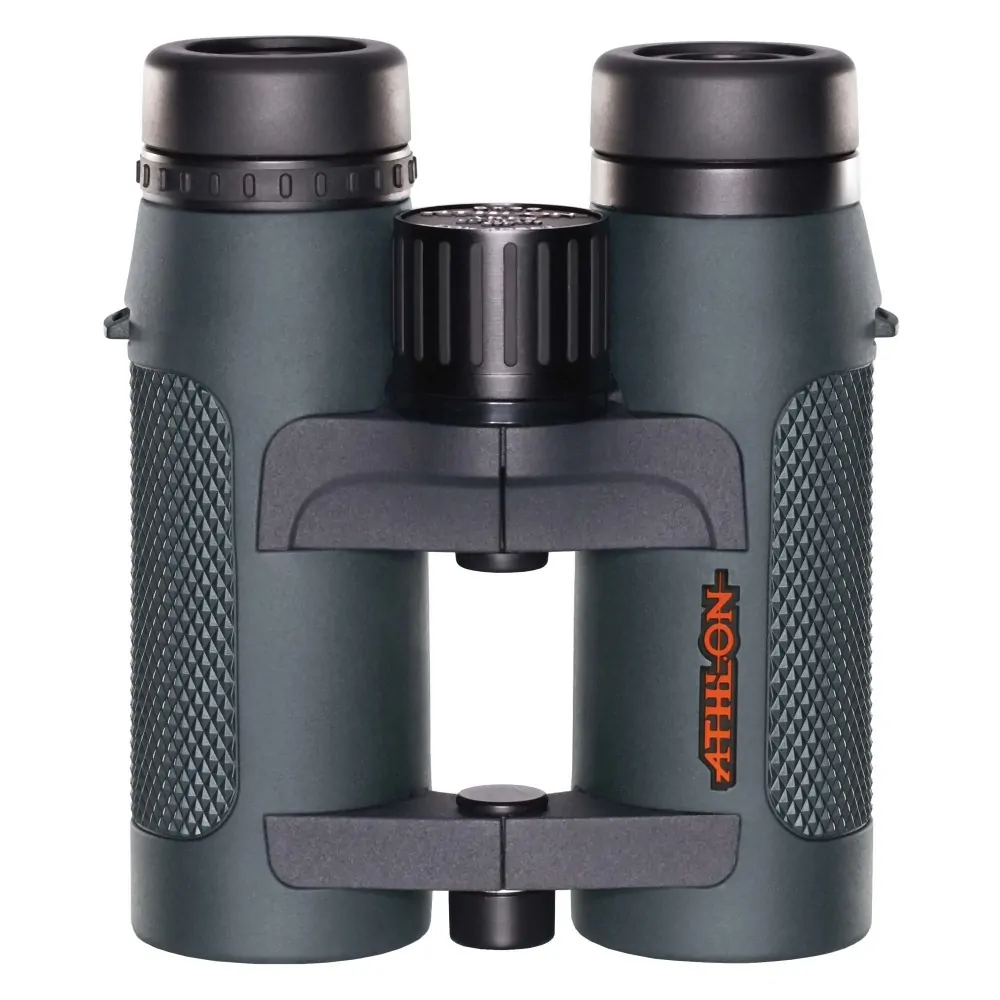
Explore this need in the finder →The Athlon Ares 8x36 is an earlier binocular for viewers who want an 8x view in a smaller objective format than the line’s 42 mm models. Athlon lists it at 24.9 ounces, with 14.9 mm eye relief, 6.5-foot close focus and a 405-foot field at 1,000 yards. Its published angular field conflicts with that linear figure, so the true real-field value stays unknown. The Ares sits in Athlon’s discontinued directory; this review helps identify an existing pair or assess a specific offer, not promise current availability.
A wider, lower-power 36 mm option
Eight-power binoculars are often easier to hold steady and to keep on a moving subject than 10x alternatives. The trade is less apparent reach when you are looking at a distant object. Here, the 36 mm objective and open-bridge roof design keep the listed body at 24.9 ounces and 6.1 by 4.9 inches. That is meaningfully smaller than the 8x42 Ares in the same catalog, but it remains a substantial binocular rather than a jacket-pocket compact.
The product table lists a linear field of 405 feet at 1,000 yards and 7.17 degrees angular. The manufacturer’s paired values are not internally consistent enough to normalize confidently. We retain the feet-per-1,000-yards value as published and leave `real_fov_deg` unknown. That means an ordinary broad-view preference may be compared with the listed number, but the model should not pass a hard six-degree real-field threshold from a conflicted source. Its 405-foot entry is still wider than the Ares 10x36’s listed 351 feet, so for scanning a flock or following activity, the 8x model has the more promising paper figure.
Ares family features, with limits
Athlon’s 2018 catalog describes Ares optics as ED glass, advanced fully multi-coated lenses and BaK-4 prisms with ESP dielectric and phase coatings. It also lists argon purging, waterproof construction, a magnesium chassis, rubber armor, twist-up eyecups, long eye relief and close focus. These are useful distinctions from a simpler optical design, but they are manufacturer claims rather than comparative lab results. The catalog does not give an immersion depth, duration, or IP-style rating, so waterproof should not be translated into a guarantee for prolonged underwater use.
The catalog’s description of the open bridge suggests a design intended to reduce bulk, but it cannot tell whether the hinge spacing or grip will feel right in your hands. Athlon’s binocular manual describes adjusting the eyecups, setting interpupillary distance and diopter, then using the center focus wheel for changes in distance. Those steps matter: a poorly adjusted pair can appear uncomfortable or soft even if the published configuration is suitable. The manual also gives conservative lens-cleaning guidance and warns against looking at the Sun. It does not establish the exact contents of a particular used seller’s box.
Fit and nearby subjects
The 14.9 mm stated eye relief is longer than the 10x36 Ares’s 13.9 mm, but shorter than the 8x42 Ares’s 16.5 mm. This is a numerical screening aid, not a promise that every eyeglass frame will show the whole field. The listed interpupillary range is 56–74 mm, which may rule it out for some viewers with narrower spacing. At 24.9 ounces for the instrument alone, it is almost five ounces lighter than the 8x42 Ares, before straps or cases.
Close focus is a useful point in its favor: Athlon lists 6.5 feet, compared with 8.2 feet on the Ares 10x36. That can help when you switch from distant wildlife to a closer subject, although it is not an extreme close-focus design. Do not infer that a 36 mm objective guarantees a brighter view than another binocular; exit pupil, coatings, eye placement, lighting and individual vision all matter, and no independent brightness measurement is available here.
Questionnaire choices that change the answer
Set “earlier models” to yes only when comparing with an identified old pair or a particular offer; leaving it at no keeps discontinued Ares models out of the ordinary current shortlist. Choose 8x and 36 mm if those are real preferences. A 25-ounce maximum passes at the listed 24.9 ounces; a 24-ounce maximum rejects it. A 14.9 mm minimum eye-relief request passes narrowly at 14.9 but fails above that value. The 6.5-foot maximum close-focus question is a strong reason to choose this model over the 10x36 when nearby subjects matter.
The catalog identifies ED glass, phase coatings and waterproof construction at the Ares family level. Those claims can satisfy corresponding essential filters because the model is one of the cataloged Ares configurations. A strict immersion depth, a confirmed tripod port, an adapter supplied in the box, or a verified six-degree real field remain unknown and must not be treated as met. If a requirement depends on fit or used condition, inspect the exact item and try it rather than relying on a family page.
When it is a better fit than the 8x42
The Ares 8x42 keeps the same magnification and lists a 426-foot field and the same 6.5-foot close focus, with 16.5 mm eye relief. It is larger at 6.7 by 5.2 inches and heavier at 29.8 ounces. If pack weight and a smaller body matter, the 8x36’s listed advantage is clear. If the extra 4.9 ounces are acceptable and longer stated eye relief or a 42 mm objective matters more, the 8x42 deserves the comparison. Both have a field-angle inconsistency in Athlon’s catalog, so neither should be selected on a strict normalized real-field claim until the manufacturer resolves it. Compared with Athlon’s current-reference Forerunner 10x42, the 8x36 gives up 10x reach and a direct tripod-thread fact, but it is lower power and carries a listed 6.5-foot close focus. This Ares is most useful as a clearly identified earlier-model reference or as a carefully checked specific offer, not a stock promise.
Manufacturer references: Ares 8x36 product page, 2018 Athlon product catalog, Ares specifications and feature description (printed pp. 6–7), and Athlon binocular user manual (adjustment, care and safety instructions).
Key specifications
Key details at a glance
| Magnification | 8× |
|---|---|
| Objective diameter | 36 mm |
| Eye relief | 14.9 mm |
| Close focus distance | 6.5 ft |
| Manufacturer-published weight | 24.9 oz |
| ED glass confirmed for this exact model | Yes |
More specifications and setup details
| Phase coatings confirmed | Yes |
|---|---|
| Lens and prism coatings | The exact Ares page and 2018 family description identify ED glass, fully multi-coated optics, BaK4 prisms, ESP dielectric and phase coatings; no comparative test was conducted. Prism type is not normalized because the reviewed exact sources do not explicitly label it. |
| Water and fog protection | The Athlon Ares catalog describes the line as waterproof, fogproof and argon-purged; no IP code, immersion depth or duration is supplied. |
| Tripod use | The archived manual is general Athlon binocular guidance and is not assigned to this SKU; direct mount compatibility and box inclusion remain unknown. |
| Published weight note | Athlon catalog-listed binocular instrument weight; not independently measured and excludes carrying accessories. |
| Manufacturer-rated waterproof | Yes |
| Built-in image stabilization confirmed | No |
| Integrated laser rangefinder | No |
| Onboard ballistic solution display | No |
Use the exact model’s instructions for operating limits, supplied equipment and version differences.
Sources for this review
Sources for this assessment

Choose your optical trade-off first.
Choose viewing purpose first, then magnification, objective size, scene width and any fit, weather or mounting constraint. A direct-Sun requirement is separate: only exact manufacturer-confirmed solar binoculars can pass it.