
On this page
Your needs, this model
Does it fit your priorities?
Does the earlier Ares 10x42 fit a 10x/42 mm outdoor viewing plan?
Yes when earlier models are deliberately included. The observed Athlon directory names Ares 10x42, and the 2018 catalog table specifies its fixed 10x42 configuration; no model number is confirmed.
Explore this need in the finder →Does its listed 14.7 mm eye relief clear a 14.5 mm minimum?
Yes by the catalog figure. A 15 mm minimum excludes it; glasses wearers still need to test their own frames and eyecup position.
Explore this need in the finder →Does the published 8.2 ft close focus meet a 9 ft maximum?
Yes by the catalog figure. An 8 ft maximum excludes it; this does not imply close-focus use at distances shorter than the specification.
Explore this need in the finder →Athlon Ares 10x42: a legacy full-size configuration
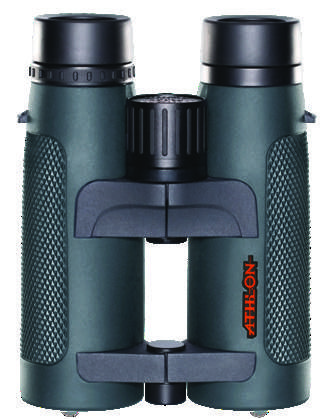
The Ares 10x42 is an earlier Athlon binocular, not a current-stock recommendation. Its identity and published specifications are present in Athlon’s own 2018 product catalog, Ares spread (printed pages 6–7), and the Ares family appears in the maker’s discontinued binocular directory. The exact 10x42 nested page did not yield a current product listing in the saved directory observation, so there is no confirmed current SKU, package list, seller, price, or availability claim here.
What the catalog establishes
This is a fixed 10-power, 42 mm objective binocular. Athlon lists 14.7 mm eye relief, 8.2 ft close focus, a 56–73 mm interpupillary range, 29.8 oz instrument weight, and a 6.7 by 5.2 in height-by-width measurement. That last measurement is not a complete three-axis size. The figure is substantial for a binocular carried all day; a strap, case, and other accessories would add weight.
The Ares table also lists a 341 ft field at 1,000 yd and a 6.5° angular field for this 10x42. Those two published values do not reconcile, so the linear figure is retained as reported while normalized real field remains unknown. Do not treat the angular entry as proof of a wide-field view or use this model to satisfy a hard minimum-real-field requirement. This is a material limitation, not a reason to silently “correct” the maker’s table.
How 10x42 changes the choice
The 10x power is the main reason to choose this configuration over its Ares 8x42 sibling: more magnification can make distant detail easier to inspect, but it also makes hand movement more apparent and usually demands a steadier hold. Both 42 mm Ares configurations are listed at 29.8 oz and 6.7 by 5.2 in, so the 10x42 does not trade down in the catalog’s stated instrument weight or envelope to get its higher power. Athlon lists the 8x42 with 16.5 mm eye relief and 426 ft per 1,000 yd, compared with 14.7 mm and 341 ft for the 10x42; the 8x42’s linear/angular field entries have their own catalog inconsistency, but its longer stated eye relief is still a useful difference when comparing the published specs.
Within the same family, the 10x36 is the more carry-conscious alternative: Athlon lists it at 24.9 oz and 6.1 by 4.9 in, with 13.9 mm eye relief and the same 8.2 ft close focus. Its objective is smaller, and it does not remove the steadiness demands of 10x power. Choose between those models by deciding whether the 42 mm objective and its larger body matter more than the 10x36’s listed five-ounce-lighter instrument weight. No comparative brightness or resolution test is claimed.
Optics and weather protection, without over-reading the labels
Athlon’s Ares family description names ED glass, advanced fully multi-coated optics, BaK4 prisms, ESP dielectric coating, phase coating, a magnesium chassis, rubber armor, and argon purging. The catalog describes the line as waterproof and fogproof. These are manufacturer construction and protection claims, not independent performance measurements. The reviewed sources do not provide an IP code, immersion depth or duration, nor do they establish that an old example has retained its seals. For a used or stored unit, inspection and a seller’s specific condition description matter more than the family label.
Fit, handling, and questionnaire tradeoffs
The general Athlon binocular user manual explains how to twist the eyecups, set interpupillary distance for one full circular image, and tune the right-side diopter after focusing the left side. It is general setup guidance, not a 10x42 package or SKU datasheet. The listed 14.7 mm eye relief clears a 14.5 mm questionnaire minimum but not a 15 mm minimum. Glasses wearers should still test their own frames and eyecup position; the number alone cannot promise access to the full field.
For a handheld outdoor plan, selecting “earlier models: yes,” 10x, and 42 mm matches the documented configuration. Leaving earlier models off excludes it, as intended. A 29.8 oz maximum-weight answer includes it; a lower limit does not. Its 8.2 ft close-focus value meets a 9 ft maximum but not an 8 ft maximum. Waterproofing may be treated as a maker-stated family feature, but exact immersion capability is unknown. Tripod compatibility, adapter inclusion, package contents, and current availability are not confirmed and should not satisfy essential requirements.
Who should consider it
This Ares is worth comparing for someone who specifically wants an older 10x42 format, accepts a nearly 30 oz instrument, and has a concrete used or old-stock listing to inspect. It is less suitable when low weight, a confirmed wide real field, long eye relief for glasses, verified current warranty coverage, or a known complete bundle are essential. If steadier handheld viewing and the longer published eye relief matter more, compare the Ares 8x42. If lighter carry matters while keeping 10x power, compare the Ares 10x36. Both remain earlier models too.
Before buying a specific offer, verify that the seller’s binocular is actually the Ares 10x42, because no manufacturer model number or current exact-product page is confirmed here. Check condition, included accessories, and any applicable warranty directly with the seller. A search for the exact model name is a way to locate possible listings, not evidence that one is in stock or that a particular listing matches this configuration.
Key specifications
Key details at a glance
| Magnification | 10× |
|---|---|
| Objective diameter | 42 mm |
| Eye relief | 14.7 mm |
| Close focus distance | 8.2 ft |
| Manufacturer-published weight | 29.8 oz |
| ED glass confirmed for this exact model | Yes |
More specifications and setup details
| Phase coatings confirmed | Yes |
|---|---|
| Lens and prism coatings | Athlon’s catalog describes Ares-family ED glass, fully multi-coated optics, BaK4 prisms, ESP dielectric and phase coatings; no comparative performance test was conducted. Prism type is not normalized because the reviewed exact sources do not explicitly label it. |
| Water and fog protection | The 2018 Ares family catalog describes the line as waterproof, fogproof and argon-purged; it supplies no IP code, immersion depth or duration. |
| Tripod use | The archived manual is general Athlon binocular guidance and is not assigned to this exact 10x42 configuration; tripod compatibility and box inclusion remain unknown. |
| Published weight note | Athlon catalog-listed binocular instrument weight; not independently measured and excludes carrying accessories. |
| Manufacturer-rated waterproof | Yes |
| Built-in image stabilization confirmed | No |
| Integrated laser rangefinder | No |
| Onboard ballistic solution display | No |
Use the exact model’s instructions for operating limits, supplied equipment and version differences.
Sources for this review
Sources for this assessment
Choose your optical trade-off first.
Choose viewing purpose first, then magnification, objective size, scene width and any fit, weather or mounting constraint. A direct-Sun requirement is separate: only exact manufacturer-confirmed solar binoculars can pass it.