
On this page
Your needs, this model
Does it fit your priorities?
Does the earlier Ares 10x36 fit an ordinary 10x/36 mm viewing plan?
Yes when earlier models are deliberately included. Its exact Athlon product page identifies SKU 112003 and fixed 10x36 configuration; the objective class is explicitly represented in the questionnaire.
Explore this need in the finder →Does the 13.9 mm stated eye relief clear a 13.5 mm minimum?
Yes at the stated boundary. A minimum above 13.9 mm excludes it; the figure is not a guarantee for every glasses frame.
Explore this need in the finder →Does the listed 8.2 ft close focus meet a 9 ft maximum?
Yes. The manufacturer lists 8.2 ft close focus, which meets a 9 ft maximum; a stricter 8 ft maximum excludes it.
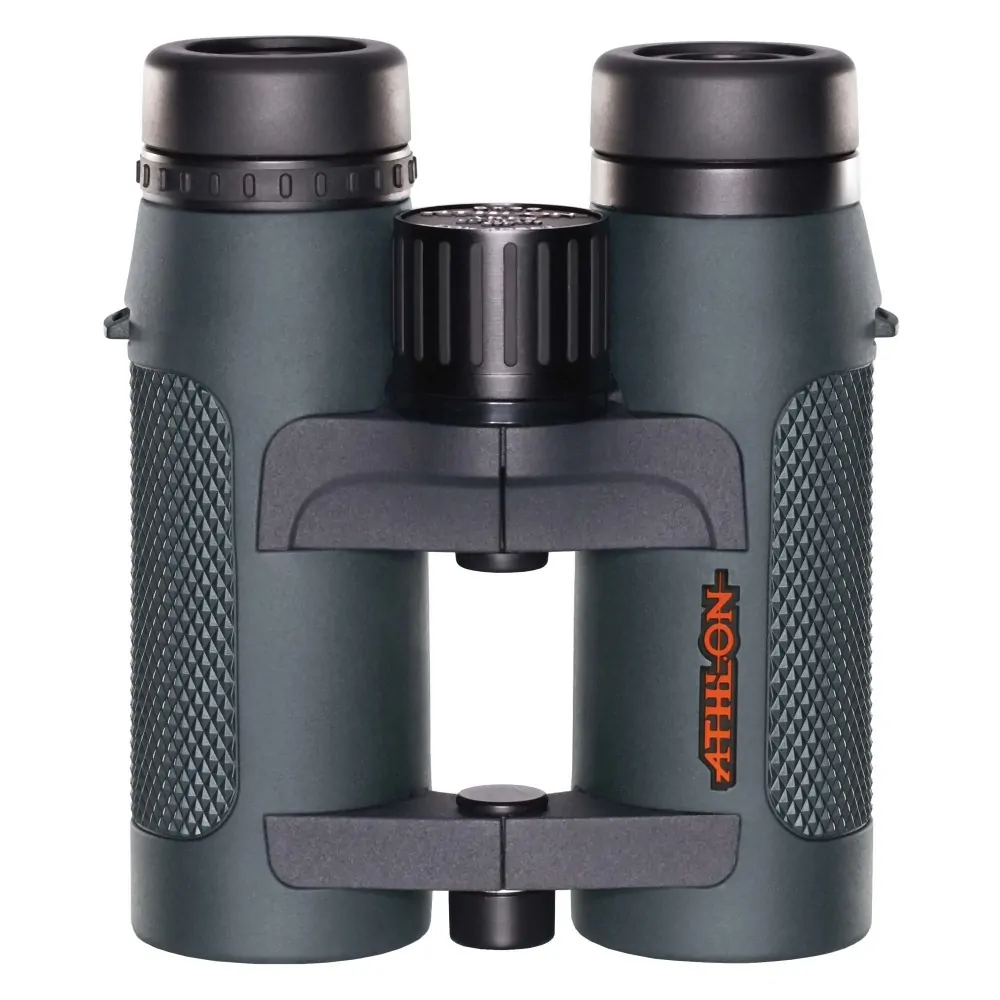
Explore this need in the finder →The Athlon Ares 10x36 is an earlier, full-featured roof binocular with a compact-for-its-power 36 mm objective, but it is not a pocket pair: Athlon lists the instrument at 24.9 ounces and 6.1 by 4.9 inches. Its 10x view favors distant detail over easy subject finding, while the published 13.9 mm eye relief and 8.2-foot close focus set practical fit limits. Athlon now groups the Ares line under discontinued binoculars, so this assessment is useful for identifying an existing pair or checking a specific offer, not as a statement of current stock.
What the 10x36 layout changes
Ten-power magnification makes a distant bird, boat or field mark appear larger than an 8x view, yet it also magnifies hand motion and narrows the apparent ease of following movement. That is a meaningful trade, not an automatic upgrade. The 36 mm objective keeps this Ares smaller and lighter than the 42 mm Ares configurations in Athlon’s 2018 table, but a 36 mm lens does not promise a particular dusk performance. We have no measured brightness or comparative field-test result for this model.
Athlon’s table lists 351 feet at 1,000 yards and also gives a 6.17-degree angular field. Those two entries do not reconcile cleanly, so the normalized real-field attribute is left unknown. The linear field is still useful as the manufacturer’s published figure, but do not treat this model as proven to clear a strict six-degree real-field requirement. The 8x36 line item is wider on the linear number at 405 feet, which supports a practical comparison, but it has its own angular-versus-linear mismatch.
Optics and weather claims
The Ares family description in Athlon’s catalog names ED glass, advanced fully multi-coated optics, BaK-4 prisms, phase correction, ESP dielectric prism coating, an argon purge, waterproofing and a magnesium chassis. These are manufacturer-stated features, not measurements we made. The reviewed catalog gives no immersion depth, duration or IP code; its waterproof language should not be turned into a quantified submersion rating. It also describes XPL protection for exterior lens surfaces. No particular scratch resistance, transmission percentage for this exact configuration, or comparative image-quality score is established here.
The open-bridge design is described as part of the Ares family. It can be a useful handling shape if you prefer the hinge to be open, but the page and catalog do not establish a guaranteed one-handed hold or a fit for every hand. Twist-up eyecups, center focusing, interpupillary adjustment and a separate right-eye diopter appear in Athlon’s binocular user manual. Use those instructions to set the instrument to your eyes before judging comfort or sharpness; the manual is general Athlon guidance rather than a SKU-specific measurement sheet.
Fit, close focus and carrying
Athlon lists 13.9 mm of eye relief and a 56–74 mm interpupillary range for the 10x36. The eye-relief figure is shorter than the 14.9 mm listed for the Ares 8x36 and 16.5 mm listed for the Ares 8x42. That makes the exact model worth trying with your own glasses rather than assuming the eyecup can compensate. A 56 mm minimum IPD is also a real fit screen for narrower-set eyes. The 24.9-ounce figure is the binocular body alone, not a packed kit.
Its listed close focus is 8.2 feet. That is close enough for many ordinary outdoor subjects but not a reason to choose it for insects or very nearby displays. If nearby focus is a firm need, the Ares 8x36’s listed 6.5 feet is better on paper. If reach matters more, accepting the longer focus may be reasonable. The manual gives basic cleaning advice: remove grit before wiping, use a soft lens cloth, and never look directly at the Sun through ordinary binoculars.
How questionnaire choices affect the fit
Choose “earlier” only if you are identifying an existing Ares or evaluating a particular seller offer; it does not certify that a new unit is available or that a used one is in good condition. Selecting 10x and the newly available 36 mm objective choice narrows the library to that format. A 24.9-ounce maximum admits the listed instrument exactly at 25 ounces but rejects a stricter 24-ounce ceiling. A minimum eye-relief requirement above 13.9 mm removes this configuration. An 8.2-foot maximum close-focus setting passes at the boundary; any shorter maximum does not.
The catalog confirms ED glass and phase coating for the Ares family, so those filters can be used when that feature is essential. Waterproofing is also listed, but a demand for a named immersion depth or IP rating cannot be met from the reviewed evidence. Likewise, do not require a confirmed tripod port or adapter-in-box status: those exact model/package facts were not established. The unresolved field-angle conflict means a strict wide-real-field filter should not admit this model just because its linear field looks appealing.
Alternatives and the right reason to keep it
For a steadier, broader-feeling view, the Ares 8x36 trades 10x reach for 8x magnification, a longer 14.9 mm eye-relief figure and a closer 6.5-foot published focus at the same listed weight and dimensions. For a larger objective and longer eye relief, the Ares 8x42 is heavier at 29.8 ounces and lists 16.5 mm eye relief and a 426-foot field; the catalog’s conflicting angular value still prevents treating its real field as verified. Among current-reference choices, Athlon’s Forerunner 10x42 is listed at 24 ounces with 16.1 mm eye relief, but its reviewed exact documentation does not confirm the Ares family’s ED and phase-coating claims. The Ares 10x36 makes the most sense when a specific 10x36 pair is already in hand, or when a verified listing’s condition and price independently make it worth considering—not as a universal current best buy.
Manufacturer references: Ares 10x36 product page, 2018 Athlon product catalog, Ares specifications and feature description (printed pp. 6–7), and Athlon binocular user manual (adjustment, care and safety instructions).
Key specifications
Key details at a glance
| Magnification | 10× |
|---|---|
| Objective diameter | 36 mm |
| Eye relief | 13.9 mm |
| Close focus distance | 8.2 ft |
| Manufacturer-published weight | 24.9 oz |
| ED glass confirmed for this exact model | Yes |
More specifications and setup details
| Phase coatings confirmed | Yes |
|---|---|
| Lens and prism coatings | The exact Ares page and 2018 family description identify ED glass, fully multi-coated optics, BaK4 prisms, ESP dielectric and phase coatings; no comparative test was conducted. Prism type is not normalized because the reviewed exact sources do not explicitly label it. |
| Water and fog protection | The Athlon Ares catalog describes the line as waterproof, fogproof and argon-purged; no IP code, immersion depth or duration is supplied. |
| Tripod use | The archived manual is general Athlon binocular guidance and is not assigned to this SKU; direct mount compatibility and box inclusion remain unknown. |
| Published weight note | Athlon catalog-listed binocular instrument weight; not independently measured and excludes carrying accessories. |
| Manufacturer-rated waterproof | Yes |
| Built-in image stabilization confirmed | No |
| Integrated laser rangefinder | No |
| Onboard ballistic solution display | No |
Use the exact model’s instructions for operating limits, supplied equipment and version differences.
Sources for this review
Sources for this assessment
- Athlon Discontinued Binoculars – Ares directory (browser observation)
- Athlon Ares 10x36 nested category
- Athlon Ares 10x36 exact product page
- Athlon 2018 Product Catalog, Ares table and family features
- Athlon Binocular User Manual (general setup/care instructions)
- Athlon Ares exact PDP-linked product image

Choose your optical trade-off first.
Choose viewing purpose first, then magnification, objective size, scene width and any fit, weather or mounting constraint. A direct-Sun requirement is separate: only exact manufacturer-confirmed solar binoculars can pass it.